EviDNA DNA Cryptography | Jacques Gascuel Memory

Illustration scientifique EviDNA avec double hélice d’ADN stylisée et symboles de sécurité numérique

EviDNA DNA cryptography: Freemindtronic complementary reference memory — EviDNA, Digital DNA, cryptographic genome, cybersecurity and digital trust (CryptPeer / EviSKMS) — July 2026.

EviDNA DNA cryptography — express summary

Read. This express abstract presents the purpose, industrial trajectory, and scope of the dissertation before the detailed executive summary.

EviDNA cryptography DNA refers to the Freemindtronic trajectory in the cryptographic universe mobilizing the expression “DNA” in the procedural and architectural sense — non-molecular by default. The thesis documents three milestones: EviDNA (human profile, industrialized 2024), DNA Digital and the cryptographic genome (industrialized 2026 in CryptPeer/EviSKMS).

The central thesis is simple. Freemindtronic has been laying an R& R& line since 2022 (Eurosatory, project presentation) D distinct from institutional molecular OTP: trusted material derived from a human profile, segmented material, field use. In 2024 (Eurosatory Lab), this trajectory materialized in DataShielder Defense NFC HSM. In 2026 (Eurosatory), it is generalized in CryptPeer via the cryptographic genome and the TPM/vTPM anchoring.

The thesis establishes documentary comparisons with the state of the art: classic digital trust (FIDO, PKI, Zero Trust), academic genomic data encryption, iDASH/Beacon ecosystem, and CNRS 2026 approach (synthetic DNA, OTP/Vernam). He does not claim any authorship on the third-party works; It specifies distinct technical objects.

The Freemindtronic positioning is treated with methodological caution. The granted international patents WO/2018/154258 (segmented key) and WO/2017/129887 (access control) allow for an enabling public description at the architecture level. Industrialization is documented by observable evidence (product, CryptPeer runtime, time-stamped videos). The internal EviDNA mechanisms, Gen2 extensions and unpublished know-how remain in the B and C registers — see §1.12.

This document is a scientific-industrial memory complementary to the framework predictive intelligence architectures — EviSKMS. It does not claim to be a peer review or product certification.

Playback settings

Reading time express summary: ≈ 4 minutes
Reading time executive summary: ≈ 5 minutes
Estimated full reading time: ≈ 1 h 15
Initial ReleaseJuly 2026
Last updated: July 2026
Level of complexity Expert / research
Technical density ≈ 78%
Available language FR · EN
Specificity: Complementary thesis on EviDNA, Digital DNA, cryptographic genome, DNA cryptography, CNRS comparisons and CryptPeer
Reading orderExpress Abstract→ Executive Summary → §1 Genome and trajectory → Limitations and falsifiability → Conclusion
Accessibility:Optimized screen readers, internal anchors, and summaries included
Editorial type:Scientific and industrial reference memory
Main topic: EviDNA cryptography DNA
Secondary Topics: EviDNA, Digital DNA, Cryptographic Genome, CNRS, CryptPeer, EviSKMS, Segmented Trust
Criticality Level:High — 8 / 10 — genetic data, cybersecurity and digital identity
Author:Jacques Gascuel, inventor and founder of Freemindtronic®.
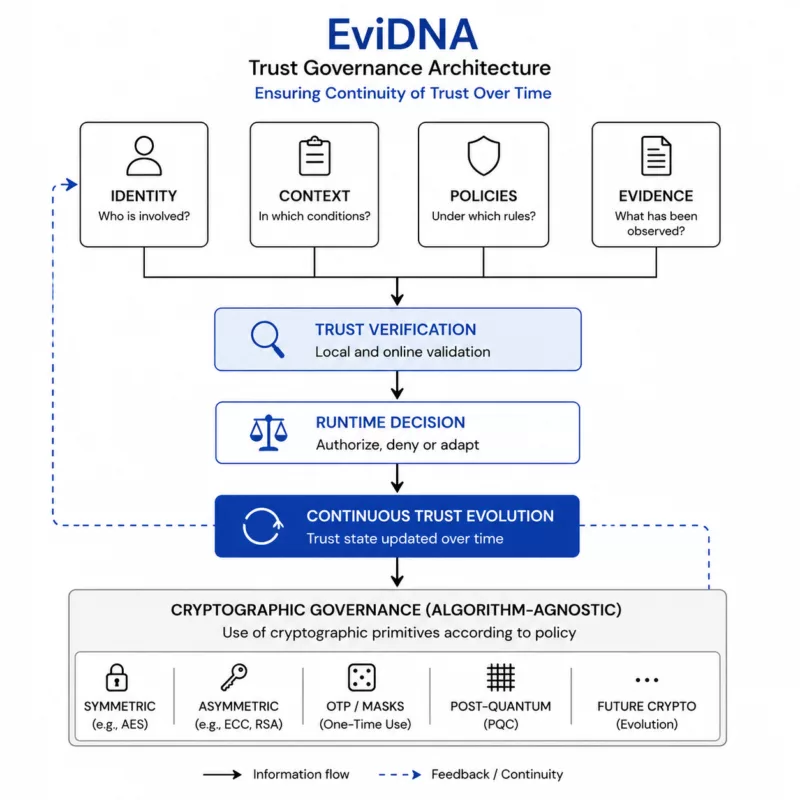
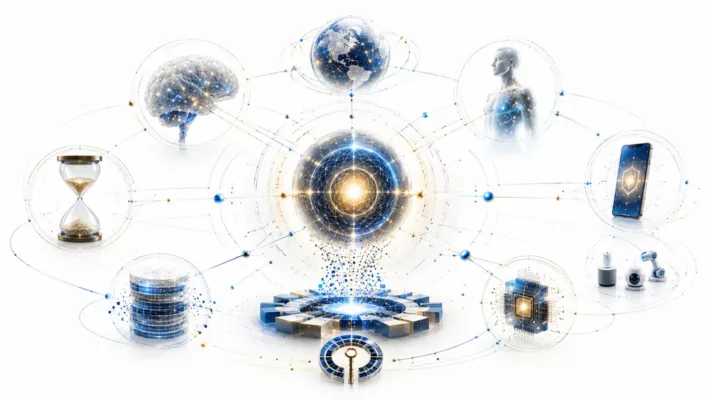
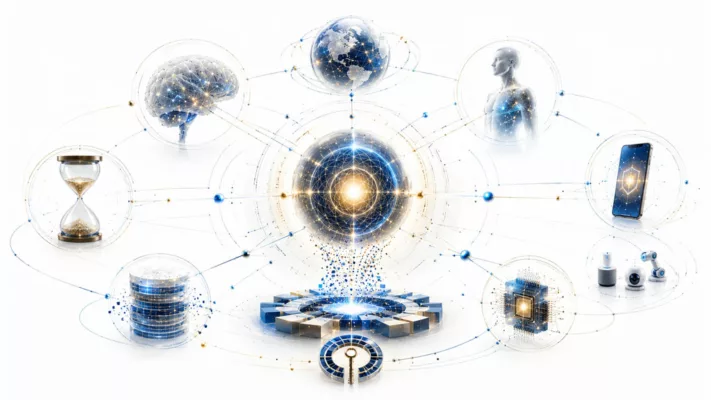
EviDNA DNA Cryptography trust governance architecture showing identity, context, policies, evidence, trust verification, runtime decision, continuous trust evolution and algorithm-agnostic cryptographic governance.

Publish status

This thesis on EviDNA cryptography DNA is a position and reference document Freemindtronic. It does not constitute a peer review, third-party audit, or product certification.

Editorial note. This quick summary presents the objectives, the industrial trajectory (Eurosatory 2022 project → 2024 Defense → 2026 CryptPeer) and the scope of the thesis EviDNA DNA cryptography. It precedes the detailed executive summary and is part of Freemindtronic Andorra’s editorial transparency approach. It distinguishes between state-of-the-art knowledge, observable evidence of industrialization and mechanisms relating to unpublished intellectual property. This content is written in accordance with Freemindtronic Andorra AI Transparency Statement — FM-AI-2025-11-SMD5.

EviDNA DNA cryptography — executive summary

This complementary thesis documents the Freemindtronic trajectory in the cryptographic universe mobilizing the expression “DNA” in the procedural and architectural sense — non-molecular by default: EviDNA (human profile, 2024), ADN Digital, cryptographic genome and industrialization CryptPeer/EviSKMS (2026).

It establishes documentary comparisons with the state of the art: classic digital trust mechanisms (FIDO, PKI, Zero Trust, HSM/TPM), academic genomic data encryption (PROMISE, Varlock), and institutional approach CNRS 2026 (synthetic DNA, OTP/Vernam). He does not claim any authorship on the third-party works; It specifies distinct technical objects. Canonical definition EviDNA: §1.11.

The publication respects the registers A (public), B (confidential) and C (IP): two international patents granted are publicly cited (WO/2018/154258 — segmented key; WO/2017/129887 — access control); no records enabling the reproduction of EviDNA, genome, Gen2 or advanced runtime mechanisms (C registry).

Controlled publication (register A). This limitation is not a documentary gap, but an assumed methodological constraint: as long as additional patent filings are not secured, the dissertation distinguishes between what can be discussed publicly and what would constitute a reproduction record. It exposes the inventive trajectory, distinct technical objects, observable evidence, and relevant comparisons — including integration into CryptPeer/EviSKMS at a high level — while preserving the internal mechanisms of EviDNA, DNA Digital and the cryptographic <>genome. See §1.12; Roadmap: §1.15.

For the interdisciplinary framework linking predictive AI, cybersecurity, and cyber-physical trust, see EviSKMS reference memory.

Key Points — EviDNA Cryptography DNA

  • Trajectoire salon : Eurosatory 2022 (projet EviDNA) → 2024 Defense NFC HSM → 2026 CryptPeer/EviSKMS industrialisé.
  • EviDNA canonical definition: §1.11 · Chronology: Appendix A.
  • CNRS 2026 comparisons, academic genomic encryption, iDASH/Beacon, classical digital trust.
  • Publication controlled non-enabling: §1.12 · roadmap§1.15.
  • Add-on predictive intelligence architectures — EviSKMS.


☰ Navigation rapide

🔝 Back to top

EviDNA DNA cryptography — Relation to the “predictive intelligence architectures — EviSKMS”</h2 thesis>

Document Perimeter
EviSKMS memory/predictive AI Taxonomy of predictive architectures, LAMP-C, agentic memory, causality, benchmarks, applied cyber component (§29.1–§29.13)
ADN / EviDNA Cryptographic Genome, EviDNA, Digital DNA, CryptPeer proofs, CNRS comparisons and digital trust

The two dissertations are complementary: the first sets the broad scientific framework; The second deepens the cryptographic trajectory and state-of-the-art comparisons without diluting the debate on artificial general intelligence.

1. Cryptographic genome, EviDNA and industrial trajectory

Scientific positioning and intellectual property. The cryptographic genome is presented here as a Freemindtronic trajectory articulating a first generation already industrialized in CryptPeer via EviSKMS and an extension of applied research on digital identity evolving over time. This section does not constitute an enabling technical disclosure, as it does not disclose the detailed technical mechanisms, internal structures, verification sequences, transition rules or operational formats that may fall within the scope of intellectual property protections, including pending or future patent filings. The elements presented are also part of a formalization work protected by copyright.

In the context of this thesis, the expression “cryptographic genome” does not refer to biological DNA, nor to a direct exploitation of biometric data, nor to a form of DNA computing. Nor does it refer to a new fundamental cryptographic building block intended to replace existing standards, encryption algorithms, signature mechanisms, PKIs, HSMs, TPMs or digital identity repositories.

It refers to a digital trust architecture approach aimed at organizing, over time, evidence, contexts, policies, states of trust, and local and online verification mechanisms around a continuity of trust. This does not prescribe a single encryption algorithm: it is agnostic with respect to cryptographic bricks — symmetric (including OTP / single-use masks), asymmetric, post-quantum (PQC), etc. — in accordance with the governance policy. It should be understood as a structuring, governance and verifiability, and not as a substitute for existing cryptographic standards.

A first generation of this approach is already industrialized in CryptPeer via EviSKMS. It materializes, at an operational level, a segmented, locally verifiable, policy-driven, and runtime-oriented trust. This Gen1 is a return to industrialization: it demonstrates that an identity, a session, an execution context or a trusted object can be treated not as a simple static identifier, but as a controlled, reassessable and governable trust structure.

Jalon EviDNA — three-step timeline (registry A).

Phase Period Content
1 — Socle commercial 2017 → QR chiffré + NFC sur M24LR 64K NFC (STMicroelectronics) — commercialisé sans couche ADN ; smartphone + papier + puce NFC
1b — R& D EviDNA 2022 Eurosatory — primer / presentation project EviDNA (R& D)
1c — Développement EviDNA 2022–2024 Compatibilité ST25 64K NFC ; couche ADN (EviDNA)
2 — Defense + DNA humain 2024 → Eurosatory LabDataShielder Defense NFC HSM industrialisé ; divulgation mai–juin 2024 (§1.9)
3 — DNA Digital + génome 2024–2026 Eurosatory 2026 — industrialisation CryptPeer/EviSKMS ; TPM/vTPM

Synthetic chronology (text schema, register A).

2017 ──► QR chiffré + NFC M24LR (commercial, sans couche ADN)
           │
2022 ────► Eurosatory — seed / EviDNA project (R& D)
           │
2022-24 ─► ST25 64K +EviDNA Development
           │
2024 ────► Eurosatory Lab — DataShielder Defense NFC HSM (industrialisé)
           │
2024-26 ─► Digital DNA + giscryptographique name
           │
2026 ────► Eurosatory — CryptPeer/EviSKMS industrialisé · TPM/vTPM

Defense / EviDNA detail: §1.11 · Product Proof§1.10. Digital DNA / CryptPeer 2026: §1.7.

To preserve scientific rigor, the qualification of industrialized Gen1 must remain attached to observable elements: code, frozen contracts, tests, runtime flows, implementation logs, technical documentation or product integration. Unpublished implementation details are not set out in this supplementary brief.

1.1. Non-sensitive level of evidence and Gen1</h4 industrialization perimeter> This subsection is part of the same methodological logic: it does not aim to impose recognition by personal authority, but to link an inventor’s intuition to verifiable, non-sensitive and observable elements. The weak and strong signals identified in the field serve here as raw material for a cautious scientific formalization, without enabling disclosure of internal mechanisms.

This thesis does not seek to publish the internal mechanisms of the cryptographic genome. It establishes its scientific and industrial positioning: a segmented, local, temporal and governable digital trust architecture, whose Gen1 and Gen2 are industrialized in CryptPeer via EviSKMS.

In order to avoid any enabling technical disclosure, the evidence mentioned below is formulated at a non-sensitive level. They indicate the scope of industrialization without exposing the detailed mechanisms, internal structures, operational formats, verification sequences or transition rules.

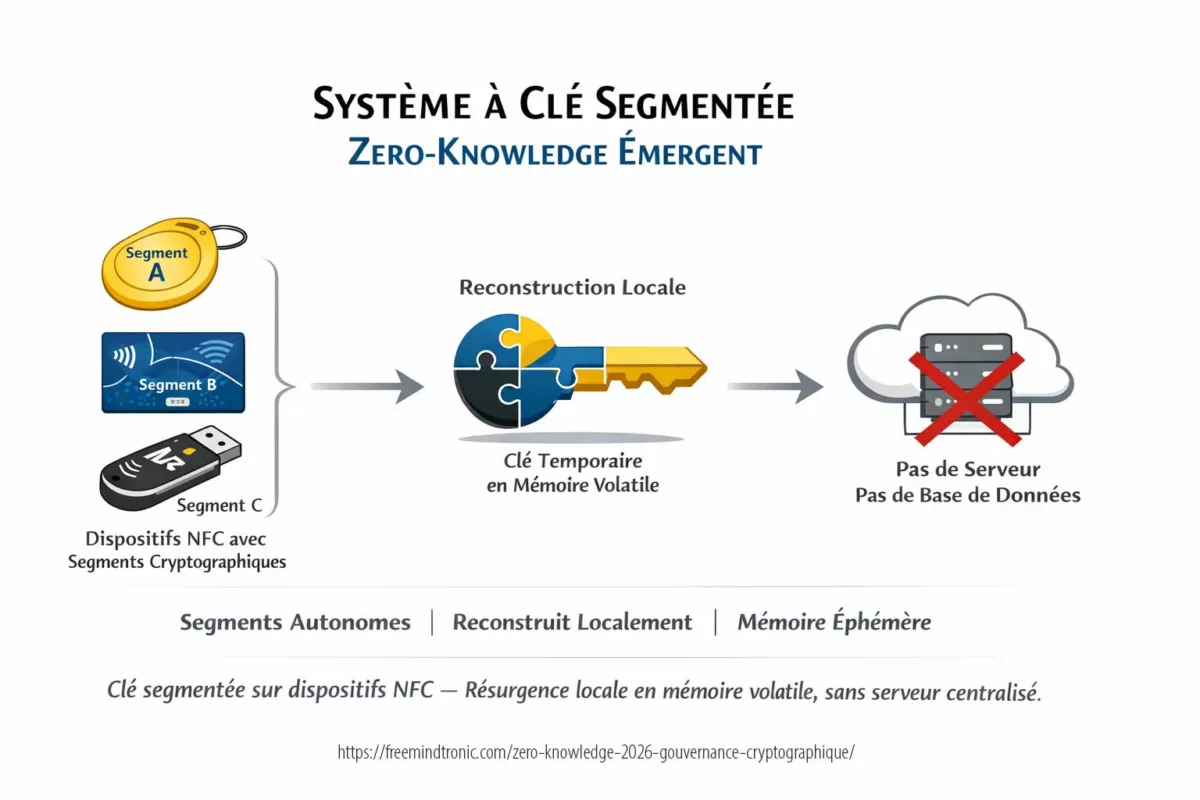
Patented, publishable parentage. The principle of segmented key and conditional reconstitution of trust can be publicly cited under the international patent WO/2018/154258 (FR3063365 B1, EP3586258, US20210136579, CN110402440, JP2020508533, KR1020190120317). This foundation covers segmentation, physical proximity, token, ephemeral volatile memory, segment governance and a variant of the invention — the scrambling module of authentication data — without allowing the disclosure of post-patent extensions not yet registered (genome, detailed EviDNA, advanced runtime).

1.1.1. Jamming module — public variant of patent (WO/2018/154258)

The granted international patent WO/2018/154258 (FR3063365 B1, EP3586258B1) describes, in addition to the segmented key, a variant of the invention relating to a scrambling module authentication data. This mechanism is freely accessible in the public description of the title: when typing on an untrusted channel (keyboard, interface, clipboard), additional characters are inserted at predetermined positions known to the legitimate user, who removes them before transmission. The documented objective is to reduce the exposure of the real secret in the face of a keylogger or any direct observation of the input surface.

Cryptographic positioning (ledger A). This module is not an OTP/Vernam schema: it protects the transient representation of the secret at the time of input, not the content of an encrypted message.

Limits and C.</strong registry> Any auto-extension, runtime generalization, or correlation with EviDNA, cryptographic genome, or EviSKMS falls under the C registry as long as no additional repositories are secured. This paragraph is limited to the variant of the issued title.

Classification legend: A = possible audience in the memory · B = confidential (private file, audit under NDA) · C = reserved IP (before filing or validation by patent advisors).

Observed Element Status Type de preuve Non-sensitive functional description Maturité Classification Synthesis
Brevet clé segmentée documented · Issued brevet · documentation International FR3063365 / WO2018154258 Family: Peering Key Segmentation, Physical Proximity, Conditional Status, Token, and Protected Credentials Industrialized (granted title) A “The architecture is based on the international patent Segmented Key Authentication System, extended in EviSKMS.”
Module de brouillage documented · issued (patent variant) brevet · documentation Variant WO2018154258: Insertion of decoy characters at predetermined positions during input; Documented patented variant (without automatic extension) (§1.1.1) Documented (public patent) · architectural extension A (patented principle) / C (procedural shunting) “The patent describes an anti-keylogger jamming module; The patented variant covers manual jamming on input.
CryptPeer implemented · Tested · Integrated product code · Test · Documentation · deployment Sovereign collaborative platform: license, E2EE, admin, local or Internet transport, packaging and runbooks Industrialisé A “CryptPeer is an industrialized application based on EviSKMS.”
EviSKMS Runtime implemented · Tested · Documented code · Test · Product integration Trust Runtime consumed by CryptPeer: Startup enforcement, state projections, architectural freeze Industrialisé A / C (Core) “The product runs in an EviSKMS trusted runtime.”
Runtime Integrity implemented · Tested · Integrated product code · test · journal Runtime health references, append-only local anchor, fail-closed operator projection Industrialisé A / B / C “Runtime integrity is embodied in verifiable references and traceable local anchoring.” · Runtime Integrity (site)
DRT implemented · Tested · Integrated product code · Test · Contract Distributed Runtime Trust Check on Startup, Persistence Continuity, Restart Tests Industrialized (integration) A / C (gate Core) “CryptPeer has a built-in DRT check at startup with documented v1 freeze.”
RSCC implemented · Tested · Documented code · test Posture-integrated sovereign runtime configuration certificate Integrated A / C “A sovereign runtime certificate accompanies the operational posture.”
Confiance segmentée implemented · Tested · Integrated product code · Testing · brevet Optional software and hardware segmentation; Patent filiation WO2018154258 Integrated/Industrialized A (principe) / C (recomposition) “Trust is segmented between a sovereign software base and optional hardware reinforcements.”
Vérification locale implemented · tested code · test · runtime Doctors operator, log string integrity, readiness without network required Industrialisé A “Local controls validate cryptographic status before mining.”
Continuité runtime implemented · Tested · Documented code · test · journal State Persistence, Regression Detection, Sovereign Backup/Restore Integrated A / C “Runtime trust continuity is monitored across sessions.”
Politiques fail-closed implemented · Tested · Documented code · test · documentation Default deny on startup, authentication, and sensitive modes Industrialisé A “The fail-closed doctrine applies to critical surfaces.”
Anti-rejeu implemented · Tested · Integrated product code · Test · Schema License, API and passwordless protection by nonces and atomic consumption Industrialisé A / B “Anti-replay guardrails cover sensitive surfaces.”
Crypto Governance implemented · Tested · Documented documentation · code · test Gel release, profils crypto, supply-chain licence E2E, coffre de confiance Industrialisé A “Crypto governance combines release freeze and supply-chain acceptance.”
Preuves composées implemented · tested code · test Converge heterogeneous signals into a verifiable snapshot without misleading promotion Integrated A / C “Heterogeneous evidence is converged into a composite state of trust.”
Journaux / ledger / traces implemented · Tested · Integrated product code · test · journal License (DB) logs, JSONL lineage, fingerprint snapshots, passwordless audit, and RI Industrialisé A “Traceability is based on chained newspapers with distinct roles.”
Passwordless Freemindtronic implemented · Tested · gel V1.1 code · Test · Product integration Passwordless Authentication, Trusted Terminal, Local Sovereign Mode Industrialisé A / C “A sovereign passwordless mode is qualified and frozen for documented local execution.”
DDNA Gen1 implemented · Tested · Integrated product code · test Category-normalized footprints, with no raw data in transit Integrated A (categories) / C “The Gen1 base materializes identity proofs by standardized fingerprints.”
Trust Identity implemented · Tested · Integrated product code · test Verifiable Cryptographic Identity Integrated into the Product Integrated A / C “Each actor has a verifiable identity of trust.”
Tests sécurité tested · Documented test · documentation Automated Security Test Campaign (Unpublished Volume) Industrialisé A “An automated security testing campaign covers trust mechanisms.”
Sovereign Deployment implemented · Documented configuration · documentation Docker souverain, agent TPM isolé optionnel, transport sovereign-local, runbooks FQC Integrated/Industrialized A “Deployment artifacts accompany controlled release.”
SVTM implemented · Tested · frozen test · documentation Runtime official sovereign software by default; Optional Hardware Industrialisé A “The sovereign software runtime is the default operational foundation.”
Transport sovereign-local implemented · Tested · frozen V1 code · test · runtime TLS local, gateway HTTPS/WSS, PKI locale, services runtime locaux Industrialisé A / B “A sovereign local execution mode provides TLS and runtime services without required internet.”
Advanced Truth Assessment Module implemented · tested code · test Conjunctival evaluation of high criteria; Safeguards against unsubstantiated insurance claims Integrated A / C “A high-level truth module arbitrates maximum assurance claims.”
Gen2 / genome avancé implemented · Integrated product code · test · documentation Gen2 Genomic Extensions in CryptPeer/EviSKMS; detailed mechanisms in register C Industrialisé A / C Gen2 Genome Extensions Operational in CryptPeer

This matrix does not purport to be a complete technical publication. It establishes a level of maturity that can be read by the scientific reader: the Gen1 and the Gen2 are industrialized in CryptPeer, anchored on an international patent issued for segmentation; the detailed mechanisms of Gen2 fall under the C register.

Full scientific recognition of this approach will require additional publications, intellectual property filings when necessary, as well as comparative evaluations documenting its contributions to traditional authentication, passwordless, PKI, access control and runtime trust mechanisms.

1.2. Towards controlled scientific recognition: evidence, comparisons and publication after PI</h4 securitization> The full scientific recognition of this approach presupposes a complementary step, carried out after securing intellectual property when necessary. This stage will have to articulate three levels: non-sensitive evidence of industrialization, structured comparisons with the state of the art and controlled publication. A first appendix of non-sensitive evidence, resulting from a local analysis of the EviSKMS-CryptPeer repository, now makes it possible to document this first level without exposing the internal mechanisms protected.

Non-sensitive evidence will be able to document the existence of operational implementation without disclosing the protected internal mechanisms. They may include product scope, functional architecture, maturity levels, usage scenarios, general flows, test categories, trust policies, execution logs, and validation criteria.

Comparisons will have to situate the Freemindtronic approach in relation to the existing mechanisms of authentication, passwordless, PKI, HSM, TPM, Zero Trust, WebAuthn/FIDO externally, machine identity, IoT and runtime trust. The objective will not be to replace them with affirmation, but to show where the genomics approach to digital trust brings a different layer: segmentation, local verification, temporal continuity, contextual governance and reassessment of the level of trust. A first comparative document matrix is proposed in §1.4.

The controlled publication can then take the form of a position paper, a scientific white paper, an evaluation report or a documented demonstrator. It should remain non-enabling until intellectual property protections are finalized, while providing sufficient elements to allow scientific discussion: problem addressed, hypotheses, scope, comparison, limitations, use cases and evaluation protocol.

Publication doctrine (register A). This thesis deliberately adopts a controlled publication logic: it documents scientific subject-matter, prior art, state-of-the-art comparisons and evidence of industrialization observable, without disclosing the internal mechanisms that may be the subject of complementary patent filings. This applies in particular to the advanced implementation in CryptPeer/EviSKMS, where only functional effects, architecture principles, and non-sensitive elements are exposed. The rules of derivation, transition, genomic correlation, internal formats and operating parameters remain in the B or C register. Detail: §1.12.

This trajectory makes it possible to clearly distinguish three registers: what is already industrialized, what can be made public without risk to intellectual property, and what must remain reserved for deposits, confidential annexes or evaluations under confidentiality agreements. It thus avoids two opposing pitfalls: an unproven assertion of innovation, or a premature disclosure of protected technical mechanisms.

The Gen2 is implemented in CryptPeer via EviSKMS. It extends the Gen1 trajectory towards an evolving, contextual, memory and verifiable digital identity over time. The detailed technical mechanisms fall under the C registry and are not disclosed in this supplementary submission.

The emergence of predictive artificial intelligence makes this development particularly important. Attacks are no longer just about isolated passwords or certificates. They can target identity continuities: progressive spoofing, deepfakes, session compromise, hijacking of AI agents, cloning of connected objects, context alteration, memory poisoning or behavioral manipulation.

Faced with these risks, one-time authentication becomes insufficient. A future identity architecture will need to verify not only what an entity knows, owns, or is, but also the context in which it operates, the consistency of its interactions, the governance of its rights, the continuity of its evidence, and the reassessment of its level of trust over time.

The cryptographic genome thus constitutes a two-stage trajectory: a Gen1 and a Gen2 industrialized in CryptPeer via EviSKMS. Gen1 embodies segmented, local and runtime-governed trust; Gen2 extends this approach to an evolving and contextual identity. Gen2 technical details are protected when they are likely to fall under additional intellectual property protections.

This approach should be thought of as distinct from the FIDO/Passkeys mechanisms, which Freemindtronic does not use as a foundation of trust. It can be situated in relation to existing repositories—NIST SP 800-63-4, Zero Trust, ETSI EN 303 645, Cyber Resilience Act, and, for external comparison, WebAuthn/FIDO—but not limited to or dependent on it.

Freemindtronic is also developing its own passwordless approach, based on EviSKMS and the Gen2 evolution. In order to preserve current or future intellectual property protections, this brief does not disclose the detailed technical mechanisms.

The public positioning can nevertheless be formulated as follows: this digital trusted genomic technology aims for a segmented, local, temporal and verifiable approach to identity and authentication. It is intended to apply to many contexts where it becomes necessary to establish, maintain or reassess a trusted identity: humans, connected objects, software agents, digital services, cyber-physical environments, critical access, secure exchanges and runtime continuity.

Its interest lies in the fact that it no longer considers identity as a simple one-off authentication event, but as a continuity of trust that is evolving, governable and verifiable over time. This orientation becomes especially important in contexts where traditional passwordless mechanisms and traditional authentication are becoming insufficient in the face of predictive AI, autonomous agents, synthetic identities, session compromises, and behavioral attacks.

This perspective is in line with the general axis of this thesis: predictive AI transforms the conditions of trust. The more systems become capable of anticipating, acting and adapting, the more identity itself must become reassessable, memorial, contextual, verifiable and governable over time.


1.3. EviSKMS-CryptPeer</h4 industrialization proof-of-the-mill summary> A synthesis of evidence of industrialization was established from a local analysis of the EviSKMS-CryptPeer repository. It does not reproduce any source code, pseudo-code, operational format, verification sequence, transition rule or repeatable mechanism. Its goal is to provide the scientific reader with proof of existence and maturity, without enabling disclosure.

This appendix confirms that CryptPeer is an integration and operational governance layer aligned with EviSKMS. It documents, at a high level, the existence of a trusted runtime, Runtime Integrity controls, DRT continuity, sovereign runtime certificate (RSCC), fail-closed policies, anti-replay guardrails, chained logs, cryptographic governance, compound proofs, frozen sovereign passwordless mode V1.1, DDNA Gen1 foundation, automated security testing campaign, and sovereign deployment artifacts.

Filiation brevete. The observable industrialization is in line with the international patent Segmented Key Authentication System (WO/2018/154258, FR3063365 B1). This title allows for the public disclosure, without weakening the residual IP, of the principles of segmented key, physical proximity, conditional reconstruction, protection of authentication data and the variant of the jamming module (§1.1.1) — the foundation on which EviSKMS and CryptPeer have been industrialized. The extensions genomic Gen2, the engine DRT complete, the convergence multi-criteria advanced, and non-patented internal mechanisms remain outside the public perimeter.

The scientific value of this synthesis does not lie in the disclosure of internal mechanisms, but in the methodological distinction between three registers:

Registre Definition Formulatable examples in the dissertation
A — Public possible Verifiable elements or already covered by a granted patent; High-level formulation without reproduction Patented segmentation, fail-closed, integrated RI/RSCC/DRT existence, Gen1 (high-level) standardized fingerprints, testing and deployment
B — Confidentiel Evidence to be kept as a private appendix, client file or audit under NDA Operational Runbooks, Red Team Scenarios, Operator Topologies, Enrollment Procedures
C — Réservé PI Elements to be protected before technical publication or supplementary filing Gen2, Fingerprint Normalization (Internal Detail), Runtime Continuity Engine (Internal), Convergence, Runtime Signature (Internal), Secondary Segment Recomposition

Disclosure perimeters (text schema).

                    ┌─────────────────────────────────────┐
                    │ C — Reserved PI │
                    │ Gen2, Continuity Engine (internal), runtime extensions (internal) │
                    │ passwordless, genome transitions │
                    │  ┌───────────────────────────────┐  │
                    │ │ B — Confidential / NDA │ │
                    │  │ runbooks, red team, code privé│  │
                    │  │ ┌─────────────────────────┐   │  │
                    │ │ │ A — Public (memory) │ │ │
                    │  │ │ brevet, fail-closed,    │   │  │
                    │ │ │ │ High-level events │ │ │
                    │  │ └─────────────────────────┘   │  │
                    │  └───────────────────────────────┘  │
                    └─────────────────────────────────────┘

EviSKMS–CryptPeer Stacking (Text Schema, A Register).

Applications / opérateur
        │
        ▼
CryptPeer — governance, integration, sovereign deployment
        │
        ▼
EviSKMS runtime ──┬── Runtime Integrity (RI) / RSCC
                  ├── DRT (continuity of trust)
                  ├── DDNA Gen1 (empreintes normalisées)
                  ├── Passwordless V1.1 (sovereign-local)
                  └── Fail-closed · Anti-Replay · chained newspapers
        │
        ▼
Hardware Anchor: TPM / vTPM (2026) — segments, policies

Directly usable public evidence (Registry A): EviSKMS–CryptPeer architecture; software-sovereign-first ecosystem gel; Runtime Integrity and RSCC as posture artifacts; built-in DRT continuity; multi-surface anti-replay; Logs with separate rolls. passwordless V1.1 qualified sovereign-local; DDNA Gen1 by standardized impressions; security test campaign; Filiation patent WO2018154258.

Do not publish: code, pseudocode, canonical payloads, check sequences, transition rules, red team fixtures, secondary segment details, advanced multi-criteria composition, Gen2.

This separation supports the credibility of the brief — and the associated industry communications — without turning the public document into a technical reproduction record. It establishes that the Gen1 of the cryptographic genome has a double anchor: an international patent granted on segmentation, and industrialization observable in CryptPeer via EviSKMS.

The exact scope of this evidence is deliberately limited: it does not constitute independent scientific validation or peer review. However, it constitutes a sufficient documentary basis for a controlled publication, a white paper, an evaluation report or a client file, after securing the patentable elements that have not yet been filed. The limits and conditions of falsifiability of the brief specify what this proof does not establish.

1.4. Structured comparison — digital trust and identity

This subsection responds to the need, formulated in §1.2, of an explicit comparison with the state of the art in terms of digital trust. It is not a quantified performance benchmark, nor a third-party audit, but a documentary positioning at a non-enabling level.

Scope compared. The following are compared, at a high level: WebAuthn / FIDO / Passkeys (external comparison — Freemindtronic does not use FIDO as a trust base), PKI / X.509, Zero Trust (NIST framework), HSM / TPM, OAuth / Federated OIDC, and EviSKMS Gen1 / CryptPeer as documented in the A</strong register> in this supplementary submission and the Appendix C.

Qualitative rating: Low · Medium · Strong · Very strong · N/A (not applicable to the perimeter).

Critère WebAuthn / FIDO PKI / X.509 Zero Trust (cadre) HSM / TPM OAuth / OIDC EviSKMS Gen1 / CryptPeer
Strong Authentication Spot Very strong Fort Medium (frame) N/A Fort Fort
Continuous Trust over time Faible Faible Moyen Faible Faible Fort
Trust Segmentation Faible Moyen Moyen Fort Faible Very strong
Conditional Trust Faible Faible Faible Moyen Faible Fort (filiation brevet WO2018154258)
Sovereign Local Verification (without cloud required) Moyen Moyen Faible Fort Faible Very strong
Verifiable Runtime Integrity Faible Faible Moyen Moyen Faible Fort
Runtime fail-closed policy Faible Faible Moyen Moyen Faible Fort
Anti-rejeu multi-surface (licence, API, auth) Faible Moyen Moyen Faible Moyen Fort
Role-Complementary Trusted Logs Faible Moyen Moyen Faible Faible Fort
Machine Identity / IoT / Agent (General Framework) Faible Moyen Moyen Moyen Moyen Moyen (Gen1/Gen2 — continuité temporelle)
Broad Ecosystem Interoperability Very strong Very strong Fort Fort Very strong Low/medium
Standardisation normative mature Very strong Very strong Fort Fort Very strong Low (proprietary, patent granted)
Documented Evidence of Public Industrialization (2026) Fort Very strong Fort Fort Very strong Means (non-sensitive annex, not to that third party)

Methodological reading. This table does not classify EviSKMS as “superior” on all axes. It shows a difference in function:

  • FIDO/OAuth/PKI excel at interoperability, standardization and large-scale one-time authentication
  • Zero Trust provides a framework for governance and policies, but is not a local sovereign trust runtime on its own.
  • HSM / TPM reinforce the material anchor, often in addition to other layers.
  • EviSKMS Gen1 aims for an layer additive: trust segmented, continuous over time, verifiable locally and governed to the runtime, as an extension of the segmented key patent — at the cost of less immediate interoperability and independent scientific validation still to be conducted.

What the comparison does not establish. It does not demonstrate the operational superiority of EviSKMS over FIDO or PKI in all contexts. It does not replace comparative numerical trials, published red team campaigns or certification. It situates the Freemindtronic positioning for a structured scientific and industrial discussion.

1.5. Cryptographic genome vs. point identity (time T)

Verification of the distinction. Recent institutional work on synthetic DNA and OTP (CNRS communication April 2026, HAL hal-05560338) describe a protocol where two correspondents have identical copies of synthetic DNA sequences, then just before a communication select and sequence fragments to produce a common binary key at time T — key distribution logic synchronized to an event, not a identity architecture evolving over time. The classic authentication mechanisms (password, certificate, WebAuthn, point biometrics) obey the same functional structure: prove “it’s me” at the moment T, then grant or deny access.

The Freemindtronic cryptographic genome is part of a different technical object: a digital trust architecture that organizes, over time, proofs, contexts, policies, runtime states, normalized fingerprints (DDNA Gen1), session continuity, fail-closed reevaluation and — in Gen2 — contextual identity, Memory and governable. This is not a marketing metaphor for molecular DNA: the expression refers to a procedural structuring of trust (segments, inheritances, dependencies, traceability), publicly formalized in this thesis and initiated by EviDNA (2024) then ADN Digital (2026).

Dimension Instant Authentication / OTP (generic, incl. Synthetic DNA OTP 2026) Génome cryptographique Freemindtronic (Gen1/Gen2)
Horizon temporel Point event: Evidence or key at time T Continuity: reassessable trust between T₀ and Tn
Protected Object Message, Session, or Immediate Access Trusted Identity, Mission, Runtime, Trajectory
Rôle de l’ADN Molecular material source of shared entropy, synchronized at time T (CNRS 2026) EviDNA (2024): human profile, trusted material (detail of B/C register); Digital DNA/genome (2024–2026)
Proof of implementation Experimental protocol / application for academic patents Sources publiques 2024 + dépôt GitHub privé DataShielderHSM (registre B) · Gen1 CryptPeer 2026

Time horizon: time T vs continuity (text diagram).

 punctual auth / CNRS OTP (time T) Cryptographic genome (continuity)
────────────────────────────────────          ────────────────────────────────────

    T₀ T₀ T₁ T₂ Tn
     │                                                │         │         │         │
 [Proof] ──► Granted or refused?       [Confidence inValuable ─────────────►]
     │                                                │
     ✕ (end of event) fail-closed · DDNA · DRT · segments

Synthèse. This precise distinction between distinct technical objects: the CNRS mobilizes synthetic DNA to a single scheme (OTP/Vernam at a given time); The Freemindtronic trajectory can also produce OTP keys, but in a broader architecture — segmented and continuous trust over time, with interchangeable mechanisms. The Freemindtronic Public Disclosures (2018–2026), the online submission (freemindtronic.com) and the patent WO/2018/154258 are elements of documented prior art on this trajectory. For the CNRS approach as publicly formulated, see §1.6.

1.6. Documentary synthesis — CNRS DNA cryptography (external reference, register A)

Status. This subsection does not claim any authorship on CNRS work. It faithfully transcribes, for documentary comparison purposes, what third-party public sources (institutional popularization video, press release of 01/04/2026, preprint HAL hal-05560338) describe the Franco-Japanese “DNA cryptography” approach. Freemindtronic welcomes this research and reminds us that the technical objects differ from EviDNA (2024) and the cryptographic genome (2026).

What the corporate video exposes (non-empowering summary).

A Franco-Japanese team (Gulliver, CNRS/ESPCI Paris — PSL laboratory: Matthieu Labousse, Yannick Rondelez; XLIM, University of Limoges: Philippe Gaborit; partner University of Tokyo) presents cryptography by DNA as a new chapter in the The history of encryption.

  1. Material. The DNA here is fully synthetic produced outside of any biological process. Four bases A, T, C, G form a “quaternary language” analogous to the binary (0/1): an ordered sequence encode information.
  2. Cryptographic property sought. Synthesis is used to generate statistically random sequences — source of entropy for cryptography.
  3. Encryption scheme. The protocol chosen is the (OTP — One-Time Pad): a random mask, as long as the message, used once; combined with the binary message to encrypt; recombined on the recipient side to decrypt. Theoretical safety is based on the randomness of the mask.
  4. Role of the molecule (explicit video wording). The synthesized DNA molecule does not contain the message: it carries the future encryption key. Two identical samples are prepared (Tokyo / France demonstration); Each matching sequence their sample just before the communication to get the same binary key.
  5. Operational chain. Sequencing (reading nanopore: differential current per base A/T/C/G) → software reading of the ATGC sequence → conversion to binary → encryption of the digital message in France → sending of the encrypted message (e.g. email) → decryption in Japan with the identical key.
  6. Applications mentioned. Critical communications: defense, diplomacy, patents, financial exchanges; so-called “unconditional” security in the sense of OTP.

CNRS Operational Chain — Molecular OTP (text diagram, public sources).

 random synthetic DNA
        │
        ▼
Duplication ──► copy France ════ Japan copy
        │
        ▼  (just before the message)
Nanopore sequencing (×2) ──► IdenticalATGC sequence
        │
        ▼
ATGC → binary → OTP mask (|mask| = |message|)
        │
        ▼
Message ⊕ Mask ──► Channel (e.g. email) ──► Encryption ⊕ samemask

Advantages and disadvantages of Vernam encryption (literature review of a classical scheme, register A). The protocol adopted by the CNRS is based on the Vernam encryption (One-Time Pad), the properties of which have been established in the cryptographic literature since the work of Claude Shannon (1949). This reminder, which is unrelated to the Freemindtronic mechanisms, sheds light on the trade-offs of the institutional scheme.

Avantages.

  • Perfect secret proved (perfect secrecy, Shannon): Under its three conditions, the cipher alone does not reveal none information about the clear message.
  • Resistance to any computing power, including a future quantum computer: security is informational, non-computational.
  • Simplicity of operation: The encryption is reduced to a bitwise XOR between message and mask.

Disadvantages (structural constraints).

  • Key as long as the message: encrypting n bytes requires n bytes of mask — hence a storage and distribution cost proportional to the volume exchanged (the press release mentions messages up to several hundred megabytes, so as much key material).
  • Strictly one-time use: Any reuse of a mask breaks the perfect secret (encryption correlation attack).
  • Distribution and synchronization of the mask: both correspondents must have a identical and secret mask before the exchange — this is the central problem that the molecular chain (DNA duplication, physical transport, sequencing “moment T”) seeks precisely to solve.
  • Perfect random required: Any statistical bias of the mask degrades the theoretical guarantee.
  • Lack of intrinsic authentication and integrity: the Vernam cipher but does not prove the origin or non-alteration of the message; it must be supplemented by separate mechanisms (MAC, signatures).

These properties explain why the OTP, although theoretically optimal, remains operationally demanding and lends itself above all to punctual critical communications — a framework claimed by CNRS sources. They also shed light on the cross-reading of §1.6.1: a cryptographically monolithic scheme (an imposed mechanism) is opposed to an agnostic layer admitting several mechanisms depending on the policy.

Vernam Principle / OTP (text schema, classical cryptography).

Émetteur                              Destinataire
────────                              ────────────
clear message (M) encrypted message (C)
random mask (K) ── channel ──► samemask (K)
     │                                      │
     ▼                                      ▼
C = M ⊕ K                            M = C ⊕ K

Conditions: |K| ≥ |M|  ;  K used only once;  K perfectly random

Three “DNA” trajectories — distinct technical objects (text diagram).

         ┌──────────────────┬──────────────────────┬─────────────────────────┐
         │ CNRS 2026 │ EviDNA 2024 │ Genome / Digital DNA │
         │ (réf. externe)   │ (Freemindtronic)     │ 2026 (Freemindtronic)   │
├────────┼──────────────────┼──────────────────────┼─────────────────────────┤
 Source │ Synthetic DNA │ Human DNA Profile │ Procedural Generator │
 Secret │ Tube + Sequencing │ NFC + Paper QR │ TPM/vTPM + runtime │
 Crypto │ Vernam/OTP only │ mechanisms according to policy* │ PQC agnostic layer* │
 Time │ Instant T │ Enrollment + session │ T₀ → Tn (continuity) │
└────────┴──────────────────┴──────────────────────┴─────────────────────────┘
         * OTPs and other mechanisms according to policy — not imposed as a single scheme

What the CNRS press release (01/04/2026) adds. Preparation of duplicated DNA sets of synthetic origin; just before communication key generation by sequencing; Messages up to several hundred megabytes demonstration during the presidential trip to Japan; HAL title: Synchronized DNA sources for unconditionally secure cryptography (Jaudou, Gasnier, Boudjella, et al.).

Dimension CNRS 2026 (video + HAL, external ref) EviDNA Freemindtronic (2024, registre A) Génome / ADN Digital Freemindtronic (2026)
Nature de l’ADN synthetic, random, no biological connection with living DNA Human DNA profile imported (structured file) Generalized DNA Digital procedure; Gen1/Gen2</td governance>
Finalité cryptographique Distribution of symmetrical OTP/Vernam masks (unique) Trusted material derived from a DNA</strong profile> (detail B/C register); Standard Mechanisms according to Policy Segmented trust runtime, continuity, DDNA, fail-closed; OTP and other mechanisms according to governance
Moment d’usage Sequencing and key at time T, before a message Shunt to enrollment; Sharing on demand; Encrypted session Re-evaluation of trust between T₀ and Tn
Support du secret Duplicated physical molecule (tube, transport) M24LR 64K (2017) · ST25 64K (2022–2024) — chiffré STMicroelectronics</td token> TPM / vTPM (2026) — segments, policies, fingerprints (CryptPeer)
Remote Sharing Physical transport of a DNA</td sample> encrypted QR: Paper, email, display — key on NFC only EviSKMS Distributed Governance (CryptPeer)
Support papier No (tube molecule) A4 printing: 16 QR × 2,331 car. Unicode; zero trace of the secret on paper Beyond Paper (Runtime, Continuity)
Message dans l’ADN ? No (key only — video) No (key → profile, not the plaintext) No (procedural metaphor, not molecular storage)
Random generation modality Statistically random molecular DNA synthesis; enzyme duplication; nanopore sequencing at time T; ATGC → binary</td conversion> Derivation from an imported human DNA profile (enrollment) Procedural generator governed by the cryptographic genome (structural inspiration of living things: segments, continuity) — without molecular synthesis
Operational Complexity (Registry A) High: laboratory, sequencing machines, physical transport of samples, biological constraints (noise, bias, interception detection — third-party sources); France-Japan proof of concept Moderate: smartphone + NFC + QR; Three documented actions Weak carrier-side post-configuration (import certificates initial, then transparent — §1.7)
Architectural complexity Moderate at the cryptographic level (OTP/Vernam, single schema); Complexity driven by the molecular chain Product Layer + PKI + RSA/QR</td Share> High: segmented trust, runtime, time continuity, fail-closed; interchangeable cryptographic bricks
fundamental cryptographic brick Vernam/OTP exclusively (CNRS protocol constraint) AES-256 CBC, RSA 4096, ECC, OTP (exemples documentés) Layer agnostic: OTP and any encryption or signature algorithms that are acceptable under the policy — including PQC
Freemindtronic public ance Post-EviDNA 2024 May–June 2024 (web + videos §1.9) July 2026 (memory, Digital DNA)

Read-across (register A, without legal advice). The CNRS video confirms that the 2026 institutional approach is focused on molecular OTP: random synthetic DNA → Vernam mask → physical synchronization of two copies → point sequencing. EviDNA (2024) previously documented another invention: DataShielder Defense NFC HSM product using a human DNA profile (technical detail B/C register). The cryptographic genome and the ADN Digital (2024–2026) extend a third trajectory: time-trusted architecture, beyond the distribution of keys at a given time. The three axes share the word “DNA” but do not cover the same technical object. For the analysis of the generation of randomness and operational complexity respectively, see §1.6.1.

1.6.1. Random Generation and Operational Complexity — Comparative Reading (A-Register)

Purpose of this subsection. Check, using public sources only, whether the two trajectories use comparable of random generation and similar levels of operational complexity. This analysis does not constitute a value judgment on the scientific quality of CNRS work; It specifies distinct technical dimensions useful for cross-reading the dissertation.

What CNRS sources document (April 2026). The Franco-Japanese approach aims to solve a classic constraint of the OTP/Vernam: to produce and synchronize, between distant correspondents, a key perfectly random, as long as the message and single-use. To do this, researchers are mobilizing a molecular and instrumental chain:

  1. Synthesis of entirely artificial DNA, whose order of bases A/T/C/G is statistically random;
  2. Enzymatic duplication in strictly identical copies, kept at the sender’s and recipient’s premises;
  3. Physical transport or pre-distribution of such samples;
  4. Nanopore just before communication, on both sides, to read the same sequence;
  5. Conversion ATGC → binary key → Vernam encryption of the digital message.

Two axes of complexity — non-interchangeable (text schema).

CNRS 2026                              Freemindtronic (ADN Digital / génome)
─────────                              ─────────────────────────────────────

OPERATIONAL COMPLEXITY OPERATIONAL COMPLEXITY
        ▲  ISLEVISE                              ▼  FAIBLE (post-config)
        │ lab · Sequencing │ Smartphone · TPM · runtime
        │ Physical transport │
        │                                      │
CRYPTO Complexity CRYPTO Complexity
        ▼ LOW (OTP only) ▲ HIGH(agnostic layer)
        │ Imposed Vernam │ Multiple mechanisms · continuity

Third-party sources (CNRS press release, IMT Atlantique, press popularization) also highlight biological and instrumental locks: sequencing noise, statistical bias in database pairing, the need to detect an interception of DNA material, sequencing machines and molecular biology protocols. At this stage, it is a proof of concept in a controlled environment, whose processing times are not intended for general public use on mobile devices.

What the Freemindtronic trajectory documents (Digital DNA/genome, registry A). The DNA Digital and the cryptographic genome do not use /strong<> molecular synthesis or biological sequencing. The expression “DNA” here refers to a procedural metaphor: an organization of trust inspired by the structural principles of the living genome (segmentation, inheritance, continuity, reevaluation over time) — without exploitation of biological DNA or DNA computing (see EviSKMS memory §29.6 on the authentication of living beings).

In this trajectory, the generation of random or pseudo-random material for the trusted identity is done by a procedural generator integrated with the cryptographic genome and governed by the EviSKMS/CryptPeer runtime. The internal mechanisms of derivation, genomic transition and digital DNA correlation → segments fall under the C register; in the A register, only the operating result is documented: after the initial import of the certificates, the usage becomes transparent for the operator (§1.7).

Comparative synthesis — two axes of complexity, not interchangeable.

Axis CNRS 2026 (public sources) ADN Digital / génome Freemindtronic (registre A)
Source of randomness Synthetic molecule (ATGC) read by sequencing Software procedure governed by cryptographic genome
Inspiration du vivant No link to human biological DNA; Random molecular Genome structural inspiration (segments, continuity) — not sequencing
Operational Complexity High: lab, duplication, T-sequencing, biophysical constraints Low user-side post-configuration (smartphone/TPM, no lab)
Architectural complexity Moderate cryptographic (classic OTP); Heavy weight carried by the physique High software (continuous trust, runtime, segments, fail-closed)
Finalité Symmetric OTP key at point T to encrypt a message (unique scheme) Segmented and continuous trust over time; multiple mechanisms including OTP if required by policy
fundamental cryptographic brick Vernam/OTP seul (schéma imposé) Polymorphic: OTP, AES, RSA, ECC, PQC, etc. — the genome structures trust and key governance, not limited to a single schema

Documentary conclusion (register A). The CNRS approach is operationally more demanding (molecular infrastructure) and cryptographically monolithic: the public protocol retains only Vernam/OTP. Freemindtronic’s DNA Digital / genome trajectory is based on a software architecture that can be industrialized, capable of producing OTP</strong keys> when the policy requires it, without limitation — and mobilizing other cryptographic bricks according to the governance policy, in a logic of continuous trust beyond the mere distribution of masks at a given time. For a mapping of the other global “DNA + security” families, see §1.6.2.

1.6.2. International mapping — “DNA + security” families and Freemindtronic distinction (Registry A)

Status. This subsection does not claim authorship on the third-party works cited. It synthesizes, from public sources (journals, preprints, research programs), a documentary taxonomy useful for locating the Freemindtronic trajectory (EviDNA, ADN Digital, cryptographic genome, CryptPeer/EviSKMS) in the face of all the global research mobilizing the “DNA” and “security” couple — including cyber, storage and molecular cryptography.

Observation Two recent syntheses (IEEE Access, 2023; iComputing, 2024) converge: the field is fragmented, poorly standardized, and often mixes — in the literature — real molecular approaches, software simulations inspired by DNA, and structural metaphors. The word “DNA” thus covers several non-interchangeable technical objects — which this thesis formalizes to avoid any confusion of authorship or reproducibility.

Seven documentary families (text schema, register A).

F1 Molecular OTP / Synchronized Entropy CNRS 2026 · ANR DNA Sec (in progress)
F2 Origami / Structural Nano Cryptography Zhang 2019 · 3D extensions (lab)
F3 Molecular Steganography Clelland 1999 · NAPDISS 2024 (Cover-Up)
F4 Pseudo-DNA software many articles · especially simulation
F5 DNA Storage + Hybrid Encryption Noise Channels · Massive archiving
F6 DNA Database Security DNA Sec Program (Theft · Tampering)
F7 Freemindtronic Procedural Genomic Cryptography 2018–2026 (≠ molecule)
Family Documented Representatives Statut public Objet technique principal Direct relationship with Freemindtronic
F1 — OTP moléculaire HAL hal-05560338 ; program ANR DNA Sec ; IMT Atlantic France-Japan Demo 2026; ongoing</td program> Duplicated synthetic DNA-synchronized Vernam mask + T</td sequencing> Distinct object: Freemindtronic can produce OTP by political, without a molecular chain (§1.6.1)
F2 — Origami crypto Zhang et al., Nature Communications 2019 ; extension 3D (2025) Proofs of concept laboratory Strand bending wrench; Combinatorial space of nano</TD structures> Distinct: No continuous runtime trust; No documented product industrialization
F3 — Stéganographie Clelland et al. (1999, history); NAPDISS nanopore (2024) Specialized demos Hide a message in or through DNA; Key sometimes = light or structure Distinct: Freemindtronic does not claim the molecular concealment of plaintext
F4 — Pseudo-ADN Littérature « DNA-inspired » (cf. surveys 2023–2024) Especially simulation computer science Biomimetic operations on simulated chains + classic crypto Distinct: The Freemindtronic genome is a trusted architecture, not a simulation of tube</td reactions>
F5 — Stockage cipher DNA storage channel work; Molecular archiving industry Active Search; Few crypto</TD standards> Encryption to survive the noise of the biological storage channel Indirect complementary: Archiving problem ≠ trusted identity over time
F6 — Sécurité bases ADN Objectifs ANR DNA Sec (MoleculArXiv / France 2030) En cours Protect molecular bases against theft, copying, forgery Distinct: Freemindtronic does not use a physical DNA database as a foundation
F7 — Procédural</td genome> Freemindtronic : brevet WO/2018/154258 ; EviDNA 2024 (sous-jalon profil humain) ; ADN Digital / génome 2026 Industrialized (CryptPeer); Post-2018 inventions on deposit forthcoming Trust segmented and continuous; governed procedural generator; agnostic</TD mechanisms> Proper line: see §1.11

Read-across matrix — dimensions that distinguish F7 (Freemindtronic).

Dimension F1–F6 (third-party state of the art, synthesis) F7 — Génome / ADN Digital Freemindtronic
Support matériel Molecule, nano-structure, or purely simulated software Software Runtime + TPM/vTPM anchor (historical NFC option) — no sequencing
Horizon temporel Instant T (key, concealment) or static archiving T₀ → Tₙ : réévaluation, fail-closed, continuité
Mécanisme crypto Often unique (OTP, structure, concealment) or fixed hybrid Polymorphic: OTP, symmetric, asymmetric, PQC — according to policy
Documented public implementation Articles, academic demos, programs Patent segmented key issued + non-sensitive product proofs (§1.3, §1.10)
Industrialisation grand public Limited (lab, heavy infrastructure except F4 software) CryptPeer/EviSKMS: initial friction certificates then transparent use (§1.7)
Cyber / IA prédictive Not explicitly addressed in the molecular DNA literature Reassessable Identity, Agents, Session Compromise — EviSKMS</td Memory Articulation>

Indirect valuation (Ledger A, no legal opinion).

  • Functional coverage. The F1–F3 families cover perfect secret distribution, structural nano and concealment, respectively. None of them publicly documents, to date, an industrialized continuous trust architecture on a terminal — the object of F7.
  • OTP without exclusivity. F1 demonstrates the institutional interest of molecular OTP; F7 can use the OTP as a mechanism among others, without depending on a laboratory or imposing Vernam as a unique scheme (§1.5).
  • Anteriority. The public disclosure EviDNA (May–June 2024) precedes the CNRS communication April 2026 on a different object (human profile vs. synthetic pool) — see §1.9.
  • CNRS program still open. The ANR DNA Sec is also aiming at securing DNA storage databases and a nascent “molecular cryptography”: F7 responds to another problem — governing digital trust over time on sovereign software infrastructure.
  • No copying, no technical convergence. No third-party public source describes the combination procedural genome + industrialized segmented key + runtime continuity + OTP/PQC</strong agnostic layer> as documented at Freemindtronic.

Authorized public implementation — patented parentage (register A). The granted patents WO/2018/154258 (segmentation) and WO/2017/129887 (local access control) allow for an strongenabling description. The CryptPeer/EviSKMS industrialization is based on this observable foundation (runtime, integrity, PKI, TPM) without exposing the mechanisms of the cryptographic genomic generator nor the inventions discovered since the formalization of the genomic cryptography system.

Segmented key post-patent inventions — register C. The following extensions are mentioned as positioning but undisclosed as long as no follow-up filing is secured: correlation DNA Digital → genomic segments; genomic transition rules; procedural derivation of trusted material; extensions Gen2 Advanced runtime couplings discovered as industrialization progresses. This thesis documents their operational effects (continuous trust, fail-closed, OTP possible by policy) — not the parameters, formats, sequences or internal algorithms allowing reproduction.

Anti-Reproduction Doctrine (Register A — editorial intent). This document is written for scientific discussion and state-of-the-art comparison, not as a reverse-engineering notice. Are deliberately absent or aggregated at a non-reconstructive level: derivation graphs, constants, transition sequences, correlation schemes between layers, and any detail equivalent to a parametric recipe of the genome generator. This omission also applies to automated processing (extraction by language models or reverse engineering pipelines): the public text must not provide, by completion or recombination, a sufficient specification to reconstruct inventions classified C. The detailed audit evidence remains in the B register (audit under NDA) or in future filing files.

Documentary conclusion (register A). The F1–F7 mapping shows that Freemindtronic occupies a family of its own (F7): cryptography genomics procedural and trust continues, industrialized, polymorphic on cryptographic mechanisms — distinct from the CNRS molecular OTP (F1), origami (F2), steganography (F3) and software pseudo-DNA (F4). The reinforce</strong comparisons> the distinction without attributing authorship to third-party works; the valuation of Freemindtronic’s trajectory is based on the public anteriority, the industrialization and the two patented titles issued to date for the documented enabling implementation (access control; segmented key).

1.7. Digital Gen1 DNA — TPM/vTPM anchor and CryptPeer user experience (2026, Registry A)

Relevance to Digital DNA and the cryptographic genome. This subsection complete the 2024–2026 trajectory: it describes how the procedural logic ADN Digital / genome Gen1 materializes in CryptPeer/EviSKMS on the operator experience side — without disclosing the mechanisms genomic shunt or transition (B/C registry).

Hardware anchor evolution (2026). In 2026, the industrialized Gen1 in CryptPeer no longer requires dedicated NFC support (M24LR / ST25): the trusted anchor is based on TPM hardware or vTPM, in continuity with the doctrine software-sovereign-first and the elements already documented in Appendix C (optional TPM agent, EviSKMS runtime) — see also EviSKMS Sovereign Runtime Anchors and EviSKMS Core Runtime (Freemindtronic publications, Registry A). The public interview Eurosatory TV (5 Jul 2026) describes, at the product level, the automatic detection of TPM and the deposition of a non-extractable genomic fingerprint in the chip — popularized formulation correlated with the A</strong registry>; the details of the fingerprint formats are the responsibility of the register C (§1.9.1). The trajectory 2017–2024 (NFC chip) and 2026 (TPM/vTPM) illustrates a generalization: from point-in-time hardware evidence to a time-governed runtime trust.

CryptPeer User Experience (Registry A, Product Level).

Étape Documented Behavior User Friction
Mise en route terminal Import initial of trusted certificates/hardware into the trusted terminal (PKI Runtime) Only sticking point explicitly identified at this point
Exploitation locale (100 % sovereign-local) Communication E2EE, passwordless, runtime EviSKMS — usage transparent après mise en route Low (post-configuration)
Exploitation distante TLS via Let’s Encrypt certificates (or public equivalent) for deployments that are not 100% on-premises Weak; blind server pattern: The server does not read the content of the exchanges

After the initial import of the certificates on the terminal, CryptPeer allows transparent use in 100% local mode; in remote mode, transport relies on Let’s Encrypt in a server blind model where the content remains end-to-end encrypted.

CryptPeer Modes of Exploitation (Text Schema, A Register).

                    ┌── Import initial certificats (friction unique)
                    ▼
              Approved Terminal
                    │
        ┌───────────┴───────────┐
        ▼                       ▼
  100 % sovereign-local    Mode distant
  E2EE · passwordless      TLS Let's Encrypt
  Transparent Blind Server Runtime (E2EE)
        │                       │
        └───────────┬───────────┘
                    ▼
        Confiance continue Gen1 (TPM/vTPM · DDNA · RI)

Limits (Registry A). Correlation details DNA Digital → genomic segments → TPM/vTPM anchor, internal formats, and transition rules fall under the C registry. This paragraph does not constitute a reproduction notice. For the published infrastructure layer (doctrine, PKI, anchors, runtime integrity), see §1.8.

1.8. EviSKMS Technology Publications (Freemindtronic.com, Register A)

Freemindtronic has published on its website four technology pages which complete this thesis on the trajectory DNA Digital / Gen1 genome / CryptPeer — without replacing the evidence appendix or disclosing any enabling mechanism (C registry). They articulate the sovereign doctrine, the PKI evidence-bound, the anchor runtime (TPM) and the integrity runtime — pillars of industrialization 2026.

Publication URL Role in the Digital DNA/genome</th trajectory>
EviSKMS Core Runtime — Sovereign Trust Doctrine & Infrastructure freemindtronic.com/technology/eviskms-core-runtime-sovereign-trust-doctrine-infrastructure/ Doctrinal foundation: segmented trust, fail-closed, offline-first, sovereign orchestration — the foundation of the Gen1 cryptographic <>genome in CryptPeer
EviSKMS PKI Runtime — Sovereign Evidence-Bound PKI freemindtronic.com/eviskms-pki-runtime-sovereign-evidence-bound-public-key-infrastructure/ Segmented certificates governance, detached verification, PKI offline-capable — sheds light on the initial friction (import certificates) and then CryptPeer transparency (§1.7)
EviSKMS Sovereign Runtime Anchors freemindtronic.com/eviskms-sovereign-runtime-anchors/ Anchor TPM-assisted, forensic continuity, out of centralized dependency hardware extension 2026 (TPM/vTPM)
EviSKMS Sovereign Runtime Integrity freemindtronic.com/eviskms-sovereign-runtime-integrity/ Integrity runtime, forensic lineage, governance fail-closed — aligned Runtime Integrity and §1.3

Read-across memory ↔ site. The dissertation formalizes the scientific framework and the trajectory DNA / genome; Freemindtronic pages detail the industrialized sovereign trust infrastructure. Together, they document the continuity DataShielder (NFC, 2017–2024)CryptPeer/EviSKMS (TPM, genome, 2024–2026).

1.9. Public Sources of Disclosure and Anticipation

This section lists time-stamped public disclosures prior art of Freemindtronic inventions — cryptographic genome, ADN Digital, EviDNA, segmented trust — without duplication of enabling mechanisms (A registry only). The common thread is the inventive trajectory (2018 patent → CryptPeer implementations → industrialization); The videos and web publications below are the correlated public proofs. Defense fairs (Eurosatory, etc.) are cited as contexts of disclosure, not as the main subject of the dissertation.

Date Jalon Contenu public formulable Sources
2017 Socle QR chiffré + NFCcommercialisé sans ADN Puce M24LR 64K NFC (STMicroelectronics) ; impression papier, scan smartphone, clé sur support NFC Registers B · §1.10
2016–2020 Patent access control (local wireless) Protected Device/Memory/Device <strong<>/strong> access; Local wireless link (NFC in implementation mode); combined factors; Path closed by default WO/2017/129887 · FR3047099 B1 · bib.
2018–2019 Segmented Key International Patent Key Segmentation, Conditional Reconstruction, Physical Proximity, Token, Protected Credentials WO/2018/154258 · FR3063365 B1 · bib.
2022 Eurosatory — primer EviDNA (R& D, project presentation) DNA Reflection + Cryptography; The trajectory starts with EviDNA Trade Show Presentation — Freemindtronic SL</td Chain>
2022–2024 Développement EviDNA + compatibilité ST25 64K Added ST25 64K NFC (STMicroelectronics) in addition to M24LR; EviDNA layer (human DNA profile); Internal validation 02/02/2024 Dépôt GitHub privé Freemindtronic/DataShielderHSM (registre B) · §1.10
14 May 2024 Eurosatory Lab — publication DataShielder Defence Defense industrialized with DNA</td innovation> Annonce Freemindtronic
25 June 2024 Divulgation publique EviDNA Human DNA Demonstration; DataShielder Defense NFC HSM Vidéo 1 · Video 2
2024–2026 ADN Digital + génome cryptographique Procedural generalization; TPM/vTPM anchoring (without NFC required); CryptPeer transparent post-certificates §1.7 · §1.8 · Videos Jul 2026
5 Juil. 2026 DNA Digital and CryptPeer genomics Genome Generator; authentication over time; CryptPeer/EviSKMS Video 1 — Eurosatory TV · synthesis §1.9.1 · Video 2
1er avr. 2026 Communication CNRS — Cryptography on DNA (external reference) DNA synthetic random; OTP/Vernam; Two physical sequenced copies just before the message. molecule = key, not the plaintext — distinct approach of EviDNA 2024 HAL hal-05560338 · CNRS press release 01/04/2026 · §1.6
juil. 2026 Mémoire et annexe d’industrialisation Scientific Formalization; EviSKMS-CryptPeer Evidence Matrix; Public/Confidential/IP</TD Classification> This document · §1.3
2026 (Eurosatory) ADN Digital / génome — industrialisation CryptPeer Presentation of the show; Gen1/Gen2 genome in CryptPeer/EviSKMS; TPM/vTPM §1.7 · Videos Jul 2026
juil. 2026 Thesis published online Public Reference Predictive Intelligence Architectures / EviSKMS freemindtronic.com — mémoire
2026 Publications technologiques EviSKMS (site Freemindtronic) Doctrine Core Runtime ; PKI evidence-bound ; Runtime Anchors (TPM) ; Runtime Integrity Core Runtime · PKI Runtime · Runtime Anchors · Runtime Integrity · §1.8
1.9.1. Interview Eurosatory TV — cryptographic genome (5 July 2026, register A)

Source and rights. Public interview broadcast on the YouTube channel Eurosatory: https://www.youtube.com/watch?v=amwVAGp9LHw — Jacques Gascuel (Freemindtronic SL) and David Amsellem (AMG PRO, distribution). English subtitles (SBV lounge). This synthesis cite and structure public statements; it does not constitute not an enabling record beyond the A register. It sets out the documentary correlation between the oral disclosure at the fair and the present thesis (copyright on the inventor’s formulation; work of formalization protected).

Objet. Verify, after public broadcast, that the interview remains aligned with the formalized trajectory of the dissertation — segmentation, trust over time, ADN Digital, CryptPeer — and specify what is not disclosed (internal mapping, generator parameters, detailed DDNA formats: registry C).

Chronological synthesis (public statements).

Period Formulation interview Memory Reference
2022 DNA Reflection Primer + Cryptography §1.9 · Eurosatory project
2024 Demonstration with his own DNA EviDNA§1.11
2026 Pathway genome; → AUTH, signature, encryption</TD generator> §1.7 · F7</td family>

Technical topics — read-across register A.

Public Theme (interview) Memory Read Registre
Beyond “it’s you”: validity over time, mission, criteria Confiance continue T₀ → Tₙ ; fail-closed A
Imprint genomics; segmentation (entity key + operator key) Clé segmentée WO/2018/154258 A / C
Modification rejected (e.g. GPS drone) Illustration fail-closed A
ADN Digital: human, animal or synthetic import Post-EviDNA</td procedural generalization> A
CryptPeer: clean genome; Digital</TD DNA generation> Industrialisation Gen1 A / C
Detection TPM; Non-Extractable Footprint §1.7 · Runtime Anchors A
eIDAS ; certificats PQC autonomes §1.8 PKI evidence-bound A
Blind server; ephemeral keys CryptPeer Doctrine — §1.7 A

Formulations to be nuanced. “Impossible to falsify”, “inviolable” or “end of cyberattacks” are part of the vulgarisation salon. The brief translates them into falsifiable terms: segmented trust, fail-closed, attack surface reduction — with no absolute guarantee. See Limits and falsifiability.

Out of scope (register C). Internal mapping, generator algorithms, detailed DDNA formats, ASC modules — §1.12.

Documentary conclusion. The interview publicly confirms the 2024 pivot → 2026 and the focus on segmentation and confidence over time — without reproduction instructions. Bibliography: Eurosatory TV 2026.

1.10. EviDNA Proof of Implementation — DataShielder Defense NFC HSM (Registry A)

The commercial base (encrypted QR + NFC, without DNA) is marketed since 2017 on M24LR 64K NFC (STMicroelectronics). Between 2022 and 2024, Freemindtronic is adding the ST25 64K NFC compatibility and the layer EviDNA (human DNA profile → keys). The Defense with human DNA is publicly disclosed in 2024 (web, videos — §1.9). Between 2024 and 2026, the trajectory extends into ADN Digital and cryptographic genome (CryptPeer/EviSKMS).

Material filiation (register A).

Period Composant NFC (STMicroelectronics) Rôle
2017 → M24LR 64K NFC Encrypted QR Business Base + Hardware Key — without DNA layer
2022–2024 + ST25 64K NFC (compatibility added) Layer support EviDNA; encrypted hardware token (B/C registry detail)
2024 → M24LR + ST25 (Defense) DataShielder Defense NFC HSM — Operational Human DNA

Public Proof of Anteriority (Registry A). The demonstrations and publications of May–June 2024 (§1.9) establish the existence of a product DataShielder Defense NFC HSM mobilizing a human DNA profile for cryptographic trust, without this brief reproducing the detailed technical chain (derivation, encapsulation, sharing) — this is the responsibility of the B/C registry as long as no additional repositories are secured.

What Registry A allows to formulate. Commercial product; NFC hardware support (M24LR / ST25); EviDNA layer publicly documented in 2024; accesscontrol architecture to protected memories (WO/2017/129887) and segmented key (WO/2018/154258); field use without molecular infrastructure. What remains unpublished: derivation parameters profile → trusted material, internal formats, detailed sharing schemes, encrypted QR capabilities, code module names.

Source anchor — two evidentiary registers.

Registre What is established Accès
A — Public Web publication May 14, 2024; videos June 25, 2024; present memoir; Anteriority product without detailed technical chain Third Party Verifiable Without Code Access
B — Internal / confidentiel Code source DataShielder Defense NFC HSM (dépôt GitHub privé Freemindtronic/DataShielderHSM) ; commercialisation socle 2017 (M24LR) ; compatibilité ST25 2022–2024 ; archives produit, factures, attestations ; empreintes SHA-256 Audit under Confidentiality Agreement

Important (Registry A). A GitHub repository private is not a public disclosure in the patent sense: it does not replace public sources (web, video, memory), but reinforce the proof of implementation in the B registry.

The detailed implementation (code structure, modules) falls under the B register. Explicit limits (register A). The public anteriority is based on the demonstrations and publications of 2024, prior to the institutional announcements of 2026; the detailed proof of implementation (private repository, commits, code) falls under the B registry.

Distinction vs CNRS 2026 (registry A). EviDNA mobilizes an imported human DNA <> as a trusted material for encryption and signature (B/C registry detail) — it is not nor a pool of duplicated synthetic DNA, ni a molecular OTP synchronization “just before the message” as described by the CNRS. The cryptographic genome (2026) extends this trajectory towards a trust governed over time; it can produce OTP</strong keys> depending on the governance policy, without limitation to this scheme — beyond the point-in-time identity “it’s me” at time T (§1.5).

Distinction méthodologique 2024 / CNRS 2026 / Freemindtronic 2026. The milestone EviDNA (2024) documents a implemented invention: DataShielder Defense NFC HSM product (technical detail registry B/C), with public disclosure by time-stamped videos (§1.9). The CNRS communication of April 2026 describes a distinct approach (synthetic DNA, OTP/Vernam, HAL hal-05560338). The 2026 Freemindtronic milestone documents the Digital DNA and the cryptographic genome in CryptPeer/EviSKMS. Gen2 is implemented in CryptPeer; mechanisms detailed in register C.

Perceived proximity and risk of confusion. Reading institutional press releases, listening to interviews or watching videos, the public can perceive a strong semantic proximity between “DNA” and “cryptography”. This media proximity must not lead to confusion of authorship or to the absorption of previous inventive trajectories — in particular the cryptographic genome, which aims at a trust continuous over time, distinct from the identity punctual at the time T (“it’s me” at the time of authentication or the generation of OTP keys). See §1.5. For the canonical definition of EviDNA, its direct comparisons and its patented parentage, see §1.11.

1.11. EviDNA — technical object, patented parentage and direct comparisons (A</h4 register> Purpose of this section. Centralize, at a non-enabling level, everything that specifically concerns the invention EviDNA (2024): definition, stacking with the segmented key patent, operator pathway, comparisons with the neighboring state of the art, bridge to Digital DNA (2026), limits and regulatory positioning. The internal mechanisms of derivation profile → trusted material fall under the B/C register.

1.11.1. Canonical definition — what EviDNA is (and what it is not)

EviDNA refers to the Freemindtronic layer (public milestone May–June 2024) that mobilizes an imported human DNA profile — a structured file provided by the operator — as trusted material to produce cryptographic material (encryption, signature; mechanisms according to policy — detail registry B/C). It is industrialized in the product DataShielder Defense NFC HSM, on an encrypted QR pad + NFC</strong token> (STMicroelectronics M24LR / ST25).

Affirmation (registre A) Précision
Entrée Human DNA profile imported (enrollment) — no molecular sequencing in the product
Sortie Trusted Hardware for Crypto Operations (Retail B/C)
Support matériel Jeton NFC HSM (clé segmentée sur puce) + QR chiffré sur papier + smartphone
Horizon temporel Enrollment and then sessions — no OTP synchronization “just before the message” (CNRS)
What it isn’t synthetic DNA in pool; molecular origami; DNA steganography; cloud-based genomic storage/analysis platform; Live biometrics at each session

Sub-milestone in the F7.</strong family> In the mapping §1.6.2, EviDNA is the sub-milestone “human profile + NFC product”; DNA Digital / genome (2026) is the procedural generalization without breaking philosophy (materialized trust, not molecule).

1.11.2. Patented parentage and technical stacking (register A)

Patented stack — three separate layers (A register).

Layer Title issued Rôle public dans DataShielder NFC HSM (dont Defense)
Access Control WO/2017/129887 (FR3047099 B1) standalone (serverless) access to a memory or protected device; local wireless communication — NFC in documented embodiment. combined factors; Path closed by default
Segmentation crypto WO/2018/154258 Segmented key, physical proximity, token, conditional reconstruction, scrambling variant (§1.1.1)
Matériau EviDNA Registers B/C Human DNA Profile → Trusted Material — non publicly empowered to date

The industrialization DataShielder (M24LR / ST25, including Defense) combines layer access control (conditional opening of the chip’s protected memories via NFC token terminal ↔ local link) and layer segmentation (154258). Other wireless protocols local (Wi-Fi, Bluetooth, etc.) can extend the sameprinciple depending ondeployment; the NFC mode is the documenté for EviDNA 2024 (§1.10).

2016-2020 WO/2017/129887 — Access control · Local wireless · Protected memory
2018-2019 WO/2018/154258 — segmented key · Proximity · NFC token
        │
2017 ─────┴──► Encrypted QR Base + M24LR NFC (Commercial, DNA-Free)
        │
2022-24 ───► ST25 Compatibility +EviDNA Layer Development 
        │
2024 ──────► EviDNA: Human DNA Profile → Trusted Material
        │         DataShielder Defense NFC HSM
        │
2024-26 ───► Digital DNA + giscryptographique name (gisnisralisation)
        │
2026 ──────► CryptPeer/EviSKMS · TPM/vTPM (NFC non obligatoire)

The EviDNA layer does not replace patents: it stacks on the access control + segmentation base. No parametric correlation profile → segments is published here.

1.11.3. Operator journey — “three gestures” (register A)

Publicly documented (videos §1.9, press sheet): smartphone + paper + NFC chip. The secret of the reconstruction does not lie on paper: the encrypted QR allows remote sharing (email, display) while the hardware key remains on the NFC token only (physical proximity — patented principle).

 Legitimate Operator
     │
     ├─► QR scan (paper or screen) ──► no raw secrets on paper
     │
     ├─► NFC approach (M24LR / ST25) ──► conditional reconstruction (patent)
     │
 └─► Costed/ signed  session ──► memechanisms according to policy (B/C)

Paper printing (A register). A4 support with multiple encrypted QRs; The 2024 press release and demonstrations document a without exposing the secret on paper exchange capability — consistent with the segmented patent doctrine.

1.11.4. Comparison — encryption/computation on genomic data (Registry A)

Another branch of research protects the genomic file itself (cloud storage, homomorphic computation, allele masking) — EviDNA’s distinct object, which uses a profile as crypto trust material, not as a hosted medical database.

Dimension Academic Genomics Encryption EviDNA Freemindtronic (2024)
Protected Object VCF/BAM file, alleles, variants — health data Trusted Material for encryption/signature
Architecture Cloud + HE/masking/selective decryption tokens Terminal + NFC HSM; No Claimed Cloud Genomics Platform
Rôle du profil ADN Content to encrypt, hide, or scan Enrollment Input to Trusted Material (B/C)
Exemples documentés PROMISE ; Varlock ; outsourcing HE génomique DataShielder Defense NFC HSM ; divulgation 2024
Industrialisation produit Clinical trials / research prototypes Commercial since 2017 base; Defence 2024
1.11.5. Comparison — live biometrics and point identity (register A)
Dimension Biometrics / WebAuthn (external comparison) EviDNA
Proof at session Physiological trait live (finger, face) or FIDO</td hardware key> Profile imported to enrollment + NFC</td segmented token>
Révocabilité Biometrics difficult to revocable; Passkeys linked to provider Profile change/re-enrollment possible (Operator Policy — Registry A)
Couplage matériel Often software alone (Passkeys) or built-in sensor Proximity NFC explicit (segmented key patent)
Lien §1.4 / §1.5 Authentication at time T Initiates the continued trust trajectory (genome 2026)

Freemindtronic does not use FIDO as a foundation of trust (§1.4); The table above is an external literature comparison, not an interoperability claim.

1.11.6. Pont EviDNA (2024) → ADN Digital / genome (2026)
Dimension EviDNA 2024 ADN Digital / génome 2026
Matériau Profil ADN humain importé Genome<<>procedural genome/td generator>
Ancrage NFC HSM (M24LR / ST25) TPM / vTPM ; NFC optionnel (historique)
Produit phare DataShielder Defense CryptPeer / EviSKMS
Continuité Sessions product; Segmented Trust Primer T₀ → Tn ; DNA; fail-closed runtime
philosophy unchanged: “DNA” = procedural structuring of trust — not molecule or genomic cloud

EviDNA is not obsolete: it remains the documented founding milestone (prior 2024, video evidence) of the F7 lineage; ADN Digital is the industrialized generalization (§1.7).

1.11.7. Regulatory context, use cases and EviSKMS link (Registry A)

Genetic data (without legal advice). The GDPR treats genetic data as special category (art. 9). EviDNA does not claim not the massive hosting of genomes in the cloud: the profile is mobilized under operator control on terminal and token, in line with a sovereign local logic — distinct from DTC models (consumer tests) whose leaks have illustrated the risks of centralization.

Publicly Documented Use Cases.

  • Defense / counter-espionage — public primer 2022 (defense exhibition); version Defense Eurosatory Lab May 2024 (Freemindtronic announcement).
  • Sensitive exchanges — encryption and authentication with portable trusted hardware (NFC + QR).
  • Remote sharing — Encrypted QR without carrying a molecule or key in plain text on paper.

EviSKMS Memory Link. The authentication of living beings — presence, life, context (EviSKMS memory §29.6) deals with the living/artifact distinction; EviDNA, on the other hand, treats the imported profile as a trusted material produced — complementary axes, objects not confused.

1.11.8. Specific limits EviDNA (Registry A)
  • EviDNA does not provide molecular OTP or perfect informational secrecy in the Shannon sense of the CNRS.</li protocol>
  • It does not constitute a genomics research platform, GWAS cloud or homomorphic computation on third-party genomes.
  • It does not replace medical advice, genetic diagnosis or civil identity eIDAS.
  • The quality and provenance of the imported profile are the responsibility of operator governance (outside the public technical perimeter).
  • The dedicated falsifiable hypotheses are in § Limits — EviDNA component; the derivation mechanisms remain in the register C.

Synthesis (Registry A). EviDNA is the Freemindtronic invention that set the first public milestone of cryptography mobilizing a human DNA profile as a trusted material on commercial product, before the molecular OTP (2026) and distinct of encryption of genomic files. Its documented public implementation is based on the key</strong patent>; Its genomic extensions are part of future deposits. For the framework of assumed non-disclosure (including CryptPeer), see §1.12; For competitive reading and renowned laboratories, §1.13.

1.12. Controlled publication — upcoming complementary patents and CryptPeer scope (register A)

Status. This section explains, in scientific language, why the does not disclose everything — including the implementation in CryptPeer/EviSKMS. This is not an unintentional omission, but a methodological choice related to the protection of intellectual property in the process of being secured.

Principe. As long as complementary inventions (EviDNA detailed, Digital DNA, genome generator, Gen2 extensions, advanced runtime couplings) are not securely deposited, any enabling publication would risk anticipating the state of the art and weakening residual IP. The dissertation thus adopts a posture of non-reproducible scientific discussion: it establishes the problem, the trajectory, the distinctions, the proofs of maturity and the limits — without providing the parameters allowing a reconstruction.

Registre What the Brief Exposes What the brief does not expose (upcoming patents / IP)
A — Public Distinct Technical Objects; Anteriority 2017–2026; CNRS, academic, FIDO/PKI comparisons; segmented key patent (WO/2018/154258); CryptPeer proofs nonsensitive (§1.3); operational effects (fail-closed, continuity, E2EE) Bypass key → profile; genomic transitions; Digital DNA correlation → segments; internal formats; fine</TD governance settings>
B — Confidentiel Code, commits, runbooks, detailed proofs of implementation — auditing under NDA
C — PI Enabling mechanisms for post-patent inventions 2018; extensions discovered during the industrialization of CryptPeer

CryptPeer Perimeter (Registry A). The industrialization CryptPeer/EviSKMS is documented as proof existence and maturity runtime: integrity, evidence-bound PKI, TPM anchors, sovereign passwordless, DRT continuity, test campaign — without genomic core reproduction instructions. The reader can verify that a product exists and works; he cannot, from the dissertation alone, reconstruct inventions classified C. This frontier also applies to automated processing (LLM, assisted reverse engineering).

Closing Wording (Register A). As it stands, the granted international patents WO/2018/154258 and WO/2017/129887 allow for a public description enabling at the architectural level (segmentation; local access control). The derivation EviDNA and the genome remain attested (product, videos, industrialization) but not fully published — pending IP security. This reservation will be gradually lifted by controlled deposits and complementary publications (§1.2).

1.13. Competitive landscape, renowned laboratories and indirect valorization of EviDNA (Registry A)

Objet. Situate EviDNA in relation to the solutions and laboratories which, by their reputation and advancement, structure the “security + DNA / genome” market — without any claim of absolute superiority or legal opinion. The desired effect is a enhancement by documentary contrast: the more credible and active the adjacent state of the art, the more readable the distinct technical object of EviDNA becomes.

Constat. No identified public source documents, to date, the following combination: human DNA profile imported → operational trusted material→ segmented key HSM NFC token → QR encrypted without secrets on paper → commercial product disclosed in 2024. Renowned players mainly deal with other problems — protection of genomic files, OTP molecular, or centralization DTC — which, through intellectual capitalarity, strengthens EviDNA’s positioning rather than weakening it.

Actor / family Type Objet documenté Statut public Report with EviDNA (Registry A)
CNRS / Gulliver / XLIM / IMT — DNA Sec Laboratoires + ANR program molecular OTP; DNA</TD databases> Demo 2026; Current program Distinct — molecule vs human profile produced (§1.6)
PROMISE (CISPA, Universities DE, Heidelberg…) Consortium research EU Genome + smartphone encryption; Genomics Cloud Research; Non-consumer app Distinct — cloud genomic file, not field trust hardware (bib.)
SQUiD (Columbia / precision medicine ecosystem) Recherche HE on genetic data in the public cloud Publié 2024 Distinct — analyse chiffrée en cloud (bib.)
Varlock Recherche Masking + confidential storage sequenced genomes Publié 2021 Distinct — archivage BAM/VCF (bib.)
GenoGuard (EPFL, Cornell Tech…) Recherche Honey encryption ; biobanque mot de passe IEEE S& P 2015 Distinct — stockage long terme génome (bib.)
TX-Phase Recherche Private genome phasing in TEE Genome Research 2025 Distinct — pipeline bioinformatique (bib.)
GeneLock (A.D.A.M. Innovations) Commercial Platform Announced Distributed Fragmentation of Genomic Data Genomic Protection Offer Distinct — protection of genomic assets, not operational NFC profile→key
PrivDNA Service in development WGS air-gapped; Delivery on FIPS</TD encrypted media> Whitepaper public Distinct — sequencing + file delivery, not EviDNA</td segmented trust architecture>
DTC classique (23andMe, Ancestry, etc.) Commercial grand public Centralized DNA Testing; Cloud</TD databases> Industrialized; Documented Incidents Opposite — centralization vs. local sovereignty operator
EviDNA Freemindtronic Product + genome trajectory Human profile → trusted material; NFC HSM + QR; Defence 2024 Commercial; previous public disclosure CNRS 2026 Proper line — see §1.11

Indirect valuation reading (register A).

  • Scientific capital effect. The activity of prestigious laboratories (CNRS/ESPCI, CISPA, Columbia/Broad, EPFL, Genome Research) confirms that the “genome + security” boundary is strategic — but according to technical objects different from that of EviDNA.
  • No documented direct competition. None of the players mentioned publicly claims the same product stack (human profile + segmented NFC key + QR + 2024 defense field use).
  • Apparent complementarity. Cloud/HE searches could coexist with a operational trust layer on the terminal — objects not merged in this thesis.
  • Enhanced Anteriority. The EviDNA disclosure May–June 2024 precedes several recent public milestones (CNRS 2026, SQUiD 2024 in archiving) on related but not identical problems.

Limitations of this analysis (Register A). The table is not intended to be a comprehensive systematic review; It selects representative and verifiable references to inform positioning. The absence of an actor in the table does not mean the absence of related works not cited. Freemindtronic does not minimize the quality of third-party searches; it specifies the non-recouvreance with the EviDNA object.

Synthesis (Registry A). The global landscape validates the importance of the subject while showing that EviDNA occupies a niche of its own: trusted material derived from a human profile, industrialized, anchored on a segmented key patent — beyond genomic storage, homomorphic cloud and molecular OTP. This reading completes the thesis for a documentary closure of the comparative component. For the “genomic privacy” research ecosystem (iDASH, Beacon), see §1.14.

1.14. Genomic privacy — iDASH, Beacon (Broad/Stanford) and scientific equity (Registry A)

Objet. Complete §1.13 by the research on the sharing and re-identification of genomic data — a field that has been structured for more than fifteen years (MIT, Stanford, Broad Institute, Columbia, NIH/iDASH).

Historical observation. As early as 2008, Homer et al. showed that it was possible to infer the presence of an individual in an aggregated dataset (bib.). The Beacon (GA4GH) network enabled binary queries on research cohorts. In 2015, Shringarpure and Bustamante (Stanford) demonstrated re-identification attacks on these services (bib.). The iDASH Genomic Privacy & Security Workshop 2016 devoted tracks to Beacon mitigation and computation on encrypted genomes (bib.).

Family Institutions Problème vs EviDNA
Inférence statistique MIT, Broad… Re-identification from aggregated data Distinct — bases partagées
Beacon / GA4GH Broad, consortiums Federated Sharing Search Distinct — interrogation cohortes
iDASH NIH, universités Benchmarks HE, MPC, Beacon Distinct — archivage/analyse cloud
EviDNA Freemindtronic Profil → confiance locale Proper line§1.11

Capitalarity (Registry A). The intensity of genomic privacy research confirms the strategic importance of genetic data (GDPR art. 9, §1.11.7). No work cited documents the stacking produced EviDNA (2024). iDASH and Beacon indirectly reinforce its valuation by showing the limits of centralized or federated sharing models.

1.15. Roadmap for future publications (Register A)

Status. What can be published after securing PI — without a timetable commitment. Complete§1.12.

Phase Trigger Deliverables Registre
1 — PI EviDNA repositories, Digital DNA, genome, Gen2 Registered securities CA partiel
2 — Science Secure Titles Position Paper; Non-Enabling White Paper A
3 — Preuves NDA Technical Appendix; Client Audit B
4 — Mémoire Jalons PI Revision of this document; Appendix A A
5 — Démo Operator Policy Documented demonstrator without reproduction instructions A / B

Principe. Each phase expands the public register without transforming the memoir into a reproduction record. CryptPeer remains attested in phases 2–3 as proof of maturity runtime.

EviDNA cryptography — Limits, falsifiability and scope of validity

What this memoir doesn’t pretend to prove

  • An independent security audit or a certificate of compliance (eIDAS, Common Criteria, FIPS);
  • A published quantitative benchmark opposing EviSKMS to FIDO or PKI in all contexts;
  • An enabling technical notice allowing the reproduction of Gen2 or detailed EviDNA mechanisms (C registry);
  • An equivalence between the Freemindtronic procedural randomness and the CNRS molecular OTP perfect randomness;
  • Clinical or regulatory validation of the use of imported DNA profiles (EviDNA) beyond documented product demonstrations;
  • A substitution for a cloud genomics vault (PROMISE, Varlock, etc.) — separate search object (§1.11.4).

Falsifiable hypotheses — EviDNA (2024)</h3 component> H-E1 — NFC Segmentation and Proximity. Utterance. Without an approved NFC token and physical proximity in accordance with the patented model, trust reconstitution for an EviDNA session fails (denied or no operation). Rebuttal. Successful session with QR only, with no expected token present.

H-E2 — Absence of paper secrets. Statement. Inspection of the paper medium (printed QR) does not allow the reconstruction of the trusted material equivalent to the NFC token. Refutation. Extraction of complete secrecy from paper alone, reproducible on documented sample.

H-E3 — Uniqueness of the trusted material. Statement. Two distinct DNA profiles, under the same product policy, do not produce an interchangeable trust material (black-box test on observable outputs). Refutation. Collision or interchangeability demonstrated without knowledge of the internal mechanism.

H-E4 — Distinction vs. Molecular OTP. Statement. EviDNA does not require nanopore sequencing or molecular sample duplication for a documented session. Réfutation. Molecular instrumental dependence identical to the CNRS protocol on the same product scope.

H-E5 — Anteriority product. Statement. The time-stamped public sources of May–June 2024 precede the CNRS communication April 2026 on a separate technical object. Rebuttal. Third-party public source establishing a prior disclosure of the same object (human profile + NFC HSM + QR) by another actor.

Falsifiable hypotheses — digital trust component (EviSKMS Gen1)

H-C1 — Continuity vs. point-in-time authentication. Utterance. A segmented trust architecture that is re-evaluated over time, and governed at runtime, reduces spoofing scenarios compared to point-in-time, comparable friction MFA. Refutation. Lack of measurable gain on a predefined battery of scenarios.

H-C2 — Fail-closed runtime. Utterance. If runtime integrity or continuity regression is detected at startup, the system denies exploitation. Rebuttal. Exploitable without alert after controlled corruption of continuity artifacts.

H-C3 — DDNA Gen1 without raw data exposure. Statement. The Gen1 foundation allows traceability by standardized fingerprints without transit of sensitive raw sequences. Refutation. Reproducible leakage of raw data in transit or logs.

H-C4 — Multi-surface anti-replay. Utterance. Anti-replay guardrails prevent successful reuse of queries that have already been consumed. Refutation. Successful replay attack on a qualified surface.

H-C5 — Documented differentiation vs. standards. Statement. EviSKMS Gen1 provides measurable value on at least two criteria of the comparative table §1.4. Refutation. No favorable deviation observable on the tested perimeter.

EviDNA DNA cryptography: PI</h3 constraint> The publishing strategy (A/B/C registries) strengthens IP protection but reduces immediate external tamperability on mechanisms classified C. See §1.2 and the mapping §1.6.2.

Publicly cited issued titles. The patents WO/2018/154258 (segmented key) and WO/2017/129887 (access control) constitute the two granted titles on which the dissertation can rely for an enabling architecture description. All inventions related to genomic cryptographic generator, detailed EviDNA, ADN Digital, extensions Gen2 and discoveries subsequent to the creation of the genomic cryptography system are included in the C register until further deposit.

Publication vs reverse engineering. The dissertation values observable results (product, runtime, comparisons, anteriority) and public patented filiation, without providing a reconstructive specification of the genomic core. This rule also applies to automated uses (LLM, code extraction, assisted reverse engineering): the A register text must not be sufficient, alone or recombined, to deduce internal parameters, transitions or derivations. Detailed evidence is reserved for the B (NDA) registry or intellectual property files in preparation.

CryptPeer and upcoming patents. Implementation in CryptPeer/EviSKMS is attested at the non-enabling level: architecture, functional effects, evidence of industrialization — not the internal mechanisms of segmented key post-patent inventions. This boundary is explained in §1.12. It does not indicate a deficiency in the memory, but a waiting for PI to be secured before any further disclosure.

Conclusion

This thesis establishes that the Freemindtronic trajectory (EviDNA 2024, ADN Digital, cryptographic genome 2026, CryptPeer/EviSKMS) constitutes a distinct object from recent institutional approaches on synthetic DNA and OTP/Vernam (CNRS 2026), while saluting the corresponding academic research.

It documents an industrialization observable (Gen1/Gen2 in CryptPeer) at a non-enabling level, a patented parentage (WO/2018/154258), the canonical definition EviDNA (§1.11), a controlled publication doctrine (§1.12), a international map, a competitive landscape (§1.13), the ecosystem genomic privacy iDASH/ Beacon (§1.14) and a roadmap complementary publications (§1.15).

GDPR positioning (register A, without legal advice). genetic data falls under the Article 9 of the GDPR (special category). EviDNA is part of a logic of minimization and local control by the operator: profile imported as a trusted material on an approved terminal/hardware, without cloud centralization comparable to DTC players (§1.13). Purpose, security (Art. 5 and 32) and impact assessment (Art. 35) remain the responsibility of the data controller — see §1.11.7.

The broader framework — predictive AI, agentic memory, cyber-physical trust — is developed in the EviSKMS reference memory.

EviDNA DNA cryptography — Selected bibliography

Entries cited in this memoir. Full IA bibliography: EviSKMS memory.

Gascuel, J. — Système de contrôle d’accès / Access Control System (2016–2020).

Links: WO/2017/129887 · FR3047099 B1 · EP3408777 Usage: standalone memory/protected device access control; local wireless communication (documented NFC); DataShielder NFC HSM stacking — §1.11.2 · §1.10.

Gascuel, J. — Segmented Key Authentication System (2018–2019).

Links: WO/2018/154258 · FR3063365 B1 Usage: patented parentage, segmented key, conditional trust reconstruction, variant jamming module (§1.1.1).

NIST SP 800-63-4 — Digital Identity Guidelines.

Links: NIST Usage: identity and authentication framework, external comparison.

NIST SP 800-207 — Zero Trust Architecture.

Liens : NIST Usage : comparaison cadre Zero Trust.

FIDO Alliance — Passkeys.

Links: fidoalliance.org/passkeys Usage: WebAuthn/FIDO external comparison (Freemindtronic does not use FIDO as a base).

W3C — Web Authentication Level 3.

Liens : W3C WebAuthn Usage : comparaison externe authentification forte.

ETSI EN 303 645 — Cyber Security for Consumer IoT.

Usage: comparison of IoT and connected objects.

EU Cyber Resilience Act (2024).

Usage: regulatory framework for connected products.

OWASP Top 10 for LLM Applications (2025).

Usage: AI threat context and continuous trust.

Eurosatory TV (2026) — Interview Jacques Gascuel, cryptographic genome and CryptPeer.

Links: YouTube amwVAGp9LHw Usage: public disclosure salon (5 Jul 2026); segmentation; confidence in time; Digital DNA; TPM; synthesis register A §1.9.1 — without enabling reproduction.

CNRS / HAL hal-05560338 (2026) — Synchronized DNA sources for unconditionally secure cryptography.

Links: HAL hal-05560338 Usage: CNRS external reference — OTP/Vernam, synthetic DNA; documentary comparison without claim of authorship.

Survey — DNA-Based Cryptography and Steganography (IEEE Access, 2023).

Links: doi.org/10.1109/access.2023.3324875 Usage: natural taxonomy / pseudo-DNA / steganography; Framework§1.6.2.

A Review of DNA Cryptography (iComputing / Science Partner J., 2024).

Links: doi.org/10.34133/icomputing.0106 Usage: state of the art, lack of standardized protocols; distinction F4 vs F7.

Zhang et al. — DNA origami cryptography for secure communication (Nature Communications, 2019).

Links: doi.org/10.1038/s41467-019-13517-3 Usage: F2 family — structural nanocryptography; indirect comparison.

ANR — DNA Sec : DNA data and Cybersecurity (ANR-24-CE39-3908).

Links: anr.fr · IMT Atlantique DNASec Usage: current F1/F6 program; Context Franco-Japanese research.

PROMISE — Controlling my genome with my smartphone (2021).

Links: doi.org/10.1007/s00392-021-01942-8 Usage: comparison of cloud genomic encryption + smartphone; distinction vs EviDNA (§1.11.4).

Varlock — Privacy-preserving storage of sequenced genomic data (BMC Genomics, 2021).

Links: doi.org/10.1186/s12864-021-07996-2 Usage: masking and confidential storage of sequenced genomes; separate object of EviDNA.

GDPR — Regulation (EU) 2016/679, Art. 9 (genetic data).

Links: EUR-Lex 32016R0679 Usage: special category frame; cautious positioning EviDNA (§1.11.7) — without legal advice.

Blindenbach et al. — SQUiD: ultra-secure storage and analysis of genetic data (Genome Biology, 2024).

Links: doi.org/10.1186/s13059-024-03447-9 Usage: HE / genomics cloud; distinction vs EviDNA (§1.13).

Huang et al. — GenoGuard: Protecting Genomic Data against Brute-Force Attacks (IEEE S& P, 2015).

Liens : doi.org/10.1109/sp.2015.34 Usage : honey encryption biobanque ; objet distinct stockage long terme.

TX-Phase — Secure phasing of private genomes in a trusted execution environment (Genome Research, 2025).

Links: genome.cshlp.org/content/35/12/2626 Usage: TEE and genomic pipeline; indirect comparison §1.13.

Homer et al. — Resolving individuals contributing trace amounts of DNA (PLoS Genetics, 2008).

Links: doi.org/10.1371/journal.pgen.1000167 Usage: genomic re-identification; §1.14.

Shringarpure & Bustamante — Privacy leaks from genomic data sharing beacons (AJHG, 2015).

Links: doi.org/10.1016/j.ajhg.2015.09.010 Usage: Beacon attack; §1.14.

iDASH — Genomic Privacy & Security Workshop 2016.

Links: humangenomeprivacy.org/2016 Usage: genomic privacy benchmarks; §1.14.

GA4GH — Beacon API.

Links: docs.ga4gh.org/beacon Usage: genomic federated sharing; separate from EviDNA (§1.14).

Glossaire

This glossary sets out the vocabulary of this thesis (EviDNA, Digital DNA, cryptographic genome) without constituting a reproducing-enabling record.

EviDNA
open
Freemindtronic Milestone (2024): Trusted hardware derived from an imported human DNA profile, industrialized under DataShielder Defense NFC HSM. Separate object of the CNRS 2026 molecular OTP — see §1.11.
ADN Digital
open
Software procedure governed by the cryptographic genome, without molecular sequencing. Structurally inspired by living things (segments, continuity) to organize trust over time — §1.7.
Génome cryptographique
open
Digital Trust Architecture: Proofs, Segments, Policies, States, and Time Continuity. Does not refer to biological DNA or a single fundamental cryptographic building block — §1.
Human DNA profile
open
A structured file imported by the user to derive EviDNA trusted hardware. Distinct from a pool of random synthetic DNA (CNRS approach) — §1.6.
Matériel de confiance
open
Support (NFC HSM, TPM/vTPM, runtime) carrying key segments and local proofs, without centralized exposure of secrets — patent WO/2018/154258.
Clé segmentée
open
Authentication by complementary segments (context, medium, evidence, policy) rather than a single static factor — subject matter of public patent WO/2018/154258.
DataShielder Defense NFC HSM
open
Industrialized product presented at Eurosatory Lab 2024: ST25 NFC hardware with the EviDNA layer — §1.10.
CryptPeer / EviSKMS
open
Industrialized platform (Eurosatory 2026) materializing the Gen1/Gen2 cryptographic genome: segmented trust, local runtime, TPM/vTPM anchor — §1.3.
Registres A / B / C
open
A: controlled public publication; B: confidential (NDA, audits); C: Undisclosed intellectual property. Architecture Public Enabling Titles: WO/2018/154258 and WO/2017/129887§1.12.
Publication contrôlée
open
Public discourse that distinguishes what can be discussed from what would constitute a reproduction record, as long as the complementary IP is not secure — §1.12.
Briques cryptographiques
open
Standard mechanisms (OTP/Vernam, symmetric, asymmetric, PQC) mobilized according to policy by the genome — without a single imposed scheme, unlike the monolithic molecular OTP — §1.5.
OTP/Vernam
open
One-time pad encryption. Theoretically optimal but demanding in synchronization; the CNRS 2026 approach retains it as a unique scheme via synthetic DNA — §1.6.1.
Confiance continue
open
Dynamic reappraisal of identity, context, and action on the T₀ horizon → Tn, rather than a one-time validation at time T.
Confiance segmentée
open
Proof of trust is based on several complementary segments (medium, context, policy, environment) rather than a unique identifier.
Fail-closed
open
The system denies access or blocks action when a piece of evidence, context, or trust state is uncertain or invalid.
Empreinte génomique
open
Public metaphor (Eurosatory 2026 interview) for a segmented trust criterion related to the procedural genome — TPM anchoring, continuity over time. Does not refer to a molecular fingerprint or an enabling format (C registry) — §1.9.1.
ADN Digital Gen1
open
First generation industrialized in CryptPeer via EviSKMS: local segmented trust, governed by policies, TPM/vTPM anchor — §1.7.
Runtime de confiance
open
Runtime environment where integrity, policies, and trust decisions are evaluated during use — separate from a simple isolated crypto module.

Appendix A — Synthetic prior art chronology (register A)

Objet. Legal reading and press at a glance — synthesis of §1.9 without enabling reproduction.

Period Jalon Nature Antériorité / distinction
2016–2020 WO/2017/129887 (FR3047099) Patent granted Local Access Control — Public Enabling Title
2017 QR + NFC M24LR commercial Product (DNA-free) Previous hardware base
2018–2019 WO/2018/154258 Patent granted Segmented Key — Public Enabling Title
2022 Eurosatory — amorce EviDNA Project / R& D Start of trajectory named EviDNA
mai–juin 2024 Eurosatory Lab — Defense DataShielder Defense NFC HSM Avant CNRS 2026; Separate Object
2026 (Eurosatory) CryptPeer/EviSKMS Industrialized Genome TPM/vTPM — §1.7
juil. 2026 This Submission Formalisation Documentary closure A

Lecture. Trajectoire salon : Eurosatory 2022 (projet) → 2024 (Defense industrialisée) → 2026 (CryptPeer). Filiation continue 2017 → 2026.
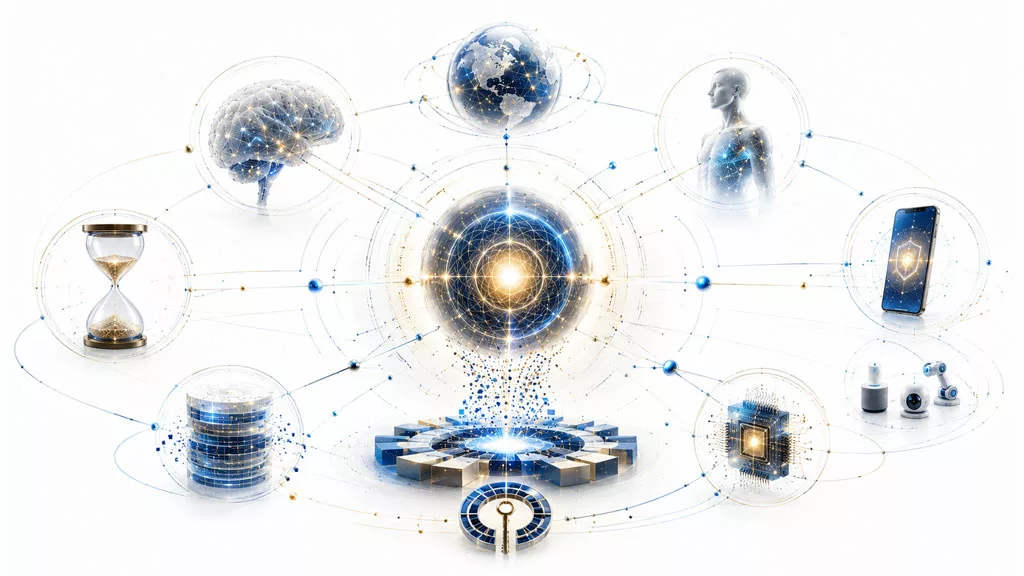
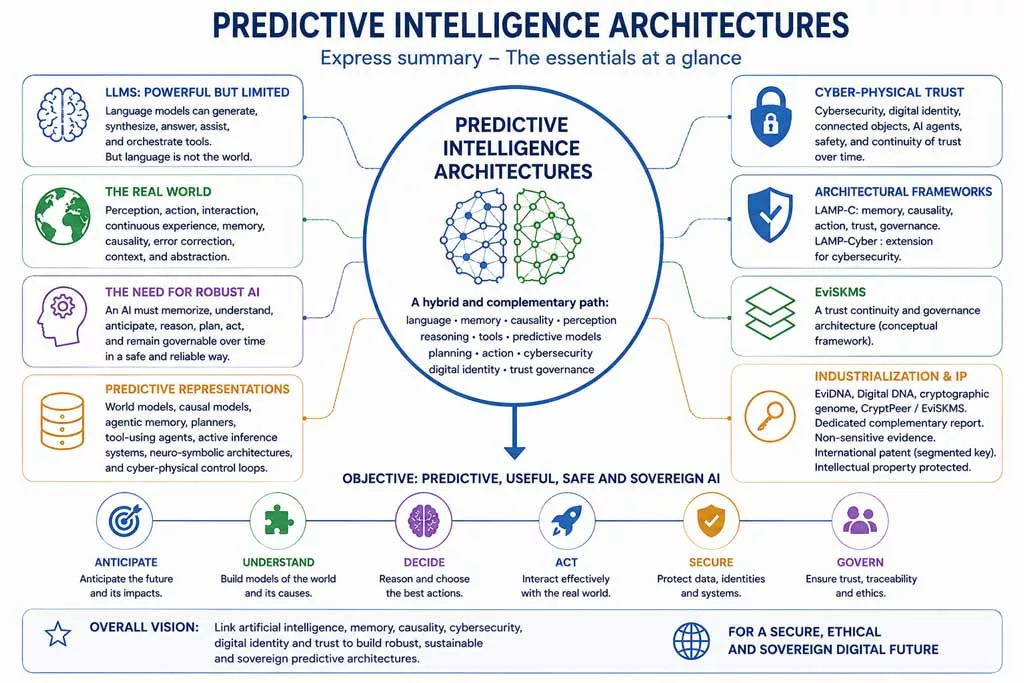
related documents

Predictive Artificial Intelligence Architectures: Freemindtronic EviSKMS R&D Memorandum

Predictive artificial intelligence architectures diagram showing world models, agentic memory, causality, cybersecurity, digital identity, connected devices, cryptographic trust and EviSKMS.

Predictive Artificial Intelligence Architectures: Freemindtronic reference memorandum on Artificial Intelligence, World Models, LAMP-C, Cybersecurity and Cyber-Physical Trust (EviSKMS) — July 2026.

Predictive Artificial Intelligence Architectures — Express Summary

Quick overview. This express summary introduces the purpose, central thesis and scope of this memorandum before the detailed Executive Summary.

Predictive Artificial Intelligence Architectures represent a broader framework for understanding the evolution of Artificial Intelligence (AI). Rather than limiting the future of AI to Large Language Models (LLMs) or solely to World Models, this memorandum explores the convergence of language, memory, causality, perception, planning, action, cybersecurity, digital identity and trust governance.

The central thesis is straightforward. Although LLMs are remarkably powerful, language alone is unlikely to produce a robust, embodied and governable intelligence. An AI capable of anticipating, reasoning, remembering and acting over time will most likely rely on a hybrid architecture combining agentic memory, causal models, predictive representations, tool-using agents, symbolic reasoning, active inference and security-by-design.

Within this framework, World Models play a major, but not exclusive, role. They constitute one family of predictive architectures capable of simulating the evolution of an environment and forecasting the potential consequences of future actions. This memorandum places them within a broader ecosystem where intelligence emerges from the integration of multiple complementary capabilities.

The memorandum also extends this analysis to Cyber-Physical Trust. It connects predictive AI with cybersecurity, digital identity, connected devices, software agents, safety engineering and long-term trust continuity. LAMP-C and LAMP-Cyber are introduced as conceptual architectural frameworks designed to organize memory, causality, action, governance and security within predictive intelligent systems.

The Freemindtronic positioning is presented with methodological caution. EviSKMS, CryptPeer, EviDNA, Digital DNA and the Cryptographic Genome are distinguished through three disclosure levels. The published international patent belongs to the public prior-art record. Observable industrialization is documented through verifiable, non-sensitive evidence. Internal mechanisms, Gen2 extensions and unpublished know-how remain protected under Register C.

This document therefore serves as a scientific and industrial reference memorandum. It does not claim to be a peer-reviewed publication or a definitive experimental validation. Instead, it provides a structured framework for designing future Predictive Artificial Intelligence Architectures capable of integrating AI, memory, causality, cybersecurity, digital identity, cryptography and long-term trust continuity.

Reading Information

Express Summary reading time ≈ 4 minutes
Executive Summary reading time ≈ 6 minutes
Estimated full reading time ≈ 2 hours
First publication August 2022
Last updated July 2026
Complexity level Expert / Research
Technical density ≈ 82%
Available language FR ·  EN
Scope Scientific and industrial memorandum on Predictive Artificial Intelligence Architectures, World Models, Agentic Memory, Causality, Cybersecurity and Cyber-Physical Trust
Recommended reading order Express Summary → Executive Summary → State of the Art → LAMP-C → LAMP-Cyber → Limitations and Falsifiability
Accessibility Optimized for screen readers, internal anchors and structured summaries
Editorial format Scientific and Industrial Reference Memorandum
Primary topic Predictive Artificial Intelligence Architectures
Secondary topics LLMs, World Models, Agentic Memory, Causality, LAMP-C, LAMP-Cyber, Cybersecurity, EviSKMS, Digital Identity and Cyber-Physical Trust
Criticality level High — 8 / 10 — rapid evolution of AI, autonomous agents, cybersecurity and digital identities
Author Jacques Gascuel, inventor and founder of Freemindtronic®.

Predictive Artificial Intelligence Architectures express summary diagram showing the relationships between Large Language Models, World Models, Agentic Memory, LAMP-C, LAMP-Cyber, EviSKMS, Cyber-Physical Trust, Digital Identity, Cybersecurity and Trust Governance.

Publication Status

This memorandum on Predictive Artificial Intelligence Architectures is a Freemindtronic position and reference document. It is neither a peer-reviewed publication, an independent third-party audit nor a product certification.

Editorial Note. This Express Summary outlines the objectives, central thesis and scope of the Predictive Artificial Intelligence Architectures memorandum. It precedes the detailed Executive Summary and forms part of Freemindtronic Andorra’s editorial transparency approach. It clearly distinguishes established scientific knowledge, proposed architectural frameworks, observable industrialization evidence and mechanisms protected by unpublished intellectual property. This content has been prepared in accordance with the Freemindtronic Andorra AI Transparency Statement — FM-AI-2025-11-SMD5.

Predictive Artificial Intelligence Architectures — Executive Summary

Initial Observation

Large Language Models (LLMs) represent a major breakthrough in artificial intelligence. They show that large-scale learning from language can generate coherent text, assist programming, answer questions, summarize documents and orchestrate external tools.

However, this achievement should not be confused with complete general intelligence. Language is a trace of the world; it is not the world itself. Human and animal intelligence learn through continuous experience involving perception, action, memory, error correction, social interaction, causality and abstraction.

LLMs can learn useful internal representations, including spatial and temporal structures. Nevertheless, these representations often remain fragile, format-dependent and insufficient for embodied, robust and planning-oriented understanding. See Gurnee & Tegmark, Berglund et al. and Bender et al..

Proposed Analytical Framework

This memorandum now develops a broader central axis: Predictive Artificial Intelligence Architectures. It does not treat World Models as an exclusive doctrine, but rather as one major family of solutions within a wider architectural framework.

The objective is to analyze how an AI system can remember, abstract, predict, reason causally, plan, act and remain governable.

Predictive representations may take several forms, including explicit World Models, causal models, experiential memories, symbolic planners, tool-using agents, active inference systems, neuro-symbolic architectures and cyber-physical control loops.

The decisive debate is therefore not simply “World Model or not?”. It is rather the following question: which predictive architecture, at which level of abstraction, with which memory, which causality, which capacity for action and which security control?

The Role of World Models

The term “World Model” remains an important reference. It belongs to a scientific tradition rooted in the mental models of Craik, causal models in cognitive science, model-based reinforcement learning described by Sutton & Barto, the World Models of Ha & Schmidhuber, and later JEPA / V-JEPA architectures associated with LeCun, Bardes et al. and Assran et al..

In this memorandum, the World Model becomes one pillar among others, rather than the sole interpretive center.

The general conclusion is that the most credible path will probably be hybrid: language, perception, memory, causality, symbolic reasoning, external tools, predictive models, planning, action, cybersecurity, identity and trust governance.

Freemindtronic Positioning

The trajectory involving the Cryptographic Genome, EviDNA and Digital DNA through CryptPeer/EviSKMS industrialization is documented in a distinct companion memorandum.

This approach assumes an inventor-researcher posture grounded in applied observation, continuous monitoring of the state of the art, identification of weak and strong signals, analysis of hardware and software attack vectors, and the design of sovereign counter-espionage, encryption, authentication and trust solutions.

This field experience does not replace scientific evaluation. It provides the empirical starting point for a vision that must be formalized, protected, compared and tested.

The DNA/EviDNA companion memorandum documents the observable industrialization of EviSKMS-CryptPeer through verifiable elements, including trusted runtime, Runtime Integrity, DRT continuity, RSCC, fail-closed policies, anti-replay mechanisms, chained logs, cryptographic governance, sovereign passwordless operation, DDNA Gen1, security testing campaigns and deployment artifacts.

This appendix discloses no source code, pseudo-code, internal formats or transition rules, in order to preserve current and future intellectual property protections.

The industrial trajectory also relies on an internationally patented foundation: the Segmented-Key Authentication System (FR3063365 B1, WO/2018/154258 family and EP, US, CN, JP and KR extensions).

This granted title enables limited public discussion of the published principles of cryptographic segmentation, physical proximity and conditional trust reconstitution, without exposing Gen2 genomic extensions, the complete DRT engine or EviSKMS mechanisms developed after the founding patent.

Patent / industrialization / confidential tripartition (Register A). Patent WO/2018/154258 constitutes a public document of prior art and technological foundation. CryptPeer/EviSKMS industrialization is documented through observable industrialization elements and non-sensitive evidence (Register A). Genomic extensions, internal mechanisms and unpublished know-how remain protected under Register C.

A chain of time-stamped public disclosures from 2018 to 2026 is listed in the companion memorandum.

For the public reference publication, the present memorandum includes a section on limitations, falsifiability and scope of validity, as well as a short version.

Cryptographic details and CNRS/EviDNA comparisons are addressed in the companion memorandum. These additions aim to distinguish what is demonstrated, what is industrialized, what belongs to applied research and what remains open to independent validation.

Key Points — Predictive Artificial Intelligence Architectures

  • LLMs are powerful, but text alone is probably not sufficient for robust and embodied intelligence.
  • Predictive Artificial Intelligence Architectures connect language, memory, causality, action and governance.
  • LAMP-C and LAMP-Cyber formalize a hybrid pathway applicable to cyber-physical trust.
  • The DNA/EviDNA/Cryptographic Genome details are addressed in the EviDNA companion memorandum.
  • Public disclosure remains controlled through Registers A / B / C.
[/col] [/row]

Predictive Artificial Intelligence Architectures — Foundational Thesis of the Memorandum

This memorandum proposes the following formulation as its scientific foundation.

The next stage of artificial intelligence will not depend on a single paradigm, but on the convergence of language, memory, perception, causality, prediction, action and governance. World Models represent a major pathway for learning how to anticipate the consequences of an action, but they are not the only possible response. Other approaches, including tool-using LLM agents, neuro-symbolic AI, active inference, causal models, reinforcement learning, agentic memory and hybrid architectures, seek to address the same fundamental problem, allowing artificial intelligence to build an actionable representation of its environment, reason about its transformations and act in a controlled manner.

This thesis deliberately shifts the focus of the memorandum. The central issue is no longer to defend one specific school of thought or to oppose LLMs to World Models. The subject becomes broader: identifying the functions required for a robust predictive intelligence architecture.

These functions are: understanding language, perceiving or integrating context, remembering experience, abstracting relevant variables, anticipating possible evolutions, reasoning causally, planning, acting and remaining controllable.

An LLM may be excellent at language. A symbolic engine brings particular strength to formal logic. A causal model clarifies intervention and counterfactual reasoning. A World Model helps predict the evolution of an environment, while active inference seeks to reduce uncertainty through action.

None of these approaches, taken in isolation, is sufficient today to constitute a robust general intelligence.

The research question therefore becomes: how can these capabilities be composed into a coherent, verifiable, secure architecture capable of long-term learning?

Methodological Note — Inventor-Researcher Posture and Applied Observation

This reflection is not limited to a conventional academic approach. It is also grounded in a long inventor-researcher experience, built over more than fifteen years through continuous observation of digital threats, analysis of weak and strong signals, study of hardware and software attack vectors, and the design of digital counter-espionage, encryption, authentication and sovereign trust solutions.

This applied observation posture has gradually led to a core conviction: digital security can no longer be reduced to isolated mechanisms of protection, identification or compliance. It must be understood as a continuity of trust capable of linking identity, context, proof, memory, governance, hardware environment, software runtime and the evolution of threats over time.

The memorandum therefore assumes a dual nature. It engages with the scientific state of the art while also carrying a vision derived from invention, industrialization and operational analysis of attack surfaces. This articulation between documentary research, field observation and technical design forms the basis of the Freemindtronic trajectory around EviSKMS, CryptPeer as an industrialized embodiment of this approach, and the Cryptographic Genome as a conceptual and prospective formalization.

This posture does not claim to replace scientific validation with individual experience. It clarifies the origin of the approach: an architectural hypothesis born from prolonged observation of threats, reinforced by the industrialization of solutions, then formulated as a research framework intended to be compared, evaluated and discussed.

Eurosatory 2022–2026 Trajectory — From Human DNA to the Cryptographic Genome

This inventor-researcher posture was built through successive public milestones. Presentations delivered at Eurosatory between 2022 and 2026 help clarify the evolution of the reasoning, from an initial cyber foundation toward a trust architecture based on human DNA, then toward the Cryptographic Genome as a response to the time factor.

In 2024, this trajectory reached an industrial milestone with DataShielder Defense NFC HSM. The product does not only address the highly secure sharing of cryptographic keys associated with DNA. It also introduces an initial continuity of operational identity. The person who creates the key knows to whom it is transmitted, the recipient holds a trusted NFC device, and importing the key into that device establishes a controlled relationship between identity, physical possession, cryptographic key and encrypted/signed use.

This continuity, however, remains tied to a hardware and transactional perimeter involving the NFC device, the compatible terminal, key validity, media governance and control over the sharing lifecycle. It therefore provides a partial response to trust over time, without fully covering the challenge of a durable, re-evaluable and governable identity in a context where current AI, and later predictive AI architectures, may transform recognition, authentication, decision and trust models.

This shift led, in 2026, to the demonstration of Digital DNA and the Cryptographic Genome Generator. Biological DNA remains usable, but it becomes one possible element within a broader structure designed to organize proof continuity, trust criteria, segmentation, traceability, governance and the evolution of identity over time. This transition is therefore not a rupture. DataShielder Defense NFC HSM provides operational identity continuity, while Digital DNA and the Cryptographic Genome extend this approach toward a durable, contextualized, re-evaluable and governable identity. This evolution constitutes one of the cyber-identity application cases of the present memorandum on Predictive Artificial Intelligence Architectures.

Strict Definitions

To avoid ambiguity, this memorandum uses the following definitions.

Artificial General Intelligence. The ability of a system to learn, reason, plan and act across diverse domains, including novel situations, with robustness and adaptability beyond simple pattern memorization.

World Model. An explicit or implicit internal representation that enables a system to predict the evolution of an environment, especially under the effect of possible actions. See Craik, Ha & Schmidhuber and the World Model for Robot Learning Survey.

Predictive Representation. An internal structure that is not only used to recognize a situation, but also to anticipate its future transformations.

Causality. The ability to distinguish a correlation from a productive mechanism and to reason about what would happen under intervention. See Pearl and Schölkopf et al..

Planning. The ability to evaluate several possible sequences of actions, simulate their consequences and select a trajectory aligned with a goal.

Experiential Memory. A form of memory that stores not only documents or facts, but also episodes, errors, strategies, abstractions and feedback that can be reused for future action. See Du.

Grounding. The relationship between symbols, language, perception, action and environment. The symbol grounding problem is discussed by Harnad.

Predictive Artificial Intelligence Architectures — Introduction

Contemporary artificial intelligence is advancing at an unprecedented pace, driven largely by Large Language Models (LLMs). These systems generate text, answer questions, summarize documents, translate languages, write code, and assist users across a wide range of intellectual tasks.

Their impressive performance can sometimes create the impression that they are approaching artificial general intelligence. This perception, however, deserves careful examination. Large Language Models are trained primarily on vast collections of textual data. They learn to predict the most probable continuation of a sequence by identifying statistical regularities within their training data.

Although this capability is remarkable, it does not necessarily imply a deep understanding of the world. Language describes objects, events, intentions, relationships, and causes, yet it cannot replace perception, action, sensory feedback, or embodied experience.

From the earliest stages of life, humans learn through vision, movement, touch, interaction with objects, the consequences of their actions, social relationships, and continuous experience of the physical world. They progressively construct abstractions, discard irrelevant details, and retain the structures that enable prediction and purposeful action.

The central question therefore becomes: can robust intelligence emerge solely from learning based on text? Or does it require a new generation of architectures capable of integrating language, memory, abstraction, causality, prediction, action, and Trust Governance?

This dissertation adopts the following position: Large Language Models are indispensable, yet they are likely insufficient on their own. World Models represent an important direction, but not the only one. The next stage of AI should instead be conceived as a convergence of Predictive Artificial Intelligence Architectures combining World Models, Neuro-symbolic AI, Causal Models, Active Inference, Tool-using Agents, Agentic Memory, AI Planning, AI Cybersecurity, and Cyber-Physical Trust.

1. Large Language Models — Capabilities and Limitations

Large Language Models are trained on enormous quantities of textual data. Their training corpora may encompass a substantial portion of publicly available Internet content, supplemented by additional sources such as books, scientific articles, web pages, document repositories, software code, and annotated conversations.

The model transforms this massive body of information into internal parameters. This process can be viewed as a form of statistical compression of human language. Rather than memorizing every sentence, the model learns structures, associations, stylistic patterns, grammatical regularities, factual knowledge, and recurring reasoning patterns present within its training data.

This approach enables remarkable performance. LLMs can explain concepts, solve certain classes of problems, reformulate ideas, generate coherent text, and orchestrate external tools. Nevertheless, their operation remains fundamentally grounded in predicting the most probable continuation of a sequence of text.

This limitation explains several well-known challenges, including hallucinations, the absence of native persistent memory, the fragility of certain forms of generalization, difficulty with long-horizon planning, and the lack of direct grounding in the physical world. The critique proposed by Bender et al. reminds us that language alone does not guarantee situated understanding.

A balanced scientific position is therefore not to claim that LLMs never reason. Rather, it is more precise to state that LLMs can produce useful reasoning and acquire certain forms of Predictive Representations of the world, yet these representations are not currently sufficiently stable, causal, embodied, or verifiable to constitute a complete artificial general intelligence.

Predictive Artificial Intelligence Architectures — 2. What LLMs Already Do Well

A rigorous scientific dissertation should not caricature Large Language Models. They are far more than statistical dictionaries. They can learn abstract regularities, perform reasoning expressed in natural language, generate software code, manipulate mathematical representations, invoke external tools, and occasionally infer information that is not explicitly stated in a prompt.

Research such as Gurnee & Tegmark suggests that some language models internally encode spatial and temporal dimensions as exploitable latent structures. This finding indicates that learning from text alone can give rise to latent Predictive Representations of the world.

However, these internal representations should not be confused with robust World Models. The Reversal Curse, for example, demonstrates that a model may learn a relationship in one direction while failing to generalize correctly to the inverse relationship. This fragility suggests that certain capabilities remain strongly dependent on the training distribution and on how a problem is formulated.

The scientific question is therefore not, “Do LLMs understand or not?” Rather, it is: What internal representations do they construct, under which conditions, how robust are these representations, and to what extent can they support causality, Agentic Memory, AI Planning, and purposeful action?

3. The Real Cost of Modern Artificial Intelligence

Massive investment in artificial intelligence is driven primarily by two requirements: computational infrastructure and post-training.

The first concerns the computing resources required to train and deploy modern AI models. Training relies on specialized processors, memory, networking, energy, and large-scale data centers. Inference at scale is also computationally expensive, as every request consumes resources while imposing constraints on latency, availability, and security.

The second concerns post-training. A raw model is not automatically reliable, useful, or safe. It must be refined through supervised learning, human feedback, alignment, filtering, instruction tuning, tool integration, retrieval mechanisms, and security policies.

This reality demonstrates that the raw model alone is insufficient. Modern artificial intelligence already depends on an ecosystem composed of models, data, external memory, tools, guardrails, interfaces, governance policies, infrastructure, and continuous supervision.

This observation reinforces the central thesis of this dissertation: advanced AI will likely not consist of a single isolated model, but rather of a composite architecture.

Predictive Artificial Intelligence Architectures — 4. Human Learning: Sensory Experience, Action, and Abstraction

Comparing a Large Language Model with a young child highlights the fundamental difference between text-based learning and embodied learning.

By the age of four, a child has already experienced thousands of hours of wakefulness. During this period, the child continuously receives visual, auditory, tactile, and motor sensory inputs. The retina does not transmit a raw image directly to the brain; it transforms, filters, and compresses information before sending it through the optic nerve. Although estimates vary, the literature on retinal coding indicates that the transmitted information flow remains substantial. See Koch et al..

Any comparison with the token streams processed by Large Language Models must therefore remain cautious. Human visual experience should not be presented as directly equivalent to textual data. The essential qualitative distinction is that a child learns from a continuous, active, multimodal sensory experience that is intrinsically linked to the consequences of its own actions.

The child observes objects, interacts with them, experiences the consequences, adjusts expectations, memorizes regularities, and progressively constructs abstractions. The child learns that some objects fall, roll, break, resist, disappear behind others, or reappear. At the same time, the child acquires an understanding of intentions, social cues, emotions, and implicit rules.

Human intelligence is therefore not built simply through the accumulation of information. It emerges through experience, interaction, abstraction, prediction, and error correction. This perspective aligns with the work of Lake et al., who emphasize the importance of Causal Models, intuitive physics, intuitive psychology, and rapid generalization.

5. Why Text Alone Is Likely Not Enough

Text is a secondary representation of the world. It describes objects, events, emotions, intentions, and relationships. It is not the world itself.

A model trained exclusively on text learns the regularities of language about the world, but not necessarily the regularities of the world itself. It may learn that people often write “a glass falls and breaks,” yet this knowledge remains mediated through language. It does not arise from direct experience of gravity, fragility, sound, trajectory, or the physical consequences of an action.

This distinction is closely related to the Symbol Grounding Problem discussed by Harnad. A symbol cannot be considered fully understood if it is connected only to other symbols. At least part of its meaning must ultimately be grounded in perception, action, or experience.

This does not imply that text is of limited value. On the contrary, language is an extraordinarily powerful medium for abstraction, cultural transmission, and reasoning. However, language alone appears insufficient to produce robust embodied intelligence.

The most scientifically accurate formulation is therefore that text alone can give rise to rich internal Predictive Representations, yet it does not appear sufficient to build a general intelligence capable of perception, causality, Experiential Memory, AI Planning, and effective action within the physical world.

Predictive Artificial Intelligence Architectures — 6. World Models as a Family of Predictive Architectures: Origins of the Concept

Throughout this dissertation, World Models are no longer treated as the exclusive focus of the discussion. Instead, they are examined as one of the major families of Predictive Artificial Intelligence Architectures because they explicitly formalize a fundamental capability: anticipating how an environment evolves from its current state under possible actions.

The term World Model is not a recent invention. It extends a long-established scientific tradition.

Craik proposed that the mind constructs small-scale internal models of reality, enabling actions to be mentally simulated before being executed. This intuition remains fundamental: thinking consists, in part, of testing possible actions internally before acting in the external world.

Johnson-Laird later developed the theory of mental models, according to which human reasoning relies on internal representations of possible situations.

In artificial intelligence, the concept emerged through model-based reinforcement learning, in which an agent uses a model of environmental dynamics to simulate the consequences of alternative actions. See Sutton & Barto.

The expression World Models became explicit in the work of Ha & Schmidhuber, who learned compressed representations of environments and used them to train autonomous agents. More recently, the JEPA and V-JEPA architectures proposed by LeCun, Bardes et al., and Assran et al. have extended this approach by learning to predict abstract latent representations rather than individual pixels.

The concept itself is therefore not new. What is new is its renewed central role in contemporary discussions about the future of artificial intelligence.

7. World Models as Predictive Representations: A Rigorous Definition

A World Model is a specific form of Predictive Representation: an internal representation that enables a system to predict how an environment is likely to evolve.

Within the broader perspective of this dissertation, it is not presented as the only solution, but rather as a central class of architecture capable of linking state, action, future, and decision-making.

Formally, if a system observes the state of the world at time t, denoted x_t, it constructs an abstract representation s_t. Given a candidate action a_t, the model predicts a future state s_{t+1} or a probability distribution over possible future states.

Observation x_t
      ↓
Encoder E
      ↓
Abstract state s_t
      ↓ + action a_t
Predictor P
      ↓
Predicted future state ŝ_{t+1}

The value of a World Model lies not merely in recognizing the current state of the environment, but in predicting what may happen next.

A system equipped with a World Model can answer the question: What would happen if I performed this action? This question lies at the heart of AI Planning, practical causality, and autonomous intelligence.

Predictive Artificial Intelligence Architectures — 8. Abstraction and Hierarchical Representations

It is impossible to represent the complete state of the world down to its ultimate physical details. Describing an ordinary room at the level of quantum field theory would be impractical: the complete wave function of a macroscopic system cannot be measured, and no realistic computation could predict every physically possible evolution in a useful manner.

Humans do not reason in this way. Instead, they construct abstractions: objects, surfaces, agents, intentions, obstacles, trajectories, rules, tools, and risks. Each level of abstraction discards part of the lower-level detail while preserving the information that is useful for prediction at a given scale.

This hierarchy mirrors the organization of science itself: particle physics, nuclear physics, chemistry, biochemistry, molecular biology, biology, psychology, sociology, and ecology. Each discipline focuses on the level of organization most relevant to its domain.

An effective World Model must therefore learn hierarchical representations. Lower levels may encode shapes, textures, and motion. Intermediate levels may encode objects, relationships, and scenes. Higher levels may encode intentions, constraints, goals, norms, and abstract causal structures.

Intelligence does not consist of preserving every detail, but of constructing the appropriate level of abstraction for effective action.

9. Learning Through Prediction: Encoder, Predictor, and Prediction Error

A system can learn a World Model through self-supervised predictive learning.

  1. It observes the world at time t as input data x_t.
  2. An encoder transforms x_t into an abstract representation s_t.
  3. A predictor estimates the future state ŝ_{t+1}.
  4. The system then observes x_{t+1}.
  5. The same encoder produces the corresponding representation s_{t+1}.
  6. The system minimizes the discrepancy between ŝ_{t+1} and s_{t+1}.

The objective is to make predictions within a meaningful abstract representation space rather than predicting every individual pixel. This is precisely the intuition behind JEPA architectures: learning to predict useful representations instead of reconstructing every detail. See LeCun and Bardes et al..

This learning mechanism fundamentally changes the nature of learning: the system no longer learns merely to recognize the world; it learns to anticipate its evolution.

Predictive Artificial Intelligence Architectures — 10. From Prediction to Planning

Planning requires the ability to simulate multiple possible futures.

To choose an action, an intelligent agent must evaluate several possible trajectories:

Current state
   ├── Action A → Possible future A
   ├── Action B → Possible future B
   └── Action C → Possible future C

The agent then compares these alternative futures according to an objective, a constraint, a cost, or a risk.

This capability is fundamental to model-based reinforcement learning, where an internal model is used to simulate the consequences of actions before they are executed. See Sutton & Barto.

Planning may also be delegated to symbolic engines, constraint solvers, search trees, or formal verification tools. Even in these cases, however, the system must represent states, actions, and transitions. In other words, planning almost always reintroduces some form of World Model.

11. World Models Within Predictive Artificial Intelligence Architectures: Promise and Limitations

This section retains World Models as a major scientific reference while placing them within a broader architectural perspective. Their importance lies not in belonging to a particular school of thought, but in the function they embody: learning useful Predictive Representations that support prediction, AI Planning, and action.

11.1. Generative World Models

The World Models proposed by Ha & Schmidhuber learn a compressed representation of an environment and then use this representation to train an autonomous agent. This approach demonstrates that an agent can learn not only from the real or simulated world, but also from an internally learned model of that world.

Predictive Artificial Intelligence Architectures — 11.2. JEPA, V-JEPA, and Latent-Space Prediction

JEPA and V-JEPA architectures aim to predict abstract representations rather than individual pixels. Their objective is to capture the information that is most relevant for understanding and action, without expending learning capacity on secondary visual details. See LeCun, Bardes et al., and Assran et al..

11.3. World Models in Robotics

World Models have become a major research direction in robotics because they enable systems to predict environmental dynamics, simulate actions, perform planning, and improve out-of-distribution generalization. See World Model for Robot Learning Survey.

11.4. Embodied Robotics and Digital Simulators

Simulation environments and digital twins make it possible to generate rare or hazardous scenarios. They are particularly valuable for autonomous driving, industrial robotics, and physical agents. Nevertheless, a simulation is never a complete representation of the real world and must always be validated against real-world observations.

Predictive Artificial Intelligence Architectures — 11.5. Limitations of World Models

World Models are not a universal solution. They face several fundamental challenges:

  • learning stable abstractions;
  • managing uncertainty and multiple possible futures;
  • distinguishing Causal Models from statistical correlations;
  • avoiding the prediction of irrelevant details;
  • generalizing beyond the training distribution;
  • integrating language, action, and Agentic Memory;
  • evaluating model quality objectively;
  • ensuring safety when actions affect the physical world.

An inaccurate World Model may become dangerous precisely because it appears internally coherent. Consequently, evaluation, Trust Governance, and Runtime Integrity become central requirements.

Predictive Artificial Intelligence Architectures — 12. Competing and Complementary Approaches

This section maps the principal research directions pursuing the same overarching objective: robust reasoning, generalization, AI Planning, memory, hallucination reduction, and reliable action.

12.1. Neuro-symbolic AI

Neuro-symbolic AI combines neural networks with symbolic reasoning, including rules, logic, knowledge graphs, constraint solvers, and inference engines.

This approach is particularly promising in domains where explainability, verification, and regulatory compliance are essential, including law, AI Cybersecurity, mathematics, formal verification, diagnostics, Trust Governance, and safety-critical systems. See Garcez & Lamb, Colelough & Regli, and Yang et al..

Primary strength: explainable and controllable reasoning. Main limitation: limited grounding in perception and the physical world. Relationship to World Models: symbolic systems often perform planning over abstract states and therefore frequently reintroduce a discrete or logical World Model.

12.2. Tool-using LLM Agents, RAG, Memory, and Planning Systems

A major industrial direction consists of using Large Language Models as orchestration engines. They invoke external tools, retrieve information, execute code, consult knowledge bases, rely on external Agentic Memory, and delegate specialized tasks to dedicated modules.

Retrieval-Augmented Generation (RAG) improves factual accuracy by connecting the model to external knowledge sources. See Lewis et al.. Tool-using Agents further extend LLM capabilities through planning, reasoning, tool use, and memory. See Yao et al., Huang et al., and Du.

Primary strength: immediate operational effectiveness. Main limitation: retrieval and external tools do not replace genuine causal understanding. Relationship to World Models: the agent may construct an external task model composed of states, sub-goals, constraints, tools, and memory.

Predictive Artificial Intelligence Architectures — 12.3. Model-Based Reinforcement Learning

Model-based reinforcement learning learns or exploits a model of environmental dynamics. The agent can simulate the consequences of its actions before acting. See Sutton & Barto and Moerland et al..

Primary strength: efficient planning and anticipation. Main limitation: learning reliable models in complex environments remains difficult. Relationship to World Models: this is one of the most explicit forms of a World Model.

12.4. Model-Free Reinforcement Learning

Model-free reinforcement learning learns an action policy directly without constructing an explicit model of the environment. It has achieved remarkable success in games and several simulated environments. See Mnih et al. and Schulman et al..

Primary strength: strong performance in well-defined environments with clear reward functions. Main limitation: high training cost, limited data efficiency, and poor robustness outside the training distribution. Relationship to World Models: although it avoids an explicit World Model, it generally struggles with long-horizon planning and systematic generalization without predictive structure.

12.5. Imitation Learning and Learning from Demonstration

Imitation learning trains a system to reproduce observed behaviors. It plays a central role in robotics, autonomous driving, and software agents.

Primary strength: rapid learning from human demonstrations. Main limitation: behavior may be reproduced without deep understanding, leading to failures outside the training distribution. Relationship to World Models: demonstrations provide trajectories, but the agent often requires a predictive model to adapt to novel situations.

Predictive Artificial Intelligence Architectures — 12.6. Active Inference and the Free Energy Principle

Active Inference, associated with Friston, proposes that intelligent agents act to reduce uncertainty and minimize the discrepancy between predictions and observations. Policies are selected according to their expected ability to minimize free energy by jointly maximizing utility and information gain. See Friston et al. and de Vries.

Primary strength: a unified framework integrating perception, action, and uncertainty. Main limitation: considerable theoretical complexity and limited industrial adoption. Relationship to World Models: Active Inference relies on internal generative models and is therefore closely related to, rather than opposed to, World Models.

12.7. Causal Models and Probabilistic Reasoning

Causal Models seek to distinguish correlation from causation while enabling counterfactual reasoning: what would happen if a variable were changed? See Pearl and Schölkopf et al..

Primary strength: conceptual robustness and intervention capabilities. Main limitation: learning large-scale causal structures automatically remains extremely challenging. Relationship to World Models: a causal model is often an abstract World Model centered on causal mechanisms.

12.8. Neuromorphic and Brain-Inspired Architectures

Neuromorphic architectures investigate spiking neural networks, continuous plasticity, local memory, and highly energy-efficient computation.

Primary strength: biological inspiration and potentially high energy efficiency. Main limitation: lower technological maturity compared with mainstream deep learning architectures. Relationship to World Models: these architectures do not inherently provide a World Model, but they may constitute an effective substrate for continuous learning.

Predictive Artificial Intelligence Architectures — 12.9. Planning Through Search, MCTS, Programs, and Formal Verification

Planning may be performed through explicit search methods, including decision trees, Monte Carlo Tree Search, constraint solvers, theorem provers, and formal verification systems. See Kocsis & Szepesvári and Silver et al..

Primary strength: systematic exploration of alternative scenarios. Main limitation: combinatorial explosion and dependence on a formal representation of states. Relationship to World Models: every search tree assumes states and transitions and therefore relies on some form of World Model.

12.10. Evolutionary AI and Open-Ended Learning

Evolutionary AI seeks to generate increasingly complex behaviors through variation, selection, and open-ended environments. The objective is not merely to optimize a fixed task, but to encourage the emergence of novel capabilities.

Primary strength: open-ended exploration of behavioral diversity. Main limitation: computational cost, unpredictability, and limited controllability. Relationship to World Models: evolved agents may develop internal representations, although these are often difficult to interpret.

12.11. Metacognitive Architectures

Metacognitive architectures provide a system with self-assessment capabilities, enabling it to detect its own errors, estimate uncertainty, decide when to request assistance, verify hypotheses, or revise its strategy.

Primary strength: robustness, self-correction, and operational safety. Main limitation: objectively evaluating the quality of self-assessment remains difficult. Relationship to World Models: metacognition can supervise and regulate the use of a World Model, but it does not replace it.

13. Proposed Taxonomy of Predictive Artificial Intelligence Architectures

This taxonomy proposes seven dimensions for comparing candidate architectures capable of achieving robust artificial general intelligence.

  1. Language: processing symbols, text, instructions, and dialogue.
  2. Perception: learning from images, video, audio, sensors, or the surrounding environment.
  3. Memory: storing, organizing, abstracting, and reusing experience.
  4. Causality: distinguishing correlation, intervention, and consequence.
  5. Action: operating within real, simulated, or software environments.
  6. Prediction: anticipating future states and multiple possible scenarios.
  7. Planning: selecting sequences of actions to achieve a goal.

This taxonomy deliberately avoids classifying approaches according to technological trends or implementation choices. Instead, it organizes them according to the cognitive functions they are required to perform.

The central question therefore becomes: Which architecture most effectively integrates these seven dimensions while ensuring robustness, safety, and verifiability?

Predictive Artificial Intelligence Architectures — 14. Comparative Matrix of Current Approaches

Qualitative scale: Low / Moderate / High / Very High.

Approach Language Perception Memory Causality Action Prediction Planning Primary Limitation
Pure LLM Very High Low Low Moderate/Low Low Linguistic Text-based No direct grounding in the physical world
Agentic LLM Very High Moderate Moderate/High Moderate Moderate Tool-assisted Strong but fragile Dependence on tools and context
RAG High Low Document-based Low Low Low Low/Moderate Retrieval is not understanding
Neuro-symbolic AI Moderate/High Variable Moderate High for rule-based reasoning Variable Moderate Strong logical reasoning Difficult grounding
Model-free RL Low Variable Implicit Low High Weak explicit prediction Moderate High training cost
Model-based RL Variable High Moderate Moderate High High High Difficult model learning
Active Inference Variable High High Probabilistic High High High Theoretical complexity
Causal Models Variable Variable Moderate Very High Variable Strong intervention capability High when structure is known Difficult causal discovery
World Models Variable High High Moderate/High High Very High Very High Difficult evaluation
Neuromorphic AI Low/Moderate Variable Variable Low/Moderate Variable Variable Variable Insufficient maturity
Hybrid Architecture Very High High High High High High High Complex Trust Governance

This comparative matrix shows that World Models are not the only possible path toward advanced intelligence. However, nearly all advanced approaches ultimately face the same fundamental challenge: representing, predicting, remembering, acting, and planning.

15. Proposed Hybrid Architecture: LAMP-C

Epistemological status (Register A). Conceptual architecture · research framework · not experimentally validated at this stage.

To establish this dissertation as a foundation for future research, we propose a conceptual architecture named LAMP-C:

  • L — Language: communication, instruction, and symbolic reasoning expressed through natural language.
  • A — Abstraction: construction of hierarchical and compressed representations.
  • M — Memory: storage, consolidation, forgetting, retrieval, and contradiction management through Agentic Memory and Experiential Memory.
  • P — Prediction / Planning: simulation of possible futures and selection of appropriate actions.
  • C — Causality / Control: intervention, counterfactual reasoning, verification, Runtime Integrity, and Cyber-Physical Trust.
Multimodal perception / data / language
                ↓
          Abstraction Encoder
                ↓
        Experiential Memory
                ↓
       Predictive World Model
                ↓
     Causal and Counterfactual Module
                ↓
 Planning Engine / Symbolic Engine / Tools
                ↓
Action: robot, API, software, or decision
                ↓
     Experience feedback and correction

This architecture is not intended as a finished technical product; it is a conceptual research framework. It provides a basis for comparing existing approaches while identifying the capabilities that remain absent from each of them.

LAMP-C is built upon a central hypothesis: advanced intelligence must be compositional. It does not emerge from a single monolithic model, but from the integration of language, perception, memory, prediction, causality, and control.

Predictive Artificial Intelligence Architectures — 16. Memory, Experience, and Cognitive Continuity

Without memory, an intelligent agent remains largely stateless. It may answer questions within a context window, yet it cannot develop continuity of experience.

Current AI systems are exploring several complementary forms of memory:

  1. Contextual Memory: information available within the model’s context window.
  2. Document Memory: retrieval of documents or passages through RAG.
  3. Episodic Memory: records of interactions, actions, errors, and outcomes.
  4. Semantic Memory: consolidated abstract knowledge.
  5. Procedural Memory: strategies, methods, routines, and acquired skills.
  6. Experiential Memory: action trajectories, feedback, failures, corrections, and accumulated learning.

Modern Tool-using Agents based on Large Language Models already investigate these memory mechanisms. See Du and Zhang et al..

Useful memory should do more than simply accumulate information. It must also filter, consolidate, forget, resolve contradictions, preserve confidentiality, and connect past experience to future decision-making.

A rigorous research program should therefore evaluate not only retrieval performance, but also whether memory genuinely improves decision quality.

17. Causality, Counterfactual Reasoning, and Robustness

Causality represents one of the major boundaries between statistical correlation and robust intelligence.

A statistical model may learn that two events are associated. A Causal Model seeks to understand what produces what. It enables questions such as:

  • What would happen if I intervened on this variable?
  • Does this action cause the observed effect, or merely reveal it?
  • What would have happened if a different action had been taken?

Pearl formalized this distinction through causal and counterfactual reasoning. Schölkopf et al. further discuss the importance of causality for robust learning and out-of-distribution generalization.

A World Model without causality may capture only superficial regularities. Conversely, a Causal Model without perception may lack grounding in reality. A robust hybrid architecture should therefore integrate both.

Predictive Artificial Intelligence Architectures — 18. Scientific Evaluation of Candidate Architectures

To establish this dissertation as the foundation of a research program, its hypotheses must be scientifically falsifiable.

Predictive Artificial Intelligence Architectures — 18.1. Evaluation Framework

A candidate architecture should be evaluated according to ten dimensions:

  1. Prediction: Can it accurately anticipate the evolution of an environment?
  2. Counterfactual Reasoning: Can it simulate “What would happen if…” scenarios?
  3. Planning: Can it select an effective sequence of actions?
  4. Causality: Can it distinguish causal relationships from mere correlations?
  5. Out-of-Distribution Robustness: Can it operate reliably in novel situations?
  6. Long-Term Memory: Does it learn effectively from previous experiences?
  7. Physical or Operational Grounding: Does it integrate language, perception, and action?
  8. Explainability: Can its decisions be understood and analyzed?
  9. Safety: Does it fail safely when necessary?
  10. Trust Governance: Can its capabilities, access rights, and objectives be effectively controlled?

18.2. Falsifiable Hypotheses

Hypothesis H1. An architecture combining a Large Language Model, Experiential Memory, and a latent predictive model performs better on long-horizon planning tasks than a standalone LLM.

Hypothesis H2. Adding a Causal Model improves out-of-distribution robustness under changing environmental conditions.

Hypothesis H3. Consolidated Experiential Memory reduces the recurrence of errors across multi-session tasks.

Hypothesis H4. A Neuro-symbolic AI architecture reduces hallucinations in tasks involving formal constraints.

Hypothesis H5. Latent World Models predict the consequences of physical actions more accurately than purely text-based models.

18.3. Candidate Experimental Protocols

  • Simulated robotic or physics-based environments.
  • Multi-step planning tasks involving hidden constraints.
  • Multi-session memory benchmarks.
  • Causal and counterfactual reasoning benchmarks.
  • Out-of-distribution evaluation scenarios.
  • Formal verification of generated plans.
  • Comparative evaluation of standalone LLMs, Tool-using Agents, LLMs with memory, LLMs with World Models, and the proposed LAMP-C architecture.

19. Mapping the Scientific Debates

A reference document should present scientific disagreements as well as defend its own thesis.

Predictive Artificial Intelligence Architectures — 19.1. Is Text Alone Sufficient?

Some researchers argue that scale, data, and external tools will ultimately enable Large Language Models to build sufficiently rich internal representations. Others contend that text alone cannot provide the grounding required for causal and physically situated intelligence.

19.2. Do Large Language Models Truly Reason?

LLMs sometimes produce reasoning that is useful and convincing. However, distinguishing robust reasoning from the imitation of common reasoning patterns or implicit search within textual representations remains an open scientific question.

19.3. Can Causality Emerge from Scale?

Causal relationships may be learned partially from data, but intervention and counterfactual reasoning often require additional representational structures beyond statistical scaling alone.

Predictive Artificial Intelligence Architectures — 19.4. Is Physical Embodiment Necessary?

Artificial intelligence can clearly be useful without a physical body. However, intelligence approaching that of humans or animals may require some form of embodied experience, whether real or simulated.

19.5. Are Video Models Sufficient?

Video models learn visual dynamics effectively, yet they may still lack causal understanding, intentionality, hidden physical constraints, and validation through interaction with the real world.

19.6. Is Neuro-symbolic AI a Transitional Stage or a Long-Term Direction?

Neuro-symbolic AI may serve either as a reasoning and control layer or as a central component of future hybrid architectures.

Predictive Artificial Intelligence Architectures — 19.7. Are Tool-using Agents a Sustainable Architecture?

They are already highly valuable in industrial applications, but their long-term robustness depends heavily on memory, external tools, verification mechanisms, and effective control.

Predictive Artificial Intelligence Architectures — 20. Proposed Research Program

20.1. Overall Objective

Design and evaluate a hybrid architecture capable of integrating language, perception, memory, prediction, causality, and planning.

20.2. Year 1: Taxonomy and Experimental Foundation

  • Finalize the proposed taxonomy.
  • Develop the comparative evaluation matrix.
  • Select appropriate benchmark suites.
  • Develop an initial prototype combining an LLM, memory, and external tools.
  • Evaluate the limitations of standalone LLMs on planning tasks.

Predictive Artificial Intelligence Architectures — 20.3. Year 2: Memory, Causality, and Latent World Models

  • Integrate Experiential Memory.
  • Add a causal or counterfactual reasoning module.
  • Evaluate a latent predictive model within a simulated environment.
  • Compare model-free RL, model-based RL, and Tool-using Agents.

20.4. Year 3: LAMP-C Architecture and Validation

  • Integrate language, abstraction, memory, prediction, and causality.
  • Evaluate out-of-distribution robustness.
  • Measure reductions in repeated errors.
  • Assess safety and explainability.
  • Publish the framework, experimental results, and identified limitations.

20.5. Scientific Deliverables

  • Position paper.
  • Comparative survey in French and English.
  • LAMP-C taxonomy.
  • Internal benchmark for planning and memory.
  • Experimental prototype.
  • Evaluation report.
  • Continuously maintained annotated bibliography.

21. Risks, Trust Governance, and Safety

Advanced AI architectures introduce specific risks.

A World Model improves planning capabilities, yet more effective planning may also increase a system’s ability to pursue unintended objectives. Persistent memory strengthens continuity but raises important issues regarding confidentiality, the right to be forgotten, and the persistence of erroneous knowledge. External tools improve operational effectiveness but also introduce risks associated with uncontrolled execution.

Trust Governance should therefore be integrated into the architecture from the outset:

  • capability control;
  • logging and traceability;
  • plan verification;
  • operational action limits;
  • clear separation between prediction, decision, and execution;
  • memory management;
  • explainability;
  • auditability;
  • safe failure (fail-safe);
  • goal alignment.

Consequently, any research program on Predictive Artificial Intelligence Architectures must also be conceived as a research program in AI safety and Cyber-Physical Trust.

Predictive Artificial Intelligence Architectures — 22. A Defensible Scientific Position

This dissertation does not claim to demonstrate that World Models constitute the only path toward artificial general intelligence. It defends a broader and more robust position: any architecture aiming to achieve reliable intelligence, planning capabilities, and generalization will need to include, explicitly or implicitly, predictive, memory-based, causal, and actionable capabilities.

This position avoids two extremes. The first would be to reduce Large Language Models to simple systems with no internal representations at all: work such as Gurnee & Tegmark 2023 suggests that they can encode certain spatial and temporal reference structures. The second would be to conclude that text alone is sufficient to produce robust embodied intelligence: limitations such as the Reversal Curse, the absence of direct sensorimotor grounding, and weaknesses in planning indicate that such a conclusion remains fragile.

The defensible thesis is therefore the following:

Large Language Models can make a major contribution to artificial general intelligence, but they need to be integrated with mechanisms for memory, perception, causality, action, control, and prediction. The scientific debate is not limited to “LLMs versus World Models”; it concerns the design of Predictive Artificial Intelligence Architectures capable of linking representation, anticipation, decision-making, and Trust Governance.

This formulation makes the dissertation compatible with competing and complementary approaches, including Neuro-symbolic AI, Tool-using Agents, RAG, Active Inference, causality, embodied robotics, reinforcement learning, and hybrid architectures. It also supports the argument that World Models are less a doctrine than a remarkable instance of a broader cognitive function: anticipating what may happen given the current state and the possible actions. See Craik 1943, Johnson-Laird 1983, Sutton & Barto 2018, Ha & Schmidhuber 2018, and LeCun 2022.

23. State of the Art at the Time of Writing: Research, Industrialization, and Observed Results

State of the art documented up to 2026-07-07; this field is evolving rapidly. This section distinguishes three levels:

  1. scientific research: articles, surveys, benchmarks, and experimental architectures;
  2. industrialized implementation: products, platforms, standards, regulations, or already deployed uses;
  3. observed results: measured benefits, real limitations, disappointing outcomes, or persistent risks.

The objective is not to provide an exhaustive list of AI products, but to position Predictive AI Architectures within their operational reality: what already works, what is progressing, what remains fragile, and what still needs to be demonstrated.

Predictive Artificial Intelligence Architectures — 23.1. Short Synthesis

At the time of writing, the state of the art shows a clear convergence: the most effective systems do not rely on a single component. They generally combine a language model, memory or external retrieval, tools, guardrails, access policies, evaluations, and sometimes specialized modules for vision, planning, cybersecurity, or robotics.

Industrialized LLMs are already effective for writing assistance, code generation, user support, document analysis, augmented search, and support for security teams. However, their limitations remain well documented: hallucinations, context dependence, fragile long-horizon planning, agent security, variable quality of generated code, data leakage risks, and the continuing need for supervision.

World Models and predictive video models are progressing rapidly in research, particularly with V-JEPA 2 and the 2025–2026 surveys on robotics and embodied AI. However, their full industrialization remains limited: results are promising for video understanding, prediction, zero-shot planning, and controlled robotics, but they are not yet equivalent to open-world autonomous general intelligence.

Cybersecurity and Digital Identity approaches are the most industrialized from a normative standpoint: NIST SP 800-63-4, OWASP LLM Top 10, NIST AI RMF, NIST CSF 2.0, ETSI EN 303 645, the Cyber Resilience Act, and the EU AI Act already form a reference foundation. WebAuthn/FIDO and Passkeys may also be cited as external points of comparison for passwordless authentication, without constituting the Freemindtronic trust foundation. The real outcome is clear: digital trust is evolving toward strong identity, security by design, AI risk governance, and phishing resistance. However, the integration of AI, identity, connected objects, and cyber-physical safety remains an emerging field of applied research.

23.2. LLMs and Tool-using Agents: Strong Industrialization, Still Incomplete Robustness

Large Language Models are the most industrialized building blocks of contemporary AI. They are now integrated into office environments, search engines, development platforms, support tools, business assistants, augmented SOCs, and document workflows.

Examples of Already Industrialized Implementations

Domain Implementation Official / Primary Reference Observed Result Persistent Limitation
Software development GitHub Copilot GitHub Copilot, Microsoft Research / arXiv study A controlled experiment measured a task completed 55.8% faster with Copilot. Gains vary depending on the task, prompt quality, expertise, integration, and code security.
Office environments Microsoft 365 Copilot Microsoft 365 Copilot Large-scale deployment within collaborative productivity suites. Productivity is difficult to measure universally; dependence on internal data and governance.
Operational cybersecurity Microsoft Copilot for Security Microsoft Security Copilot, GA details Microsoft reports that experienced analysts were 22% faster and 7% more accurate in an internal study. Results depend on SOC context, data quality, integrations, and human supervision.
SOC and cloud security Google Security Operations / Gemini Google Security Operations, Gemini in SCC Natural-language assistance, contextual summaries, recommendations, and creation of detections/playbooks. Automation must be governed: signal quality, false positives, permissions, and tool security.
RAG and document retrieval Industrial RAG Lewis et al. 2020 Reduction of certain factual hallucinations through document access. RAG does not equal truth: obsolete sources, poisoned documents, poorly ranked context, and residual hallucinations.
Tool-using Agents ReAct, Toolformer, API agents ReAct, Toolformer Enables the integration of reasoning, action, and external tools. Risks of excessive agency, indirect prompt injection, tool misuse, and context leakage.

Expected Real-World Outcome

The realistic short-term outcome is not autonomous artificial general intelligence, but a significant increase in productivity for well-defined tasks, including writing, summarization, information retrieval, standard code generation, SOC investigations, alert triage, document assistance, and the execution of controlled workflows.

When Results Fall Short of Expectations

Results become disappointing when a Large Language Model is expected to provide:

  • guaranteed truth without verification;
  • reliable planning across long sequences of actions;
  • complete causal understanding;
  • safe autonomy without guardrails;
  • ungoverned long-term memory;
  • intrinsic resistance to indirect prompt injection;
  • code quality equivalent to expert human review.

The operational conclusion is therefore straightforward: industrialized LLMs are already highly valuable, but their effectiveness depends on the surrounding architecture, including RAG, memory, external tools, policies, sandboxing, logging, verification, Trust Governance, and human supervision.

23.3. World Models, Video Models, and Robotics: Active Research, Partial Industrialization

World Models represent one of the major research directions for moving beyond token prediction toward the prediction of states, actions, and their consequences.

Recent surveys on World Models in robotics describe these models as predictive representations of how an environment evolves under the influence of actions. They are used for policy learning, AI Planning, simulation, evaluation, synthetic data generation, and video-based robotics. See World Model for Robot Learning: A Comprehensive Survey.

V-JEPA 2 represents an important milestone. Meta presents it as a video-trained model capable of understanding, prediction, zero-shot planning, and robotic control in previously unseen environments. See Meta AI V-JEPA 2 and the official V-JEPA 2 blog.

Current Implementations and Technology Readiness

Approach Status as of July 6, 2026 Observed Results Main Limitation
Predictive video models Advanced research, demonstrators, benchmark evaluations Improved motion understanding, anticipation, and latent representations Limited physical generalization, long-horizon errors, difficult evaluation
World Models for robotics Rapid growth in surveys and research prototypes Planning, imagination, simulation, synthetic data generation Costly and fragile transfer to the real world
Robot Foundation Models / VLA Partial industrialization in controlled robotics Language-to-action instructions and limited manipulation Need for embodied data, retargeting, safety, and robustness
Digital twins / simulators Already deployed across multiple industries Scenario testing, training, and validation Simulation-to-reality gap, incomplete models, validation costs

Expected Real-World Outcome

In the medium term, the expected outcome is AI capable of improving robotics, autonomous driving, simulation, physical planning, digital twins, and cyber-physical systems. However, the credible objective is not yet a universally autonomous general-purpose robot.

Results That Remain Unproven or Disappointing

Current limitations remain substantial:

  • accumulation of prediction errors over long horizons;
  • difficulty in evaluating physical consistency;
  • scarcity of unified benchmark suites;
  • high cost of robotic training data;
  • difficult transfer from Internet video to robotic action;
  • insufficient safety for safety-critical physical actions;
  • the continuing need for memory, causality, and control beyond video prediction alone.

These observations reinforce the central thesis of this dissertation: the future will not consist solely of World Models, but of Predictive Artificial Intelligence Architectures integrating memory, causality, action, and Trust Governance.

Predictive Artificial Intelligence Architectures — 23.4. RAG, Memory, and Agents: Operational Success, Risk of False Confidence

Retrieval-Augmented Generation (RAG) is already widely deployed across industry to connect Large Language Models with document repositories. Its value is clear: reducing certain hallucinations, citing sources, leveraging internal documents, and making AI genuinely useful in professional environments.

However, RAG does not automatically transform an answer into verified truth. A RAG pipeline may fail when:

  • documents are outdated;
  • the vector index retrieves an irrelevant passage;
  • a source contains an indirect prompt injection;
  • document permissions are improperly managed;
  • the model conflates retrieved information with inference;
  • memory preserves a false belief.

Agentic Memory has therefore become a central research topic. Recent surveys on memory for Tool-using Agents already formalize mechanisms for writing, management, retrieval, consolidation, forgetting, contradiction handling, and recall. See Zhang et al. and Du.

Expected Real-World Outcome

RAG and Agentic Memory are already effective for document assistance, customer support, enterprise search, compliance, knowledge retention, augmented SOCs, and domain-specific AI agents.

Potentially Disappointing Outcome

They become hazardous when treated as inherently trustworthy memory systems. Agent memory should instead be governed as a critical asset, including access rights, provenance, versioning, retention policies, forgetting mechanisms, correction procedures, logging, encryption, and revocation.

23.5. Cybersecurity and Digital Identity: Strong Regulatory and Standards-Based Industrialization

Cybersecurity is currently the domain where implementation has progressed furthest through standards and regulatory frameworks.

Already Established Reference Frameworks

Framework Nature Contribution to this Dissertation
OWASP LLM Top 10 2025 GenAI / LLM security framework Formalizes prompt injection, data poisoning, supply-chain attacks, information disclosure, excessive agency, and related threats.
NIST SP 800-63-4 Digital Identity Defines identity proofing, authentication, authenticators, federation, and assurance levels.
NIST AI RMF 1.0 AI Risk Management Provides a framework for AI governance, measurement, risk mapping, and risk management.
NIST CSF 2.0 Cybersecurity Risk Management General governance framework placing governance at the core of cybersecurity.
NIST SP 800-207 Zero Trust Continuous access re-evaluation based on identity, context, policy, and protected resources.
FIDO Passkeys Passwordless authentication Replace shared secrets with phishing-resistant asymmetric cryptography.
W3C WebAuthn Web standard Public-key credential API enabling strong authentication.
Cyber Resilience Act EU Regulation Horizontal cybersecurity requirements for products with digital elements.
EU AI Act EU Regulation Risk-based governance framework for AI systems.
ETSI EN 303 645 IoT Standard Baseline cybersecurity requirements for consumer connected devices.

Expected Real-World Outcome

The practical outcomes are already becoming visible:

  • accelerated deployment of Passkeys and phishing-resistant authentication;
  • a transition from perimeter-based security toward Zero Trust architectures;
  • growing adoption of security by design;
  • mandatory governance of AI and cybersecurity risks;
  • standardization of cybersecurity requirements for connected devices;
  • increased attention to the security of LLMs, RAG systems, and Tool-using Agents.

Disappointing or Insufficient Results

Despite these standards, several challenges remain:

  • uneven adoption of Passkeys;
  • continued dependence on platform ecosystems and portability concerns;
  • biometric authentication still vulnerable to presentation attacks when poorly implemented;
  • IoT ecosystems frequently remain weak in software updates, end-of-life management, and asset inventory;
  • complex regulatory compliance for small and medium-sized enterprises;
  • AI security remains immature when facing attacks targeting Tool-using Agents;
  • a lack of reference frameworks integrating AI, Digital Identity, memory, action, and Cyber-Physical Trust within a single architecture.

It is precisely within this gap that the applied contribution of this dissertation is positioned.

23.6. AI Cybersecurity: A Distinct Discipline in Its Own Right

The industrialization of AI reveals a fundamental distinction:

  • AI for cybersecurity: using AI to strengthen cyber defense;
  • AI cybersecurity: securing AI models, datasets, prompts, tools, agents, memories, and AI supply chains.

The OWASP LLM Top 10 2025 demonstrates that GenAI vulnerabilities extend far beyond prompt injection. They also affect outputs, training data, supply chains, information disclosure, excessively autonomous agents, and model theft. See OWASP GenAI Security Project.

The NIST AI Risk Management Framework provides a broader framework for governing AI-related risks. See NIST AI RMF.

Expected Real-World Outcome

In the short term, organizations will need to integrate AI security into their existing practices, including governance, threat modeling, red teaming, supply-chain security, software security, Identity and Access Management (IAM), logging, tool governance, human oversight, and adversarial testing.

Disappointing Outcome

AI security is still too often applied as an afterthought. Many organizations deploy assistants, RAG systems, or AI agents before defining:

  • which users are authorized to invoke which tools;
  • which data may enter the model context;
  • which forms of memory are permitted;
  • how memorized beliefs or instructions can be revoked;
  • how an entire chain of actions can be audited;
  • how the system should refuse to act under critical uncertainty.

Predictive Artificial Intelligence Architectures — 23.7. Summary of Observed Results: Valuable, but Architecture-Dependent

Domain Industrialization Observed Results Main Limitation Implication for this Dissertation
General-purpose LLMs Very High Writing productivity, summarization, code generation, user assistance Hallucinations, context dependence, security The model alone is insufficient.
Code copilots High Efficiency gains on standardized tasks Quality, integration, security, variable performance Human review and testing remain essential.
Cybersecurity copilots High but tightly governed Faster investigation and alert triage Risk of excessive automation SOC governance remains indispensable.
RAG Very High Context-aware responses False or contaminated sources Requires provenance tracking and access control.
Tool-using Agents Rapidly expanding Multi-step workflow execution Prompt injection and tool abuse Requires sandboxing and capability restrictions.
World Models Advanced research Prediction, video understanding, robotics, simulation Generalization and real-world validation A major pillar, but not a complete solution.
Digital Identity / Passkeys Strong industrialization Improved phishing resistance Adoption and portability Foundation for trustworthy digital identity.
IoT / Cyber-Physical Systems Strong regulatory framework, uneven deployment Lifecycle security requirements Legacy systems, updates, end-of-life management Requires Trust Continuity.
AI Governance Active regulatory development Risk management frameworks Complexity and compliance evidence Requires measurable metrics and auditability.

23.8. State-of-the-Art Conclusion

The state of the art as of July 6, 2026, confirms the central thesis of this dissertation: advanced AI cannot be reduced either to a larger Large Language Model or to an isolated World Model. The most convincing real-world results emerge when systems are architected around verified data, governed memory, constrained tools, strong Digital Identity, logging, evaluation, security, and human supervision.

The most compelling short-term industrial outcome is supervised human augmentation for developers, SOC analysts, legal professionals, researchers, support teams, engineers, and compliance specialists. The greatest disappointments arise when AI is presented as autonomous, inherently reliable, and causally competent without an appropriate control architecture.

The principal contribution of this dissertation is therefore to propose a unifying framework based on Predictive Artificial Intelligence Architectures, in which World Models, Large Language Models, Agentic Memory, Causal Models, Digital Identity, AI Cybersecurity, and Cyber-Physical Trust are integrated within a single analytical framework.
[/ux_text] [/col] [/row]

Predictive Artificial Intelligence Architectures — 24. Benchmarks and Evaluation Protocols

A reference dissertation should propose not only concepts but also evaluation criteria. A candidate Predictive Artificial Intelligence Architecture must be assessed through protocols that measure its ability to predict, plan, remember, act, explain its decisions, and fail safely.

24.1. Evaluating Prediction

Key questions:

  • Can the system accurately predict the evolution of an environment?
  • Can it represent multiple possible futures?
  • Does it distinguish epistemic uncertainty from aleatoric uncertainty?
  • Does it predict in pixel space, token space, or an abstract latent representation?

Relevant references: Ha & Schmidhuber 2018, Moerland et al. 2023, Bardes et al. 2024, Assran et al. 2025.

Predictive Artificial Intelligence Architectures — 24.2. Evaluating Planning

Key questions:

  • Can the system decompose a complex task into manageable steps?
  • Can it compare multiple alternative plans?
  • Can it revise a plan after failure?
  • Can it plan under temporal, energy, or regulatory constraints?

Relevant references: Kocsis & Szepesvári 2006, Silver et al. 2018, Huang et al. 2024, ReAct.

24.3. Evaluating Memory

Key questions:

  • Does the system retain relevant episodes?
  • Can it consolidate experience into abstract knowledge?
  • Can it forget information that is unnecessary or potentially harmful?
  • Can it manage contradictions, corrections, and the right to be forgotten?

Relevant references: Zhang et al. 2024, Du 2026, Lewis et al. 2020.

24.4. Evaluating Causality and Counterfactual Reasoning

Key questions:

  • Can the system distinguish correlation from causation?
  • Can it answer “What would happen if…?” questions?
  • Can it identify the relevant intervention variables?
  • Does it remain robust under distribution shifts?

Relevant references: Pearl 2009, Schölkopf et al. 2021, Lake et al. 2017.

Predictive Artificial Intelligence Architectures — 24.5. Evaluating Out-of-Distribution Robustness

Key questions:

  • Can the system generalize to previously unseen scenes, objects, or rules?
  • Can it recognize its own limitations?
  • Can it suspend an action instead of producing a plausible but incorrect response?

Relevant references: Berglund et al. 2023, Bender et al. 2021, World Model for Robot Learning 2026.

24.6. Evaluating Trust Governance

Key questions:

  • Are generated plans auditable?
  • Is memory fully traceable?
  • Are actions clearly separated from decisions?
  • Are guardrails, uncertainty thresholds, and fail-safe mechanisms implemented?

A comprehensive benchmark should therefore combine prediction tasks, planning tasks, long-term memory tasks, causal reasoning tasks, out-of-distribution evaluations, decision auditing, and safety testing.

25. Agentic Memory: The Missing Link

Memory is often treated as a secondary module. This is a fundamental mistake. Without memory, an intelligent agent possesses no continuity of experience. Without continuity, it cannot learn sustainably from its actions, correct recurring mistakes, manage contradictions, or build a stable functional identity.

A World Model without Experiential Memory risks remaining only a local prediction mechanism. To become a cumulative intelligence, it must be coupled with a memory system capable of preserving experience, extracting abstractions, forgetting irrelevant details, managing contradictions, and reusing acquired knowledge in new situations.

25.1. Three Levels of Memory

  1. Contextual Memory: the information contained within the model’s current context window.
  2. External Memory: documents, vector databases, RAG systems, logs, and knowledge graphs.
  3. Experiential Memory: episodes, errors, decisions, consequences, abstraction, consolidation, and forgetting.

Predictive Artificial Intelligence Architectures — 25.2. The Write–Manage–Read Loop

Recent research formalizes agent memory as a continuous cycle:

Observation / action
        ↓
Memory writing
        ↓
Memory management:
compression, hierarchy, contradiction handling, forgetting
        ↓
Selective retrieval
        ↓
Decision / planning
        ↓
New action

This loop must be integrated with perception, action, access control, and data Trust Governance. See Du 2026 and Zhang et al. 2024.

25.3. Memory and Operational Sovereignty

Agentic Memory also introduces sovereignty requirements, including data localization, encryption, traceability, the right to be forgotten, human oversight, separation between personal and professional memories, and protection against memory poisoning.

Memory is therefore not merely a technical challenge; it is fundamentally a matter of Trust Governance.

Predictive Artificial Intelligence Architectures — 26. AI-TRL Maturity Framework

To transform this dissertation into the foundation of a research program, the maturity of candidate architectures must be assessed. The following framework adapts the spirit of Technology Readiness Levels (TRLs) to Predictive Artificial Intelligence Architectures.

Level Name Description Minimum Expected Evidence
1 Concept Theoretical hypothesis formulated Definition, architecture diagram, hypotheses
2 Simulation Evaluation in a controlled environment Reproducible simulation results
3 Benchmark Validation on standardized tasks Comparative scores with a public evaluation protocol
4 Tool-using Agent Integration of tools, APIs, and information retrieval Action logs and error-control mechanisms
5 Multimodal Perception through images, video, audio, or sensors Multimodal evaluation results
6 Embodied Interaction with robotic systems or rich environments Perception–action feedback loop
7 Causal Validated counterfactual reasoning Interventional testing
8 Robust Out-of-distribution generalization Unseen scenarios and uncertainty detection
9 Governed Auditability, safety, and human oversight Logs, guardrails, and fail-safe mechanisms
10 Operationally Deployable Controlled operational deployment Field validation, supervision, and regulatory compliance

This framework enables meaningful comparisons between approaches without conflating them. A Large Language Model may score very highly on language while remaining limited in embodied interaction. A World Model may excel at prediction while remaining weak in Trust Governance. A hybrid architecture should therefore strive for balanced progress across all dimensions.

27. Manifesto for Predictive, Memory-Driven, and Governable AI

  1. Language is not the world. Text describes reality, but it cannot replace sensory experience, action, or causality.
  2. Predicting tokens is not the same as predicting consequences. An intelligent system that acts must anticipate the effects of its actions.
  3. Memory is not merely a document repository. It should become a continuity of experience through consolidation, forgetting, and controlled contradiction management.
  4. Causality cannot be reduced to correlation. A robust AI system must reason about interventions and counterfactuals.
  5. Planning requires simulatable futures. Choosing an action presupposes comparing multiple possible trajectories.
  6. Action requires safety control. The greater a system’s capacity to act, the greater the need for Trust Governance, auditability, and operational constraints.
  7. Abstraction is prediction-oriented compression. Irrelevant details must be discarded while preserving the variables that matter for prediction.
  8. Artificial general intelligence will most likely be hybrid. Language, perception, Agentic Memory, Causal Models, tools, and latent World Models will need to cooperate.
  9. Evaluation must consider long-term behavior and out-of-distribution performance. Short benchmarks alone cannot adequately measure robustness.
  10. A powerful AI system must know how to fail safely. Refusing, suspending action, requesting verification, or limiting execution may be more intelligent than producing a plausible but incorrect response.

This manifesto summarizes the central ambition of this dissertation: to move beyond generative AI centered on text production toward Predictive Artificial Intelligence Architectures that integrate prediction, Agentic Memory, causality, action, and Trust Governance.

Predictive Artificial Intelligence Architectures — 28. Appendix: Doctoral Research Project / Consortium

28.1. Possible Title

Toward a Hybrid Architecture for Predictive Intelligence: Memory, Causality, World Models, and Tool-using Agents.

Predictive Artificial Intelligence Architectures — 28.2. Research Problem

Current AI architectures excel at language generation. However, they remain fragile when they need to act over time, retain experience, generalize beyond the training distribution, reason causally, and plan within open environments.

This research project aims to study whether a hybrid architecture combining a Large Language Model, a World Model, Agentic Memory, Causal Models, and symbolic control can improve the robustness and governability of autonomous agents.

28.3. Research Hypotheses

  • H1: structured Experiential Memory reduces repeated errors in LLM-based agents.
  • H2: a latent predictive model improves planning compared with purely text-based planning.
  • H3: adding a Causal Model improves out-of-distribution robustness.
  • H4: Neuro-symbolic AI control reduces incoherent or forbidden actions.
  • H5: a hybrid LAMP-C architecture achieves greater governability than a Tool-using LLM Agent alone.

28.4. Scientific Bottlenecks

  • Learning the right abstractions without reconstructing every detail.
  • Combining long-term memory with confidentiality requirements.
  • Evaluating causality and counterfactual reasoning.
  • Controlling action in open environments.
  • Preventing memory poisoning.
  • Maintaining auditability despite opaque neural modules.

Predictive Artificial Intelligence Architectures — 28.5. Methodology

  1. Conduct a structured literature review.
  2. Define internal benchmarks for memory, planning, causality, and safety.
  3. Develop an agentic prototype combining an LLM, RAG, memory, a simulator, and a symbolic verifier.
  4. Progressively integrate a latent predictive model.
  5. Evaluate the system against a standalone LLM, a RAG agent, a Tool-using Agent, an agent with memory, and a hybrid agent.
  6. Analyze failures, including hallucination, causal errors, impossible plans, and contradictory memory.
  7. Publish the results, limitations, and evaluation protocols.

28.6. Deliverables Over 36 Months

Period Deliverable
M0–M6 State of the art, taxonomy, evaluation protocol
M6–M12 Memory / planning / causality benchmark
M12–M18 Minimal LAMP-C prototype
M18–M24 Latent predictive model integration
M24–M30 Out-of-distribution evaluation and Trust Governance
M30–M36 Publication, dataset, benchmark, final framework

28.7. Potential Applications

  • Robotics and embodied agents.
  • Long-term professional assistants.
  • AI Cybersecurity and incident analysis.
  • Governed critical systems.
  • Sovereign off-cloud agents.
  • Decision support under regulatory constraints.

Predictive Artificial Intelligence Architectures — 28.8. Success Criteria

  • Measurable reduction in repeated errors.
  • Improved planning under constraints.
  • Greater out-of-distribution robustness.
  • Complete logging of decisions and actions.
  • Explicit control over action capabilities.
  • Reproducibility of evaluation protocols.

29.4. AI as an Attack Amplifier

AI does not create every risk ex nihilo. However, it changes their scale, speed, credibility, and degree of personalization.

29.4.1. Phishing, Deepfakes, and Augmented Social Engineering

LLMs can generate credible, personalized, multilingual messages tailored to a target’s context. In parallel, voice and video models strengthen identity impersonation through voice or face imitation.

As a result, the risk is no longer limited to password compromise. It increasingly concerns the compromise of the trust relationship: an executive’s voice, a colleague’s message, a falsified video conference, or a misleading operational instruction.

Consequently, identity can no longer rely solely on intuitive human signals. Statements such as “I recognized the voice” or “I saw the person on video” are no longer sufficient for critical operations. Cryptographic proof mechanisms, contextual controls, out-of-band verification, logging, and strong authentication therefore become essential.

29.4.2. Offensive Automation

AI can accelerate:

  • vulnerability discovery;
  • generation of phishing variants;
  • translation and localization of attacks;
  • production of exploitation scripts;
  • analysis of leaked data;
  • target identification;
  • personalization of lures;
  • simulation of conversations;
  • dynamic adaptation to the victim’s responses.

This acceleration requires a shift in defensive strategy. Security can no longer remain purely reactive. It must become predictive, contextual, and capable of rapidly reducing exposure.

29.4.3. Attacks Against Non-Human Identities

Non-human identities are becoming critical assets: API keys, machine certificates, cloud workloads, containers, microservices, connected objects, robots, and AI agents. In many environments, these identities outnumber human users, are harder to inventory, and are less frequently governed with strict controls.

Agentic AI further amplifies this issue. An agent may act on behalf of a user, a service, or an organization. It therefore becomes necessary to define not only who is acting, but also under which delegation, within which scope, with which tools, for how long, with what traceability, and under which revocation mechanism.

29.5. Human Identity: From Point-in-Time Authentication to Trust Continuity

Modern Digital Identity is structured by reference frameworks such as NIST SP 800-63-4, which covers identity proofing, authentication, and federation. Mechanisms such as WebAuthn and FIDO Passkeys significantly improve phishing resistance by replacing shared secrets with public-key proofs bound to an authenticator and to the service context.

However, AI changes the nature of the problem. Strong authentication answers the question: does the person control the authentication factor? It does not always answer the following questions:

  • Is the person acting under coercion?
  • Has the session been hijacked after authentication?
  • Is the requested action consistent with the person’s role?
  • Is the environment trustworthy?
  • Is the behavior abnormal?
  • Is an agent acting on the person’s behalf?
  • Was the decision triggered by deepfake manipulation?

For this reason, authentication must evolve toward Trust Continuity.

29.5.1. Human Trust Factors

Category Examples Associated AI Risk Future Requirement
What I know Password, PIN Phishing, lure generation Reduction of memorized secrets
What I possess Key, card, smartphone, token Theft, malware, relay attack Attestation and local proof
What I am Biometrics Deepfake, artifacts, spoofing PAD, liveness, context
What I do Behavior, keystroke dynamics, usage patterns Mimicry, assisted impersonation Careful and governed profiling
Where I am Geolocation, network, BSSID VPN, spoofing, relay Multi-signal consistency
When I act Time, sequence, frequency Abnormal automation Cadence and anomaly detection
What I act with Device posture, browser, operating system Compromised endpoint Attestation, EDR, trust level
Why I act Apparent intent, task, workflow Manipulation, social engineering Critical contextual verification

29.5.2. From Declared Identity to Proven Identity

A declared identity is an assertion: “I am Jacques,” “I am this sensor,” “I am this agent,” or “I am this service.” By contrast, a proven identity requires a verification mechanism: cryptographic key, certificate, authenticator, biometrics, hardware attestation, proof of presence, proof of possession, proof of context, or proof of behavioral compliance.

In a world shaped by generative AI, declared identity loses value. Proven identity becomes central.

29.5.3. Trust Continuity and Adaptive Decisions

Trust Continuity does not mean unlimited surveillance. Rather, it means that critical decisions must be re-evaluated through a body of evidence proportionate to the risk: identity, context, device, requested action, history, resource sensitivity, and possible consequences.

This logic aligns with the Zero Trust model. The network is no longer assumed to be trustworthy; each access request to a resource must be evaluated according to context, identity, asset, and policy. See NIST SP 800-207.

Predictive Artificial Intelligence Architectures — 29.6. Authentication of Living Beings: Presence, Liveness, Context, and Dignity

The expression “authentication of living beings” must be handled with care. It should not reduce a human being to biometric data. Instead, it should distinguish four levels:

  1. Authentication of a human identity: proof that a person controls factors associated with a Digital Identity.
  2. Proof of presence: proof that an action involves a real human presence in a given context.
  3. Proof of liveness: resistance to artifacts, photos, videos, masks, copied fingerprints, or deepfakes.
  4. Authentication of a non-human living organism: veterinary traceability, research, conservation, food supply chains, transport, and biosafety.

29.6.1. Biometrics and Presentation Attack Detection

Biometrics can strengthen authentication, but they are not secret keys. A face, a voice, or a fingerprint may be exposed, reproduced, or synthesized.

Therefore, biometric security must integrate Presentation Attack Detection (PAD), liveness proof, bias evaluation, data minimization, cryptographic protection, and appeal mechanisms.

The ISO/IEC 30107 standard provides vocabulary and a framework for biometric presentation attack detection. Biometric evaluations such as NIST FRVT provide a performance evaluation framework, although they do not replace a complete system-level security analysis.

29.6.2. Biological Identity and Cryptographic Identity

A major confusion must be avoided: biological DNA, biometrics, and cryptographic identity are not the same type of object.

  • Biological DNA is sensitive biological information that is stable, familial, and strongly protected.
  • Biometrics is a modality for recognizing or verifying a living being.
  • Cryptographic identity is a proof structure based on keys, certificates, signatures, attestations, and protocols.

Expressions such as “Digital DNA” or “Cryptographic Genome” should therefore be understood as structural or procedural metaphors. They refer to the organization of proofs, segments, inheritance mechanisms, dependencies, or trust policies, and not to biological DNA or DNA computing.

29.6.3. Ethical Principles for the Authentication of Living Beings

Principle Meaning
Proportionality Collect only the evidence required for the actual level of risk.
Data Minimization Avoid centralized biometric data whenever local verification is sufficient.
Reversibility Support revocation, renewal, and appeal mechanisms.
Non-reduction Do not equate a human being with a technical identifier.
Local Protection Favor local authentication whenever feasible.
Explainability Provide justified explanations for critical refusals.
Auditability Maintain verifiable records without exposing personal privacy.
Dignity Prevent security from becoming abusive surveillance.

29.7. Machine Identity, Connected Devices, and Non-Human Agents

Connected devices and non-human identities have become central components of modern cybersecurity. A connected object may be an industrial sensor, a medical device, a camera, an access badge, an industrial controller, a vehicle, a smart lock, a robot, a smartphone, a gateway, an environmental probe, or an embedded module.

Reference frameworks such as NISTIR 8259A and ETSI EN 303 645 emphasize that connected devices should provide essential security capabilities, including device identity, secure configuration, data protection, software updates, logging, documentation, vulnerability management, and resilience.

With the emergence of AI, the role of connected devices is evolving. They may now become:

  • a sensor feeding a predictive model;
  • a source of local decision-making;
  • an entry point for an AI agent;
  • a physical actuator;
  • a non-human identity within a chain of trust;
  • a component of a safety-critical system;
  • a node within a predictive risk model.

29.7.1. Non-Human Identity: A Typology

Identity Type Example Primary Risk Recommended Control
Device Sensor, badge, industrial controller Cloning, compromised firmware Hardware identity, secure updates
Workload Container, cloud function Stolen token, lateral movement Attestation, secret rotation
API External service Overprivileged access, API abuse Scopes, quotas, auditing
AI Agent Tool-using assistant Unauthorized actions Capabilities, sandboxing, logging
Robot Industrial arm, drone Physical harm Safety interlocks, fail-safe mechanisms, human oversight
Data Document, embedding, memory Leakage, contamination Provenance, encryption, traceability
Model LLM, vision model, classifier Model extraction, poisoning Trust Governance, versioning, adversarial testing

29.7.2. Lifecycle of an Object Identity

  1. Birth: generation or injection of a root identity.
  2. Provisioning: association with an owner, role, purpose, and policy.
  3. Activation: first controlled deployment.
  4. Attestation: proof of hardware or software integrity.
  5. Operation: normal behavior under proportionate monitoring.
  6. Update: signed patches and verifiable software versions.
  7. Suspension: reduction of privileges following anomaly detection.
  8. Revocation: withdrawal of trust.
  9. Transfer: change of ownership or operational context.
  10. End of Life: secure erasure, decommissioning, and archival of evidence.

29.7.3. Connected Devices and the Cyber Resilience Act

The Cyber Resilience Act establishes horizontal cybersecurity requirements for products with digital elements within the European Union. It reinforces the principle that the security of connected devices and software must be addressed throughout their entire lifecycle, from secure design to vulnerability management.

For this dissertation, this means that Predictive Artificial Intelligence Architectures applied to IoT cannot focus solely on performance. They must also be maintainable, attestable, governable, updateable, and compatible with evolving regulatory requirements.

29.8. World Models as Predictive Models of Trust State

A cyber World Model may represent:

  • human identities;
  • machine identities;
  • connected devices;
  • AI agents;
  • sensitive assets;
  • permissions;
  • sessions;
  • network flows;
  • security events;
  • vulnerabilities;
  • software dependencies;
  • expected behaviors;
  • behavioral deviations;
  • attack paths;
  • mitigation measures;
  • the potential consequences of an action.

Such a model makes it possible to ask counterfactual questions, including:

  • What happens if this token is compromised?
  • What happens if this IoT device falsely reports its status?
  • What happens if this AI agent invokes this API?
  • Which attack path becomes feasible if this key is exposed?
  • Which action most effectively limits propagation?
  • Which evidence is still missing before this operation can be authorized?

This line of reasoning is consistent with Pearl‘s work on causality and with the causal representations proposed by Schölkopf et al.. Advanced cybersecurity should therefore do more than classify events; it should understand dependency relationships and predict the effects of interventions.

29.8.1. Variables of a Predictive Trust Model

Variable Example Predictive Role
Identity Human, device, agent Who is acting?
Authenticator Key, token, biometrics, certificate What evidence supports the identity?
Context Location, network, time, device Is the situation consistent?
Integrity Firmware, endpoint, runtime Is the environment trustworthy?
Behavior Sequences, frequency, volume Is there a behavioral deviation?
Resource File, API, vault, connected object How sensitive is the resource?
Action Read, sign, move, control What are the potential consequences?
Memory History, incidents, errors What is already known?
Causality Dependencies, propagation What could this action trigger?
Policy Rules, obligations, thresholds How should the system respond?
Uncertainty Missing evidence, anomaly Should access or action be restricted?

29.8.2. Compromise Trajectories

Within a predictive approach, an attack is not merely an isolated event. Instead, it follows a trajectory: reconnaissance, initial access, privilege escalation, persistence, lateral movement, exfiltration, manipulation, sabotage, or physical impact.

Accordingly, a cyber World Model should learn both normal and abnormal trajectories before evaluating their possible branching paths. This perspective naturally connects cybersecurity with AI Planning: the objective is not only to understand what has already happened, but also to anticipate what may happen next.

Predictive Artificial Intelligence Architectures — 29.9. LAMP-Cyber Architecture

Epistemological status (Register A). Conceptual extension of LAMP-C · applied research framework · not experimentally validated at this stage.

This section proposes an applied extension of LAMP-C for cybersecurity and safety-critical systems.

LAMP-Cyber stands for:

  • L — Language: operational instructions, security policies, alerts, reports, tickets, and regulatory requirements.
  • A — Abstraction: assets, identities, roles, risks, dependencies, and trust states.
  • M — Memory: behavioral history, incidents, decisions, operational contexts, evidence, and vulnerabilities.
  • P — Prediction: attack trajectories, propagation, Trust Continuity disruption, and potential impact.
  • C — Causality / Control: counterfactual reasoning, access decisions, isolation, revocation, fail-closed behavior, and auditing.
Human / machine / object / agent identity
        ↓
Context: device, network, location, time,
behavior, apparent intent
        ↓
Trust Memory: history, incidents,
evidence, policies
        ↓
Predictive Risk Model:
trajectories, anomalies, propagation
        ↓
Causal / Counterfactual Reasoning:
possible consequences
        ↓
Decision:
authorize, restrict, isolate,
revoke, alert, escalate
        ↓
Verifiable Log:
evidence, Trust Governance,
audit, experiential feedback

29.9.1. Classical IAM versus LAMP-Cyber

Dimension Traditional IAM LAMP-Cyber
Decision model Authentication followed by authorization Continuous and predictive trust assessment
Data considered Identity, group, role, MFA Identity, context, behavior, action, consequences
Time model Point-in-time event Continuously evolving state
Memory Logs and directories Experiential Trust Memory
Causality Limited Counterfactual analysis of consequences
Connected objects Often secondary Non-human identities treated as first-class entities
AI agents Rarely modeled Explicitly governed actors
Safety Limited coverage Integrated cyber-physical approach

29.9.2. Fail-Closed Decision-Making and Trust Continuity

In a critical system, uncertainty should not lead to authorization by default. Instead, the decision may need to become:

  • authorize;
  • authorize with restrictions;
  • request additional evidence;
  • isolate;
  • suspend;
  • revoke;
  • escalate to a human operator;
  • refuse in fail-closed mode.

This logic is particularly important for connected devices, robots, autonomous agents, and critical infrastructure.

29.10. Safety: When Digital Compromise Produces Physical Effects

Cybersecurity protects the confidentiality, integrity, availability, and governance of digital systems. Safety, by contrast, aims to prevent harm to people, property, infrastructure, or the environment.

With AI, IoT, and robotics, this boundary is narrowing. A digital compromise may produce a physical effect:

  • a connected lock opening unexpectedly;
  • an industrial robot moving dangerously;
  • a medical sensor transmitting falsified measurements;
  • a drone changing its trajectory;
  • a vehicle accepting an illegitimate command;
  • a smart building modifying ventilation, temperature, or access control;
  • an energy infrastructure receiving a false instruction;
  • an AI agent triggering an operational action through an API.

Safety therefore introduces an additional question: even if the action is technically authorized, is it safe in this context?

29.10.1. Security–Safety Convergence

Domain Central Question Example
Cybersecurity Is the system compromised? Stolen token, malware, injection
Digital Identity Who is actually acting? Human, agent, machine, connected object
Safety Can the action cause harm? Robot, vehicle, medical device
Trust Governance Who is accountable? Deployer, operator, manufacturer, agent
Predictive Model What is likely to happen next? Propagation, physical effect, cascading failure

29.10.2. Security and Safety of Autonomous Systems

Autonomous systems require stricter Trust Governance than purely text-based applications. An agent that writes a summary may make a mistake. However, an agent acting on a machine, a payment, an identity, or a physical access mechanism can cause real harm.

The EU AI Act adopts a risk-based approach to AI systems. For Predictive Artificial Intelligence Architectures applied to safety-critical contexts, this implies:

  • risk classification;
  • documentation;
  • human oversight;
  • robustness;
  • cybersecurity;
  • traceability;
  • incident management;
  • update control;
  • governance of data and models.

29.11. Identity / Authentication / AI / Connected Devices Matrix

Entity AI-Related Risk Classical Authentication Future Requirement References
Human Deepfake, adaptive phishing, coercion Password, MFA, biometrics Proof of presence, context, behavior, action control NIST 800-63-4, FIDO, WebAuthn
AI Agent Unauthorized actions, tool abuse, contaminated memory API key, token Agentic identity, capabilities, sandboxing, auditability OWASP LLM, NIST AI RMF
IoT Device Cloning, compromised firmware, deceptive sensor Certificate, embedded key Hardware attestation, signed update, expected behavior NISTIR 8259A, ETSI EN 303 645
Robot Dangerous physical action Local control, operator Safety, interlock, fail-safe, risk model EU AI Act
Cloud Service Token theft, privilege escalation, lateral movement IAM, OAuth, certificates Governed non-human identity, rotation, attestation Zero Trust
Sensitive Data Exfiltration, RAG contamination ACL, encryption Provenance, classification, controlled use, secure memory NIST CSF, SSDF
AI Model Extraction, poisoning, dangerous behavior Versioning, API access Model governance, red teaming, continuous evaluation NIST AI RMF, OWASP LLM
Critical Infrastructure Cyber-physical cascade Segmentation, supervision Predictive impact model, fail-closed behavior, resilience ENISA Threat Landscape, NIST CSF

Predictive Artificial Intelligence Architectures — 29.12. Sovereign Dimension: Trust Continuity, Segmented Identity, and Local Proof

Epistemological status (Register A). EviSKMS is presented here as a conceptual framework and an observable industrialization foundation as declared by its author. It has not yet undergone independent third-party auditing. Internal implementation mechanisms remain within Register C.

An original research direction consists of exploring architectures in which trust does not depend exclusively on the cloud, a centralized database, or a permanently available online authority. Such an approach is particularly relevant for:

  • sovereign environments;
  • critical infrastructures;
  • disconnected environments;
  • defense;
  • emergency response;
  • industrial IoT;
  • long-life connected devices;
  • local authentication;
  • AI agents operating under constrained conditions;
  • distributed secret and proof management.

Potential research directions include:

  1. Segmented Identity: separating proofs, authentication factors, secrets, or identity attributes.
  2. Local Authentication: enabling trust decisions without permanent dependence on a remote server.
  3. Local Trust Memory: maintaining a verifiable and controlled trust history.
  4. Trust Continuity: preserving a trusted operational state despite disconnection, network loss, or partial attacks.
  5. Verifiable Proof: logs, digital signatures, attestations, timestamps, and chains of evidence.
  6. Revocation Under Constrained Conditions: local suspension, risk thresholds, and emergency policies.
  7. Zero Trust Compatibility: eliminating implicit trust, even within internal environments.
  8. Protection of Connected Devices: hardware identity, signed updates, and expected behavioral profiles.
  9. AI Agent Control: capabilities, operational scope, Trust Modes, and fail-closed behavior.
  10. Operational Sovereignty: reducing critical dependencies on external services.

Rather than opposing existing standards, this approach should be viewed as complementary. Its objective is to make trust architectures more resilient, locally verifiable, and better aligned with the requirements of safety-critical environments.

29.13. Applied Research Program: Predictive AI, Digital Identity, and Cyber-Physical Trust

29.13.1. Research Question

How can a Predictive Artificial Intelligence Architecture be designed to evaluate, maintain, and govern trust among humans, AI agents, connected devices, and critical infrastructures while limiting the risks of compromise, impersonation, unsafe actions, and excessive dependence on a centralized authority?

29.13.2. Research Hypotheses

Hypothesis Statement Validation Criterion
H-CY1 A Trust Memory improves the detection of behavioral deviations. Reduction of false negatives in multi-stage attack scenarios.
H-CY2 A predictive attack-trajectory model improves response before impact. Reduced mitigation time and limited operational impact.
H-CY3 An agent identity governed by capabilities reduces unauthorized actions. Reduction of tool abuse during adversarial testing.
H-CY4 Continuous contextual authentication reduces post-login impersonation. Detection of session hijacking and behavioral anomalies.
H-CY5 Fail-closed decision-making reduces the impact of uncertain situations. No critical access granted without sufficient evidence.
H-CY6 A local, segmented architecture improves offline resilience. Maintenance of safe operations under degraded conditions.

29.13.3. Scientific Challenges

  • Representing a trust state without creating intrusive surveillance.
  • Connecting identity, behavior, context, and causality within an operational model.
  • Evaluating AI agents against realistic multi-stage attacks.
  • Securing both RAG memories and Experiential Memory.
  • Defining capability policies that are understandable and verifiable.
  • Guaranteeing the safety of cyber-physical actions.
  • Preserving the confidentiality of identity signals.
  • Managing revocation, correction, and forgetting in long-term memory.
  • Preventing unsafe defensive automation.
  • Reconciling operational sovereignty with standards-based interoperability.

29.13.4. Proposed Experimental Architecture

Sources: logs, IAM, EDR, IoT, APIs, RAG,
tickets, policies
        ↓
Normalization and abstraction:
assets, identities, relationships, events
        ↓
Trust Memory:
history, evidence, anomalies, incidents
        ↓
Predictive Model:
attack trajectories, risks,
potential consequences
        ↓
Causal Engine / Rules:
counterfactuals, constraints, policies
        ↓
Governed LLM Agent:
explanation, orchestration,
summarization, human interaction
        ↓
Capability Controller:
authorized tools, thresholds,
sandbox, fail-closed
        ↓
Actions:
alert, restrict, revoke,
isolate, request evidence
        ↓
Audit:
signed logs, replay,
justification, experiential feedback

29.13.5. Dedicated Benchmarks

Benchmark Objective Metrics
Indirect prompt injection Evaluate RAG and external tools Compromise rate, data leakage, correct refusal rate
Contaminated memory Evaluate forgetting and correction Persistence of hostile beliefs, purge time
Session hijacking Evaluate Trust Continuity Post-login detection rate, user friction
Cloned IoT device Evaluate attestation and behavioral validation False positives/negatives, isolation time
Overprivileged AI agent Evaluate capability policies Number of dangerous actions prevented
Decision deepfake Evaluate out-of-band verification Fraudulent validation rate
Attack trajectory Evaluate predictive capability Prediction before impact, mitigation effectiveness
Offline degraded mode Evaluate operational sovereignty Maintenance of safe operations
Cyber-physical scenario Evaluate safety Damage prevented, safe shutdown performance

29.13.6. Dedicated Deliverables

Period Cyber-Safety Deliverable
M0–M6 Taxonomy of human, machine, AI agent, and connected-object identities
M6–M12 Corpus of adversarial AI and identity scenarios
M12–M18 Minimal LAMP-Cyber prototype
M18–M24 Trust Memory and Tool-using Agent benchmarks
M24–M30 IoT, non-human identity, and degraded-mode demonstrator
M30–M36 Trust Governance framework, scientific publication, and evaluation guide

29.14. Bridge to the Companion Dissertation — Digital DNA, EviDNA, and the Cryptographic Genome

Epistemological status (Register A). The Cryptographic Genome is presented here as a conceptual and forward-looking formalization. Its detailed development is provided in a separate companion dissertation, while Gen2 implementation mechanisms remain within Register C.

The topics of the Cryptographic Genome, EviDNA, Digital DNA, documentary comparisons with the current state of the art (CNRS, FIDO, PKI, Zero Trust), and the documented industrialization evidence associated with CryptPeer are presented in a separate companion dissertation. This separation preserves the readability of the present document, which focuses on Predictive Artificial Intelligence Architectures and their applied cybersecurity dimension (§29.1–§29.13).

Companion dissertation: DNA and Cryptography — EviDNA, the Cryptographic Genome, and the State of the Art

Topic Section in the Companion Dissertation
Cryptographic Genome — Gen1/Gen2 evolution §1 — Cryptographic Genome
Industrialization matrix and Registers A/B/C §1.1
Obfuscation module — patented variant and EviSKMS extension §1.1.1
EviSKMS–CryptPeer implementation evidence summary §1.3
Structured comparison of digital trust (FIDO, PKI, EviSKMS) §1.4
Cryptographic Genome versus point-in-time identity §1.5
CNRS — synthetic DNA cryptography (external reference) §1.6
Digital DNA / CryptPeer 2026 §1.7
EviDNA implementation evidence — DataShielder §1.10
Prior art and public disclosures §1.9

Summary (Register A). The Freemindtronic trajectory (patent WO/2018/154258, EviDNA 2024, Cryptographic Genome 2026, and the industrialization of CryptPeer/EviSKMS) extends the sovereign architecture and Trust Continuity concepts introduced in §29.12. It is not presented as the theoretical core of this dissertation on Predictive Artificial Intelligence Architectures; rather, it constitutes a separately documented industrial application.

Patent / Industrialization / Confidentiality Partition (Register A). Patent WO/2018/154258 is a public prior-art document. The industrialization of CryptPeer/EviSKMS is supported by declarative observations and non-sensitive evidence (Register A). Genomic extensions and internal implementation mechanisms belong to Register C.

Inventive Lineage (Register A). Jacques Gascuel, inventor and author of this dissertation, oriented his research around a central observation: as Predictive Artificial Intelligence becomes increasingly capable of anticipating, imitating, and exploiting human behavior, traditional point-in-time authentication becomes progressively insufficient for protecting Digital Identity. This led to the hypothesis that a trusted identity should evolve over time, remain continuously re-evaluable, and be governable in response to the growing capabilities of AI, particularly predictive AI.

This research direction first resulted in the segmented-key patent and subsequently evolved into the conceptual framework of EviSKMS. Following the documented proof of implementation in 2024 of encryption and digital signatures derived from human DNA (the living-being dimension of the EviDNA trajectory), the research later expanded toward a broader conceptual framework for digital trust based on a genomic paradigm (Digital DNA and the Cryptographic Genome). These developments are presented in detail within the companion dissertation.

The present dissertation retains, in §29.12 and §29.13, the scientific framework connecting Predictive Artificial Intelligence, Digital Identity, and Cyber-Physical Trust. The cryptographic mechanisms, DNA/CNRS comparisons, and operational architectures are intentionally reserved for the companion dissertation.
[/ux_text] [/col]

Predictive Artificial Intelligence Architectures — Limitations, Falsifiability, and Scope of Validity

This section consolidates, for Freemindtronic’s public reference publication, material that is distributed elsewhere in the dissertation (§11.5, §18, §19, Appendix A.6). Its purpose is to make the document defensible for a skeptical reader, whether a researcher, auditor, journalist, or industrial partner.

Predictive Artificial Intelligence Architectures — What This Dissertation Does Not Claim to Prove

This document is not:

  • an exhaustive PRISMA-style systematic review;
  • an independent security audit or a compliance attestation (eIDAS, Common Criteria, FIPS, etc.);
  • a published quantitative benchmark comparing EviSKMS with FIDO, PKI, or competing solutions;
  • an enabling technical disclosure allowing reproduction of Gen2 mechanisms or post-patent extensions;
  • peer validation in the strict sense of publication in a peer-reviewed journal.

It is: an interdisciplinary framework for Predictive Artificial Intelligence Architectures; an applied positioning in cybersecurity and Cyber-Physical Trust (§29.1–§29.13); and a bridge to the companion DNA/EviDNA dissertation for cryptographic details and state-of-the-art comparisons.

Scope of Validity by Register

Register Public Scope of Validity Explicit Limitation
AI framework (LAMP-C, taxonomy) Conceptual and methodological; falsifiable hypotheses in §18.2 LAMP-C experimentation has not yet been published as a corpus of results.
State of the art (§23) Documentary synthesis at the time of writing Rapidly evolving field; non-exhaustive scope.
Genome / CryptPeer / EviDNA Developed in the companion dissertation See the limitations and hypotheses H-C1–H-C5 in the DNA/EviDNA dissertation.
Patent WO2018154258 Authorized partial disclosure on segmentation and conditional reconstruction Does not cover genomic extensions or the complete EviSKMS runtime.

Falsifiable Hypotheses — Predictive Artificial Intelligence Dimension

Hypotheses H1 to H5 in §18.2 concern LAMP-C and hybrid architectures integrating memory, causality, World Models, and Neuro-symbolic AI. They remain valid for the AI research dimension of this dissertation.

However, their confirmation or refutation requires the experimental protocols described in §18.3 and §24.

Predictive Artificial Intelligence Architectures — Falsifiable Hypotheses — Digital Trust Dimension (EviSKMS Gen1)

Hypotheses H-C1 to H-C5 concerning continuity, fail-closed behavior, DDNA, anti-replay mechanisms, and differentiation from existing standards are formulated and detailed in the companion DNA/EviDNA dissertation.

Global Refutation Conditions for the Freemindtronic Positioning

The framework defended in this dissertation would be significantly weakened if one of the following conditions were established publicly and reproducibly:

  1. Gen2 presented without register qualification, despite its detailed mechanisms belonging to Register C.
  2. Systemic bypass of fail-closed, RI, or DRT continuity controls within the qualified sovereign-local scope, without a documented corrective measure.
  3. Absence of correlation between the patented segmentation mechanism and the industrialized Gen1 mechanisms, indicating a technical or documentary discontinuity.
  4. Independent benchmark evidence showing that properly deployed MFA/WebAuthn achieves the same temporal continuity and runtime governance properties without an additional layer, across the same adversarial scenarios.
  5. Unintentional enabling disclosure in public communications, including the dissertation, videos, or press releases, allowing a third party to reproduce Gen2 or post-patent extensions.

Methodological Constraint Related to Intellectual Property

The controlled publication strategy based on Registers A / B / C strengthens IP protection. However, it also reduces immediate external falsifiability: a third party cannot reproduce or deeply audit mechanisms classified as Register C without an agreement.

This constraint is intentional. It requires a clear distinction between:

  • what is publicly verifiable, including product existence, declared automated tests, granted patents, and timestamped disclosures;
  • what is verifiable under NDA (Register B);
  • what is deliberately not published (Register C).

Full scientific recognition will require third-party evaluations on authorized scopes, after IP protection has been secured, in accordance with §1.2 of the companion dissertation.

Predictive Artificial Intelligence Architectures — Epistemological Modesty

This dissertation adopts the position of an inventor-researcher: field observation and industrialization provide strong signals, but they do not replace independent validation.

General Conclusion

Large Language Models have demonstrated the power of large-scale statistical learning. They will remain an essential component of modern artificial intelligence, because language is the primary medium of explicit human knowledge.

However, language alone is likely insufficient to produce robust artificial general intelligence. An intelligence capable of action must retain experience, represent context, anticipate the consequences of its actions, reason causally, plan, and control its own limits.

World Models represent a major path toward this capability, but they are not the only one. Neuro-symbolic AI, Tool-using Agents, RAG, persistent memory, reinforcement learning, Active Inference, Causal Models, search-based planning, and embodied architectures each contribute part of the solution.

The central contribution of this dissertation is to shift the analytical focus toward a broader framework: Predictive Artificial Intelligence Architectures. Within this framework, World Models are no longer the school of thought to defend; rather, they become one pillar of a larger architecture grounded in memory, abstraction, causality, action, and Trust Governance.

The applied cybersecurity dimension shows why this approach is becoming critical. Identity, context, memory, behavior, proof, action, and consequence must be connected in order to maintain Trust Continuity between humans, AI agents, machines, and connected devices.

The Cryptographic Genome / EviDNA trajectory, including CryptPeer/EviSKMS industrialization, illustrates this evolution on the sovereign trust side. It is developed in the companion DNA/EviDNA dissertation. The section on limitations and falsifiability specifies the scope of validity of the present document.

A major architectural evolution in AI will likely not consist merely of a larger model. Instead, it will depend on a better-structured architecture: language, abstraction, memory, prediction, causality, action, and control, subject to the methodological limits explicitly stated in this dissertation.

Predictive Artificial Intelligence Architectures — Annotated Scientific Bibliography

This bibliography is designed as an interactive section. Each entry includes a stable internal link, one or more official or primary links, and an indication of how it is used in the dissertation.

Quick Bibliography Index

Cognitive Origins and Symbolic Grounding

Craik, K. J. W. (1943). The Nature of Explanation.

Official / primary links: PhilPapers · Google Books / CUP Archive · Internet Archive. A foundational reference introducing the concept of an internal small-scale model of reality. It is useful for showing that the idea of a World Model predates modern artificial intelligence. Use in this dissertation: historical origins of internal models, mental simulation, and prediction before action. ↩ Back to the bibliography index

Johnson-Laird, P. N. (1983). Mental Models.

Official / primary links: Google Books / Harvard University Press · ACM Guide. A landmark work in cognitive psychology introducing the theory of mental models. It establishes a conceptual bridge between human reasoning and the internal simulation of possible situations. Use in this dissertation: cognition, internal simulation, and reasoning about possible situations. ↩ Back to the bibliography index

Harnad, S. (1990). The Symbol Grounding Problem.

Official / primary links: Oxford Computer Science PDF. A classic paper addressing the challenge of assigning meaning to symbols that are connected only to other symbols. Use in this dissertation: symbolic grounding and the limitations of language in the absence of perception and action. ↩ Back to the bibliography index

Large Language Models (LLMs): Capabilities and Limitations

Bender, E. M., Gebru, T., McMillan-Major, A., & Shmitchell, S. (2021). On the Dangers of Stochastic Parrots: Can Language Models Be Too Big?

Official / primary links: ACM Digital Library · ACM FAccT 2021. A landmark paper arguing that scaling language models does not, by itself, produce grounded understanding. The authors examine issues related to data quality, bias, environmental cost, and the limitations of purely statistical language modeling. Use in this dissertation: critical analysis of LLM limitations, symbolic grounding, and the distinction between language generation and genuine understanding. ↩ Back to the bibliography index

Gurnee, W., & Tegmark, M. (2023). Language Models Represent Space and Time.

Official / primary links: arXiv. This study provides evidence that Large Language Models develop internal representations encoding spatial and temporal relationships, suggesting that statistical learning can produce latent predictive representations extending beyond surface-level language patterns. Use in this dissertation: internal representations in LLMs, latent world representations, and the scientific debate on emergent cognitive capabilities. ↩ Back to the bibliography index

Berglund, L., et al. (2023). The Reversal Curse: LLMs Trained on “A is B” Fail to Learn “B is A”.

Official / primary links: arXiv. This paper introduces the Reversal Curse, demonstrating that language models may learn directional relationships without reliably inferring their inverse. The findings highlight limitations in generalization and relational reasoning. Use in this dissertation: limits of generalization, causal reasoning, and the robustness of internal representations. ↩ Back to the bibliography index

Brown, T. B., et al. (2020). Language Models are Few-Shot Learners.

Official / primary links: arXiv. The foundational GPT-3 paper demonstrating that scaling transformer-based language models enables strong few-shot, one-shot, and zero-shot performance across a wide range of natural language tasks. Use in this dissertation: emergence of in-context learning, scaling laws, and the practical capabilities of Large Language Models. ↩ Back to the bibliography index

OpenAI (2023). GPT-4 Technical Report.

Official / primary links: arXiv. Describes the architecture, evaluation methodology, capabilities, and limitations of GPT-4, including benchmark performance and safety considerations. Use in this dissertation: state of the art in industrial LLMs, evaluation methodology, and current operational capabilities. ↩ Back to the bibliography index

Cognitive Science and Human Learning

Lake, B. M., Ullman, T. D., Tenenbaum, J. B., & Gershman, S. J. (2017). Building Machines That Learn and Think Like People.

Official / primary links: Science. A seminal article arguing that human-level intelligence requires more than statistical pattern matching. The authors advocate integrating compositionality, causality, intuitive physics, intuitive psychology, and efficient learning inspired by cognitive science. Use in this dissertation: cognitive foundations of Predictive Artificial Intelligence Architectures, compositional representations, and causal reasoning. ↩ Back to the bibliography index

Dehaene, S. (2020). How We Learn: Why Brains Learn Better Than Any Machine… for Now.

Official / primary links: Penguin Random House · Collège de France. Dehaene explores the principles underlying human learning, emphasizing attention, active engagement, error correction, abstraction, and consolidation. Use in this dissertation: human learning mechanisms, abstraction, Agentic Memory, and the relationship between learning and prediction. ↩ Back to the bibliography index

Friston, K. (2010). The Free-Energy Principle: A Unified Brain Theory?

Official / primary links: Nature Reviews Neuroscience. This influential paper proposes that biological systems minimize variational free energy through prediction and continual interaction with their environment, providing a theoretical foundation for perception, action, and learning. Use in this dissertation: predictive cognition, Active Inference, and theoretical foundations of predictive intelligence. ↩ Back to the bibliography index

Clark, A. (2013). Whatever Next? Predictive Brains, Situated Agents, and the Future of Cognitive Science.

Official / primary links: Cambridge University Press. Clark argues that cognition is fundamentally predictive, with the brain continuously generating and updating models of the world through perception and action. Use in this dissertation: predictive cognition, World Models, Active Inference, and predictive representations. ↩ Back to the bibliography index

Human Vision and Sensory Processing

Gibson, J. J. (1979). The Ecological Approach to Visual Perception.

Official / primary links: Google Books. Gibson introduced the ecological theory of perception, arguing that perception is fundamentally rooted in direct interaction with the environment rather than in passive image processing. Use in this dissertation: perceptual grounding, embodied intelligence, and the relationship between perception and action. ↩ Back to the bibliography index

Marr, D. (1982). Vision: A Computational Investigation into the Human Representation and Processing of Visual Information.

Official / primary links: MIT Press. A foundational work in computational vision proposing a hierarchical theory of visual processing, from low-level sensory signals to abstract representations. Use in this dissertation: hierarchical representations, abstraction, predictive perception, and World Models. ↩ Back to the bibliography index

DiCarlo, J. J., Zoccolan, D., & Rust, N. C. (2012). How Does the Brain Solve Visual Object Recognition?

Official / primary links: Neuron. This review explains how the primate visual system develops invariant object representations while preserving behaviorally relevant information. Use in this dissertation: perceptual representations, abstraction, and biologically inspired approaches to Predictive Artificial Intelligence Architectures. ↩ Back to the bibliography index

Reinforcement Learning and World Models

Sutton, R. S., & Barto, A. G. (2018). Reinforcement Learning: An Introduction (2nd ed.).

Official / primary links: Official online edition. The reference textbook on reinforcement learning, covering value functions, policy optimization, temporal-difference learning, planning, model-based reinforcement learning, and exploration. Use in this dissertation: reinforcement learning, planning, predictive decision-making, and the foundations of World Models. ↩ Back to the bibliography index

Ha, D., & Schmidhuber, J. (2018). World Models.

Official / primary links: arXiv · Official project website. This pioneering work demonstrates how an agent can learn a compact latent model of its environment and use it for simulation, prediction, and planning before acting. Use in this dissertation: foundational reference for modern World Models, latent predictive representations, and predictive planning. ↩ Back to the bibliography index

Moerland, T. M., Broekens, J., & Jonker, C. M. (2023). Model-Based Reinforcement Learning: A Survey.

Official / primary links: arXiv. A comprehensive survey of model-based reinforcement learning, covering predictive environment models, planning algorithms, uncertainty estimation, and sample-efficient learning. Use in this dissertation: state of the art in model-based reinforcement learning, predictive planning, and World Models. ↩ Back to the bibliography index

Hafner, D., Pasukonis, J., Ba, J., & Lillicrap, T. (2023). Mastering Diverse Domains through World Models.

Official / primary links: arXiv. This paper presents DreamerV3, showing that a single World Model architecture can learn efficiently across a wide range of environments using latent imagination and predictive planning. Use in this dissertation: scalable World Models, latent imagination, generalization, and planning across heterogeneous environments. ↩ Back to the bibliography index

Silver, D., Hubert, T., Schrittwieser, J., et al. (2018). A General Reinforcement Learning Algorithm That Masters Chess, Shogi, and Go through Self-Play.

Official / primary links: Science. The AlphaZero paper demonstrates how planning, self-play, and predictive search can achieve superhuman performance without handcrafted domain knowledge. Use in this dissertation: planning, predictive search, reinforcement learning, and model-guided decision-making. ↩ Back to the bibliography index

Kocsis, L., & Szepesvári, C. (2006). Bandit Based Monte-Carlo Planning.

Official / primary links: Springer. This paper introduces Monte Carlo Tree Search (MCTS) with UCT, a breakthrough planning algorithm that balances exploration and exploitation through predictive simulation. Use in this dissertation: planning, predictive search, decision-making, and simulation-based reasoning. ↩ Back to the bibliography index

JEPA, Video, and Embodied Robotics

Bardes, A. et al. (2024). JEPA / V-JEPA Works.

Official / primary links: arXiv — Revisiting Feature Prediction for Learning Visual Representations from Video. A reference on learning predictive representations in latent space. Use in this dissertation: explaining why predicting abstract representations may be preferable to reconstructing every pixel. ↩ Back to the bibliography index

Assran, M. et al. (2025). V-JEPA 2: Self-Supervised Video Models Enable Understanding, Prediction and Planning.

Official / primary links: arXiv · Meta AI — V-JEPA 2. Useful for discussing video prediction, abstract representations, and physical planning. Use in this dissertation: linking video, physical understanding, prediction, and planning. ↩ Back to the bibliography index

World Model for Robot Learning: A Comprehensive Survey (2026).

Official / primary links: arXiv · arXiv HTML. A recent survey on World Models in robotics, covering their paradigms, applications, limitations, and relationship to planning. Use in this dissertation: 2025–2026 state of the art, embodied robotics, benchmarks, and future research directions. ↩ Back to the bibliography index

A Comprehensive Survey on World Models for Embodied AI (2025).

Official / primary links: arXiv. A survey on World Models for embodied AI. Use in this dissertation: Appendix A.3, robotics, simulation, and embodied AI. ↩ Back to the bibliography index

RAG, Tool-Using Agents, and Agentic Memory

Lewis, P., et al. (2020). Retrieval-Augmented Generation for Knowledge-Intensive NLP Tasks.

Official / primary links: arXiv. This foundational paper introduced Retrieval-Augmented Generation (RAG), combining Large Language Models with external knowledge retrieval to improve factual accuracy and reduce hallucinations. Use in this dissertation: retrieval-augmented reasoning, external knowledge integration, and the limits of document retrieval as a substitute for understanding. ↩ Back to the bibliography index

Yao, S., et al. (2023). ReAct: Synergizing Reasoning and Acting in Language Models.

Official / primary links: arXiv. ReAct demonstrates how interleaving reasoning traces with actions enables Large Language Models to interact more effectively with external tools and environments. Use in this dissertation: Tool-using Agents, reasoning-action loops, planning, and agent orchestration. ↩ Back to the bibliography index

Schick, T., et al. (2023). Toolformer: Language Models Can Teach Themselves to Use Tools.

Official / primary links: arXiv. Toolformer shows that Large Language Models can learn autonomously when and how to invoke external tools during inference, improving task performance without explicit supervision. Use in this dissertation: Tool-using Agents, autonomous tool selection, and hybrid Predictive Artificial Intelligence Architectures. ↩ Back to the bibliography index

Zhang, Y., et al. (2024). A Survey of Memory Mechanisms for Large Language Model Agents.

Official / primary links: arXiv. This survey reviews memory architectures for LLM-based agents, including memory writing, retrieval, consolidation, forgetting, contradiction handling, and long-term knowledge management. Use in this dissertation: Agentic Memory, Experiential Memory, long-term memory architectures, and trust-aware memory management. ↩ Back to the bibliography index

Du, X. (2026). Large Language Model Agent Memory: A Survey.

Official / primary links: arXiv. A comprehensive survey examining memory models for autonomous AI agents, including memory organization, lifecycle management, retrieval strategies, governance, evaluation, and future research directions. Use in this dissertation: Agentic Memory, Experiential Memory, memory governance, and persistent AI agents. ↩ Back to the bibliography index

Predictive Artificial Intelligence Architectures — Limitations and Capabilities of LLMs

Bender, E. M., Gebru, T., McMillan-Major, A., & Mitchell, M. (2021). On the Dangers of Stochastic Parrots.

Official / primary links: ACM DOI · Author PDF. An influential critique of Large Language Models, useful for addressing risks, grounding, bias, and the limits of text-only learning. Use in this dissertation: scientific caution regarding LLMs, scaling risks, and limits of understanding. ↩ Back to the bibliography index

Gurnee, W., & Tegmark, M. (2023). Language Models Represent Space and Time.

Official / primary links: arXiv · Official code. An important reference for qualifying critiques of LLMs: some models appear to encode spatial and temporal representations. Use in this dissertation: acknowledging that LLMs may contain fragments of World Models. ↩ Back to the bibliography index

Berglund, L. et al. (2023). The Reversal Curse.

Official / primary links: arXiv · OpenReview PDF. This work demonstrates a weakness in the relational generalization of autoregressive LLMs. Use in this dissertation: limits of relational reasoning and inverse generalization. ↩ Back to the bibliography index

Cognitive Science and Human Learning

Lake, B. M., Ullman, T. D., Tenenbaum, J. B., & Gershman, S. J. (2017). Building Machines That Learn and Think Like People.

Official / primary links: arXiv · PubMed · Stanford PDF. A major reference in cognitive science for Causal Models, intuitive physics, intuitive psychology, and rapid learning. Use in this dissertation: central argument for moving beyond purely text-based learning. ↩ Back to the bibliography index

Human Vision and Sensory Flow

Koch, K. et al. (2006). How Much the Eye Tells the Brain.

Official / primary links: PMC / NIH · EurekAlert / Penn. This work is useful for cautiously framing comparisons between human visual flow and the textual data processed by LLMs. The order of magnitude of retinal information transmission should be treated carefully; these estimates must not be presented as a strict equivalence between human vision and textual tokens. Use in this dissertation: cautious formulation of the passage on the four-year-old child. ↩ Back to the bibliography index

Predictive Artificial Intelligence Architectures — Reinforcement Learning and World Models

Sutton, R. S., & Barto, A. G. (2018). Reinforcement Learning: An Introduction.

Official / primary links: Official book website · Stanford PDF. A central reference on reinforcement learning, especially the distinction between model-based and model-free methods. Use in this dissertation: foundation for the distinction between action, reward, environment models, and planning. ↩ Back to the bibliography index

Moerland, T. M., Broekens, J., Plaat, A., & Jonker, C. M. (2023). Model-Based Reinforcement Learning: A Survey.

Official / primary links: ACM / Foundations and Trends · arXiv. This survey is useful for positioning model-based reinforcement learning as an approach to planning and anticipation. Use in this dissertation: integration of learning, environmental dynamics, and planning. ↩ Back to the bibliography index

Ha, D., & Schmidhuber, J. (2018). World Models.

Official / primary links: arXiv · Official interactive website. A modern explicit reference on World Models in AI: compressed representation, latent dynamics, and an agent trained within an internal model. Use in this dissertation: modern definition of World Models. ↩ Back to the bibliography index

LeCun, Y. (2022). A Path Towards Autonomous Machine Intelligence.

Official / primary links: OpenReview PDF. A structuring position on the limits of LLMs alone and the need for World Models, memory, perception, and planning. Use in this dissertation: autonomous architecture, latent-space prediction, and the role of memory and action. ↩ Back to the bibliography index

JEPA, Video, and Embodied Robotics

Bardes, A. et al. (2024). JEPA / V-JEPA Works.

Official / primary links: arXiv — Revisiting Feature Prediction for Learning Visual Representations from Video. A reference on learning predictive representations in latent space. Use in this dissertation: explaining why predicting abstract representations may be preferable to reconstructing every pixel. ↩ Back to the bibliography index

Assran, M. et al. (2025). V-JEPA 2: Self-Supervised Video Models Enable Understanding, Prediction and Planning.

Official / primary links: arXiv · Meta AI — V-JEPA 2. Useful for discussing video prediction, abstract representations, and physical planning. Use in this dissertation: connecting video, physical understanding, prediction, and planning. ↩ Back to the bibliography index

World Model for Robot Learning: A Comprehensive Survey (2026).

Official / primary links: arXiv · arXiv HTML. A recent survey on World Models in robotics, including paradigms, applications, limitations, and links with planning. Use in this dissertation: 2025–2026 state of the art, embodied robotics, benchmarks, and research perspectives. ↩ Back to the bibliography index

A Comprehensive Survey on World Models for Embodied AI (2025).

Official / primary links: arXiv. A survey on World Models for embodied AI. Use in this dissertation: Appendix A.3, robotics, simulation, and embodied AI. ↩ Back to the bibliography index

RAG, Tools, Agents, and Memory

Lewis, P. et al. (2020). Retrieval-Augmented Generation for Knowledge-Intensive NLP Tasks.

Official / primary links: arXiv · NeurIPS PDF. A foundational reference for RAG, useful for distinguishing document retrieval from causal understanding. Use in this dissertation: external document memory and the limits of RAG as a substitute for understanding. ↩ Back to the bibliography index

Schick, T. et al. (2023). Toolformer.

Official / primary links: arXiv · ACM Guide. A reference on how language models can learn to use tools. Use in this dissertation: Tool-using Agents, APIs, retrieval, and external computation. ↩ Back to the bibliography index

Yao, S. et al. (2023). ReAct: Synergizing Reasoning and Acting in Language Models.

Official / primary links: arXiv · Google Research Blog · Project / code. A major reference on the integration of reasoning and action in LLM agents. Use in this dissertation: interleaving reasoning and action, Tool-using Agents, and hallucination reduction through interaction. ↩ Back to the bibliography index

Huang, X. et al. (2024). Understanding the Planning of LLM Agents: A Survey.

Official / primary links: arXiv. This survey is useful for planning, memory, reflection, plan selection, and external modules in LLM agents. Use in this dissertation: mapping planning mechanisms in LLM agents. ↩ Back to the bibliography index

Zhang, Z. et al. (2024). A Survey on the Memory Mechanism of Large Language Model based Agents.

Official / primary links: arXiv · ACM TOIS · Associated GitHub. A reference on memory mechanisms in LLM agents. Use in this dissertation: external memory, Agentic Memory, design, and evaluation. ↩ Back to the bibliography index

Du, P. (2026). Memory for Autonomous LLM Agents: Mechanisms, Evaluation, and Emerging Frontiers.

Official / primary links: arXiv · arXiv HTML. A recent survey on autonomous agent memory, including consolidation, recall, forgetting, contradiction, and multimodal memory. Use in this dissertation: Agentic Memory, the write–manage–read loop, and cognitive continuity. ↩ Back to the bibliography index

Neuro-symbolic AI

Garcez, A. d’Avila, & Lamb, L. C. (2023). Neurosymbolic AI: the 3rd wave.

Official / primary links: DOI — Artificial Intelligence Review · Garcez author page. A useful reference for explaining the integration of neural learning and symbolic reasoning. Use in this dissertation: reasoning, rules, explainability, logic, and learning. ↩ Back to the bibliography index

Colelough, B. C., & Regli, W. (2025). Neuro-Symbolic AI in 2024: A Systematic Review.

Official / primary links: arXiv · CEUR Workshop PDF. A recent systematic review of Neuro-symbolic AI. Use in this dissertation: state of the art in Neuro-symbolic AI, gaps, explainability, and metacognition. ↩ Back to the bibliography index

Yang, X.-W. et al. (2025). Neuro-Symbolic Artificial Intelligence: Towards Improving the Reasoning Abilities of Large Language Models.

Official / primary links: arXiv · IJCAI PDF. A survey on the use of Neuro-symbolic AI to strengthen the reasoning capabilities of LLMs. Use in this dissertation: Symbolic→LLM, LLM→Symbolic, and LLM+Symbolic architectures. ↩ Back to the bibliography index

Active Inference

Friston, K. (2010). The Free-Energy Principle: A Unified Brain Theory?

Official / primary links: Nature Reviews Neuroscience · PubMed. A foundational reference on the Free-Energy Principle. Use in this dissertation: perception, action, learning, and uncertainty minimization. ↩ Back to the bibliography index

Friston, K. et al. (2025). Active inference and artificial reasoning.

Official / primary links: arXiv. A recent work connecting Active Inference, reasoning, action selection, and World Models. Use in this dissertation: action selection to reduce uncertainty in World Models. ↩ Back to the bibliography index

de Vries, B. (2026). Active Inference for Physical AI Agents — An Engineering Perspective.

Official / primary links: arXiv. A recent reference on Active Inference applied to physical agents. Use in this dissertation: physical agents, real-time constraints, message passing, and control. ↩ Back to the bibliography index

Predictive Artificial Intelligence Architectures — Causality

Pearl, J. (2009). Causality: Models, Reasoning, and Inference.

Official / primary links: Cambridge University Press · Academic PDF. A foundational reference on causality, interventions, and counterfactual reasoning. Use in this dissertation: distinction between correlation and causality, intervention, and counterfactual reasoning. ↩ Back to the bibliography index

Schölkopf, B. et al. (2021). Toward Causal Representation Learning.

Official / primary links: arXiv · Max Planck publication. An important reference on causality, representations, and out-of-distribution robustness. Use in this dissertation: learning high-level causal variables from low-level observations. ↩ Back to the bibliography index

Predictive Artificial Intelligence Architectures — Model-Free Reinforcement Learning, MCTS, and AlphaZero

Kocsis, L., & Szepesvári, C. (2006). Bandit Based Monte-Carlo Planning.

Official / primary links: Springer (ECML 2006). The seminal publication introducing the UCT algorithm, which established Monte Carlo Tree Search (MCTS) as a practical planning method. Use in this dissertation: search-based planning, decision-making under uncertainty, and predictive exploration. ↩ Back to the bibliography index

Silver, D. et al. (2018). A General Reinforcement Learning Algorithm that Masters Chess, Shogi, and Go through Self-Play.

Official / primary links: Science · Google DeepMind. Introduces AlphaZero, combining deep reinforcement learning with Monte Carlo Tree Search to achieve superhuman performance through self-play. Use in this dissertation: predictive planning, search-guided decision-making, and model-based optimization. ↩ Back to the bibliography index

Predictive Artificial Intelligence Architectures — Cybersecurity, Digital Identity, IoT, and Safety

OWASP Foundation (2025). OWASP Top 10 for Large Language Model Applications 2025.

Official / primary links: OWASP GenAI Security Project. The leading community reference describing the principal security risks affecting LLMs, agentic AI systems, retrieval-augmented generation (RAG), and tool-using agents. Use in this dissertation: AI cybersecurity, prompt injection, excessive agency, model security, supply-chain risks, and Trust Governance. ↩ Back to the bibliography index

National Institute of Standards and Technology (2023). Artificial Intelligence Risk Management Framework (AI RMF 1.0).

Official / primary links: NIST AI RMF. The U.S. reference framework for governing AI risks throughout the system lifecycle. Use in this dissertation: AI Governance, Trust Governance, risk management, evaluation, and oversight of Predictive Artificial Intelligence Architectures. ↩ Back to the bibliography index

National Institute of Standards and Technology (2024). Cybersecurity Framework (CSF 2.0).

Official / primary links: NIST Cybersecurity Framework 2.0. The reference framework for cybersecurity governance and organizational resilience. Use in this dissertation: cybersecurity governance, Cyber-Physical Trust, resilience, and Trust Continuity. ↩ Back to the bibliography index

National Institute of Standards and Technology (2020). SP 800-207 — Zero Trust Architecture.

Official / primary links: NIST SP 800-207. Defines the Zero Trust Architecture model based on continuous verification and context-aware access control. Use in this dissertation: Trust Continuity, adaptive trust decisions, Digital Identity, and Cyber-Physical Trust. ↩ Back to the bibliography index

National Institute of Standards and Technology (2025). SP 800-63-4 — Digital Identity Guidelines.

Official / primary links: NIST SP 800-63-4. The latest NIST guidance on identity proofing, authentication, federation, and authenticator assurance. Use in this dissertation: Digital Identity, continuous authentication, Trust Continuity, and identity governance. ↩ Back to the bibliography index

World Wide Web Consortium (W3C). Web Authentication: WebAuthn Level 3.

Official / primary links: W3C WebAuthn Level 3. The web standard for public-key authentication. Use in this dissertation: phishing-resistant authentication, Digital Identity, and comparison with sovereign trust architectures. ↩ Back to the bibliography index

FIDO Alliance. Passkeys.

Official / primary links: FIDO Alliance — Passkeys. Official documentation describing passwordless authentication based on public-key cryptography. Use in this dissertation: passwordless authentication, Digital Identity, phishing resistance, and comparison with EviSKMS. ↩ Back to the bibliography index

European Telecommunications Standards Institute (ETSI). ETSI EN 303 645 — Cyber Security for Consumer Internet of Things.

Official / primary links: ETSI EN 303 645. The European baseline cybersecurity standard for consumer IoT devices. Use in this dissertation: IoT security, Digital Identity, Cyber-Physical Trust, and connected devices. ↩ Back to the bibliography index

National Institute of Standards and Technology (2020). NISTIR 8259A — IoT Device Cybersecurity Capability Core Baseline.

Official / primary links: NISTIR 8259A. Defines the core cybersecurity capabilities expected from IoT devices. Use in this dissertation: device identity, secure lifecycle management, and Cyber-Physical Trust. ↩ Back to the bibliography index

European Union (2024). Regulation (EU) 2024/1689 — Artificial Intelligence Act.

Official / primary links: EUR-Lex — AI Act. The European regulatory framework governing AI systems according to risk categories. Use in this dissertation: AI Governance, Trust Governance, compliance, and high-risk AI systems. ↩ Back to the bibliography index

European Union (2024). Regulation (EU) 2024/2847 — Cyber Resilience Act.

Official / primary links: EUR-Lex — Cyber Resilience Act. Establishes cybersecurity requirements for products with digital elements throughout their lifecycle. Use in this dissertation: cybersecurity by design, IoT, Digital Identity, Cyber-Physical Trust, and lifecycle governance. ↩ Back to the bibliography index

European Union Agency for Cybersecurity (ENISA). ENISA Threat Landscape 2025.

Official / primary links: ENISA Publications. Annual European analysis of emerging cyber threats and evolving attack trends. Use in this dissertation: cyber risk evolution, AI-enabled threats, Cyber-Physical Trust, and operational resilience. ↩ Back to the bibliography index

European Union Agency for Cybersecurity (ENISA) (2025). ENISA Threat Landscape 2025.

Official / primary links: ENISA Threat Landscape 2025 · Official ENISA PDF. The annual European assessment of the cyber threat landscape, documenting emerging attack trends, adversary capabilities, and major incidents. Use in this dissertation: European cyber context, converging threats, and justification of the applied cybersecurity perspective. ↩ Back to the bibliography index

National Institute of Standards and Technology (2020). NISTIR 8259A — IoT Device Cybersecurity Capability Core Baseline.

Official / primary links: NISTIR 8259A · Official NIST PDF. Defines the baseline cybersecurity capabilities expected of Internet of Things devices, including device identity, secure configuration, data protection, logical interfaces, software updates, and cybersecurity state awareness. Use in this dissertation: IoT Digital Identity, device lifecycle, hardware attestation, and secure maintenance. ↩ Back to the bibliography index

European Telecommunications Standards Institute (ETSI) (2024). ETSI EN 303 645 — Cyber Security for Consumer Internet of Things.

Official / primary links: Official ETSI EN 303 645 (Version 3.1.3). The leading European cybersecurity standard for consumer IoT devices, covering default credentials, vulnerability management, software updates, personal data protection, and attack surface reduction. Use in this dissertation: IoT security, connected devices, minimum cybersecurity requirements, and secure lifecycle management. ↩ Back to the bibliography index

FIDO Alliance. Passkeys and FIDO Authentication.

Official / primary links: Passkeys · FIDO Specifications. Official industry references for phishing-resistant passwordless authentication based on public-key cryptography without shared server-side secrets. Use in this dissertation: Digital Identity, human authentication, local proof of possession, and phishing resistance. ↩ Back to the bibliography index

World Wide Web Consortium (W3C) (2026). Web Authentication: An API for Accessing Public Key Credentials — Level 3.

Official / primary links: WebAuthn Level 3 Specification · W3C Candidate Recommendation Announcement. Defines the WebAuthn API enabling web applications to create and use attested public-key credentials bound to a relying party. Use in this dissertation: Passkeys, strong authentication, phishing resistance, and verified Digital Identity. ↩ Back to the bibliography index

European Commission. European Digital Identity Wallet (EUDI Wallet).

Official / primary links: European Digital Identity Wallet · Architecture and Reference Framework. The European framework for user-controlled digital identity wallets supporting selective disclosure and cross-border interoperability under eIDAS 2. Use in this dissertation: sovereign Digital Identity, identity wallets, user consent, and verifiable attributes. ↩ Back to the bibliography index

National Institute of Standards and Technology (2022). SP 800-218 — Secure Software Development Framework (SSDF) Version 1.1.

Official / primary links: NIST SP 800-218. Defines recommended practices for secure software development throughout the software lifecycle. Use in this dissertation: secure development of AI agents, software tools, dependencies, and software supply chains. ↩ Back to the bibliography index

Cybersecurity and Infrastructure Security Agency (CISA). Secure by Design.

Official / primary links: CISA Secure by Design. Promotes shifting cybersecurity responsibility toward software vendors through security-by-design and security-by-default principles. Use in this dissertation: Secure by Design, AI systems, connected devices, and critical software engineering. ↩ Back to the bibliography index

European Union (2024). Regulation (EU) 2024/2847 — Cyber Resilience Act.

Official / primary links: EUR-Lex — Regulation (EU) 2024/2847. Establishes horizontal cybersecurity requirements for products with digital elements throughout their lifecycle. Use in this dissertation: connected devices, digital products, secure lifecycle management, vulnerability management, and European regulatory compliance. ↩ Back to the bibliography index

European Union (2024). Regulation (EU) 2024/1689 — Artificial Intelligence Act.

Official / primary links: EUR-Lex — Regulation (EU) 2024/1689 · EUR-Lex Summary. The European regulatory framework governing AI systems according to risk categories. Use in this dissertation: AI Governance, high-risk AI systems, safety, human oversight, and traceability. ↩ Back to the bibliography index

ISO/IEC 30107. Information Technology — Biometric Presentation Attack Detection.

Official / primary links: ISO/IEC 30107-1:2023. The ISO/IEC family of standards defining terminology and evaluation methods for biometric Presentation Attack Detection (PAD). Use in this dissertation: authentication of living persons, biometrics, liveness detection, PAD, deepfakes, and presentation attacks. ↩ Back to the bibliography index

National Institute of Standards and Technology. Face Recognition Vendor Test (FRVT).

Official / primary links: NIST FRVT. The NIST evaluation program for facial recognition technologies, providing independent performance assessments across diverse operational scenarios. Use in this dissertation: biometric evaluation, human Digital Identity, and limitations of facial recognition systems. ↩ Back to the bibliography index

Glossary

This glossary extends the analysis of predictive artificial intelligence architectures by connecting concepts from artificial intelligence, memory, causality, cybersecurity, digital identity and trust governance.

Agentopen
A software entity capable of observing an environment, reasoning, making decisions and acting to achieve one or more objectives.
Hybrid architectureopen
An architecture combining complementary approaches such as language models, memory, tools, world models, causal reasoning, symbolic reasoning and planning to improve overall intelligence.
Counterfactualopen
Reasoning about what would have happened if an action, condition or variable had been different.
Latent spaceopen
A compressed internal representation learned by a model to organize complex information into a form suitable for prediction and reasoning.
Experiential memoryopen
Memory storing episodes, actions, decisions, errors and accumulated learning throughout interactions.
Causal modelopen
A model representing cause-and-effect relationships and enabling reasoning about interventions and alternative scenarios.
World modelopen
An internal representation of an environment used to predict its evolution, simulate possible actions and estimate their consequences.
Planningopen
The process of selecting a sequence of actions to achieve an objective while accounting for constraints, uncertainty and expected consequences.
Retrieval-Augmented Generation (RAG)open
An architecture combining a language model with retrieval mechanisms to access external knowledge sources during inference.
Continuous trustopen
An approach in which the trust state is continuously reassessed according to identity, context, behaviour, available evidence and risk.
Non-human identityopen
An identity associated with a device, service, workload, API, software agent, robot or artificial intelligence system.
LAMP-Cyberopen
The cybersecurity extension of LAMP-C, integrating Language, Abstraction, Memory, Prediction and Causality/Control with cyber-physical trust continuity.
Prompt injectionopen
An attack that manipulates the behaviour of a language model or autonomous agent through malicious direct or indirect instructions.
RAG poisoningopen
The compromise or contamination of the retrieval corpus or vector database used by a retrieval-augmented generation system.
Safetyopen
The discipline concerned with preventing harm to people, property, infrastructure or the environment, particularly in cyber-physical systems.
Zero Trustopen
A security model in which no identity, device, network or session is trusted by default. Every access request is evaluated according to identity, context, evidence and applicable policies.
Cyber-physical trustopen
Trust continuity linking digital identity, operational context, physical environment, actions and governance in systems where digital decisions may produce real-world effects.
Fail-closedopen
A security principle whereby access or execution is denied whenever evidence, context or trust cannot be sufficiently established.
Trusted runtimeopen
A controlled execution environment in which system integrity, security policies and trust decisions are continuously evaluated during operation.
Local proofopen
Evidence generated or verified locally, without requiring permanent dependence on a central server, to attest an identity, state or action.
Segmented identityopen
An approach in which identity or trust is established through multiple complementary segments, such as context, hardware, evidence, environment or policy, rather than a single authentication factor.
Cryptographic governanceopen
The set of policies, controls, states, evidence and audit mechanisms governing the lifecycle and use of cryptographic mechanisms.
Falsifiabilityopen
The scientific criterion requiring that a hypothesis can be tested and potentially refuted through observations, measurements or counterexamples.
Cryptographic genomeopen
An architectural metaphor describing a structured organization of trust evidence, states, policies, dependencies and temporal continuity. It does not refer to biological DNA or DNA computing.
DNA cryptographyopen
A family of cryptographic approaches using biological or synthetic DNA as a physical substrate, encoding medium or entropy source. It must not be confused with the Freemindtronic cryptographic genome, which is a digital trust architecture.
[/ux_text] [/col] [/row]

Predictive Artificial Intelligence Architectures — Appendices

The appendices gather material useful for submission, defense, or external positioning of the dissertation, without overloading the main scientific argument: comparative positioning against the state of the art (Appendix A).

Appendix A — Comparative Positioning Against the State of the Art

Predictive Artificial Intelligence Architectures — A.1. Benchmark Status

This benchmark is not an experimental benchmark of algorithmic performance. Rather, it is a documentary, conceptual, and methodological benchmark intended to position this dissertation in relation to major publications and surveys in the field.

It compares the dissertation with three families of sources:

  1. scientific publications specializing in World Models, LLM agents, memory, Neuro-symbolic AI, Active Inference, causality, and reinforcement learning;
  2. cybersecurity, Digital Identity, and governance frameworks produced by reference organizations;
  3. synthesis documents that map a single subfield without proposing a transversal unifying framework.

The objective is to determine whether the dissertation provides distinct value: not by replacing these works, but by connecting them within a common framework oriented toward Predictive Artificial Intelligence Architectures, memory, causality, planning, cybersecurity, safety, and Trust Continuity.

A.2. Comparison Criteria

The benchmark uses nine criteria.

Criterion Question Evaluated
C1 — World Model Coverage Does the document treat World Models as actionable Predictive Representations?
C2 — Comparison of Competing Approaches Does it compare LLMs, Neuro-symbolic AI, reinforcement learning, causality, Active Inference, memory, and agents?
C3 — Memory Dimension Does it integrate memory as a central mechanism of cognitive continuity?
C4 — Causality and Counterfactuality Does it analyze the limits of correlation and the role of causal reasoning?
C5 — Planning and Action Does it connect prediction, decision-making, and action?
C6 — Evaluation and Benchmarks Does it propose falsifiable criteria and validation protocols?
C7 — Cybersecurity, Safety, and Digital Identity Does it extend these concepts to digital trust, humans, machines, AI agents, and connected devices?
C8 — Unifying Architecture Does it propose a reusable architecture or taxonomy?
C9 — Academic Exploitability Can it serve as the foundation for a university dissertation, doctoral project, or research consortium?

A.3. Qualitative Comparison with Major Publications

Source / Source Family Main Contribution Strong Coverage Relative Limitation Compared with This Dissertation Positioning of This Dissertation
World Models — Ha & Schmidhuber (2018) Modern formalization of World Models in AI Latent model, agent, internal environment Does not cover modern competing approaches, cybersecurity, or Digital Identity This dissertation builds on this foundation and integrates it into a broader architecture. See Ha & Schmidhuber — World Models.
LeCun — A Path Towards Autonomous Machine Intelligence (2022) Structuring vision: perception, memory, World Models, and planning Critique of LLMs alone; latent-space prediction Programmatic document, less comparative on cybersecurity and Digital Identity This dissertation extends that intuition by comparing it with other directions. See LeCun — A Path Towards Autonomous Machine Intelligence.
World Model surveys in robotics, 2025–2026 Technical state of the art on embodied World Models Robotics, simulation, datasets, metrics Highly specialized in robotics and embodied AI This dissertation integrates them as one major pillar, while also adding language, memory, Digital Identity, cybersecurity, and governance. See World Model for Robot Learning and A Comprehensive Survey on World Models for Embodied AI.
LLM agent surveys Planning, tools, memory, reflection, and autonomous agents Tool-using textual agents, task decomposition, memory Often centered on LLM orchestration rather than cyber-physical safety This dissertation positions LLM agents as a component, not as a sufficient architecture. See Huang et al. — Understanding the Planning of LLM Agents, ReAct, and Toolformer.
Surveys on Agentic Memory Storage, retrieval, consolidation, and experience Long-term memory for agents Limited connection with World Models, Digital Identity, and cybersecurity This dissertation treats memory as a mechanism of both cognitive continuity and Trust Continuity. See Zhang et al. — Memory Mechanism of LLM Agents and Du — Memory for Autonomous LLM Agents.
Neuro-symbolic AI Reasoning, logic, verification, explainability Rules, constraints, logic, hybridization Less centered on perception, action, and the physical world This dissertation integrates Neuro-symbolic AI as a building block for control and governance. See Garcez & Lamb — Neurosymbolic AI, Colelough & Regli — Neuro-Symbolic AI in 2024, and Yang et al. — Neuro-Symbolic AI and LLM Reasoning.
Active Inference Perception-action, uncertainty reduction, generative model Unified theory of cognition and action More theoretical and difficult to industrialize directly This dissertation positions Active Inference as a closely related path to World Models. See Friston — The Free-Energy Principle, Friston et al. — Active Inference and Artificial Reasoning, and de Vries — Active Inference for Physical AI Agents.
Causality / Causal Representation Learning Interventions, counterfactual reasoning, robustness Causality and out-of-distribution generalization Rarely integrated into complete agentic architectures This dissertation integrates causality as an axis of robustness and auditability. See Pearl — Causality and Schölkopf et al. — Toward Causal Representation Learning.
Cybersecurity / Digital Identity Frameworks Standards, assurance, risks, authentication NIST, ENISA, OWASP, FIDO, eIDAS, CRA, AI Act Do not propose a theory of Predictive Artificial Intelligence Architectures This dissertation connects these frameworks with Predictive AI, agents, Digital Identity, and connected devices. See NIST SP 800-63-4, OWASP GenAI Security Project, and ENISA Threat Landscape 2025.

Predictive Artificial Intelligence Architectures — A.4. Differentiation Matrix

Qualitative scoring: 0 = absent, 1 = weak, 2 = present, 3 = central.

Document / Approach C1 World C2 Competition C3 Memory C4 Causality C5 Action C6 Evaluation C7 Cyber / Identity C8 Architecture C9 Research Project
Ha & Schmidhuber 2018 3 0 1 0 2 1 0 2 1
LeCun 2022 3 1 2 1 3 1 0 3 2
World Models Robot Learning 2026 3 1 1 1 3 3 0 2 2
Embodied World Models 2025 3 1 1 1 3 3 0 2 2
LLM Agent Planning Survey 2024 0 2 2 1 2 2 0 1 1
Agent Memory Surveys 2024–2026 0 1 3 0 1 2 0 1 1
Neuro-symbolic systematic reviews 0 2 1 2 1 2 1 2 1
NIST / OWASP / ENISA / FIDO / eIDAS 0 0 1 1 2 3 3 1 2
Present dissertation 3 3 3 3 3 3 3 3 3

This matrix does not claim that the dissertation is superior to specialized publications within their own domains. The high scores assigned to the present dissertation reflect its cross-disciplinary synthesis function (broad coverage), not experimental superiority in every subfield. A robotics survey remains more precise on robotics; NIST remains more normative on Digital Identity; Ha & Schmidhuber remain more foundational on World Models. Rather, the matrix highlights a difference in function: it does not replace specialized surveys; it connects them within a transversal architecture. See also the digital trust comparison in the companion DNA/EviDNA dissertation, which adopts a more cautious reading of interoperability and standardization.

A.5. Distinctive Contribution of the Dissertation

The dissertation is distinguished by eight contributions.

Contribution 1 — Unifying Framework

It shifts the debate from “World Models versus LLMs” to a broader question: which architectures can connect language, perception, memory, causality, prediction, action, and control?

Contribution 2 — Proposed Taxonomy

The proposed taxonomy of Predictive Artificial Intelligence Architectures classifies architectures according to seven dimensions: language, perception, memory, causality, action, prediction, and planning.

Contribution 3 — LAMP-C Architecture

The LAMP-C architecture proposes a synthetic articulation of language, abstraction, memory, prediction, and causality/control.

Contribution 4 — Cyber-Physical Extension

The LAMP-Cyber dimension applies Predictive Artificial Intelligence Architectures to Trust Continuity among humans, machines, AI agents, and connected devices.

Contribution 5 — From Dissertation to Research Program

The dissertation includes falsifiable hypotheses, an AI-TRL maturity framework, benchmarks, and an applied research program.

Contribution 6 — Patented Lineage and Industrialization Evidence

The dissertation connects the Gen1 Cryptographic Genome with the international segmented-key patent (WO/2018/154258) and a non-sensitive evidence appendix derived from EviSKMS-CryptPeer, with public / confidential / IP classification.

Contribution 7 — Cross-Disciplinary Francophone Positioning

Most specialized publications are in English and segmented by domain. This dissertation offers a structured, interactive, research-oriented synthesis in French.

Contribution 8 — Limitations, Falsifiability, and Public Publication

The dissertation includes a limitations and falsifiability section, a companion DNA/EviDNA dissertation, and a short public version, in order to distinguish demonstration, industrialization, applied research, and validation that remains open.

EviDNA cryptographie ADN | mémoire Jacques Gascuel

Illustration scientifique EviDNA avec double hélice d’ADN stylisée et symboles de sécurité numérique

EviDNA cryptographie ADN : mémoire complémentaire de référence Freemindtronic — EviDNA, ADN Digital, génome cryptographique, cybersécurité et confiance numérique (CryptPeer / EviSKMS) — juillet 2026.

EviDNA cryptographie ADN — résumé express

Lecture rapide. Ce résumé express présente l’objet, la trajectoire industrielle et le périmètre du mémoire avant le résumé exécutif détaillé.

EviDNA cryptographie ADN désigne la trajectoire Freemindtronic dans l’univers cryptographique mobilisant l’expression « ADN » au sens procédural et architectural — non moléculaire par défaut. Le mémoire documente trois jalons : EviDNA (profil humain, industrialisé 2024), ADN Digital et le génome cryptographique (industrialisés 2026 dans CryptPeer/EviSKMS).

La thèse centrale est simple. Freemindtronic a posé dès 2022 (Eurosatory, présentation projet) une ligne de R&D distincte de l’OTP moléculaire institutionnel : matériau de confiance dérivé d’un profil humain, matériel segmenté, usage terrain. En 2024 (Eurosatory Lab), cette trajectoire s’est matérialisée dans DataShielder Defense NFC HSM. En 2026 (Eurosatory), elle se généralise dans CryptPeer via le génome cryptographique et l’ancrage TPM/vTPM.

Le mémoire établit des comparaisons documentaires avec l’état de l’art : confiance numérique classique (FIDO, PKI, Zero Trust), chiffrement de données génomiques académique, écosystème iDASH/Beacon, et approche CNRS 2026 (ADN synthétique, OTP/Vernam). Il ne revendique aucune paternité sur les travaux tiers ; il précise des objets techniques distincts.

Le positionnement Freemindtronic est traité avec prudence méthodologique. Les brevets internationaux délivrés WO/2018/154258 (clé segmentée) et WO/2017/129887 (contrôle d’accès) autorisent une description publique habilitante au niveau architecture. L’industrialisation est documentée par des preuves observables (produit, runtime CryptPeer, vidéos horodatées). Les mécanismes internes EviDNA, extensions Gen2 et savoir-faire non publié restent en registres B et C — voir §1.12.

Ce document constitue un mémoire scientifique-industriel complémentaire au cadre architectures intelligence prédictive — EviSKMS. Il ne prétend pas être une revue par les pairs ni une certification produit.

Paramètres de lecture

Temps de lecture résumé express ≈ 4 minutes
Temps de lecture résumé exécutif ≈ 5 minutes
Temps de lecture intégral estimé ≈ 1 h 15
Publication initiale juillet 2026
Dernière mise à jour juillet 2026
Niveau de complexité Expert / recherche
Densité technique ≈ 78 %
Langue disponible FR · EN
Spécificité Mémoire complémentaire sur EviDNA, ADN Digital, génome cryptographique, cryptographie ADN, comparaisons CNRS et industrialisation CryptPeer
Ordre de lecture Résumé express → Résumé exécutif → §1 Génome et trajectoire → Limites et falsifiabilité → Conclusion
Accessibilité Optimisé lecteurs d’écran, ancres internes et résumés inclus
Type éditorial Mémoire de référence scientifique et industrielle
Sujet principal EviDNA cryptographie ADN
Sujets secondaires EviDNA, ADN Digital, génome cryptographique, CNRS, CryptPeer, EviSKMS, confiance segmentée
Niveau de criticité Élevé — 8 / 10 — données génétiques, cybersécurité et identité numérique
Auteur Jacques Gascuel, inventeur et fondateur de Freemindtronic®.

Statut de publication

Ce mémoire sur EviDNA cryptographie ADN est un document de position et de référence Freemindtronic. Il ne constitue pas une revue par les pairs, un audit tiers ni une certification produit.

Note éditoriale. Ce résumé express présente les objectifs, la trajectoire industrielle (Eurosatory 2022 projet → 2024 Defense → 2026 CryptPeer) et le périmètre du mémoire EviDNA cryptographie ADN. Il précède le résumé exécutif détaillé et s’inscrit dans la démarche de transparence éditoriale de Freemindtronic Andorra. Il distingue les connaissances issues de l’état de l’art, les preuves d’industrialisation observables et les mécanismes relevant de la propriété intellectuelle non publiée. Ce contenu est rédigé conformément à la Déclaration de transparence IA Freemindtronic Andorra — FM-AI-2025-11-SMD5.

EviDNA cryptographie ADN — résumé exécutif

Ce mémoire complémentaire documente la trajectoire Freemindtronic dans l’univers cryptographique mobilisant l’expression « ADN » au sens procédural et architectural — non moléculaire par défaut : EviDNA (profil humain, 2024), ADN Digital, génome cryptographique et industrialisation CryptPeer/EviSKMS (2026).

Il établit des comparaisons documentaires avec l’état de l’art : mécanismes classiques de confiance numérique (FIDO, PKI, Zero Trust, HSM/TPM), chiffrement de données génomiques académique (PROMISE, Varlock), et approche institutionnelle CNRS 2026 (ADN synthétique, OTP/Vernam). Il ne revendique aucune paternité sur les travaux tiers ; il précise des objets techniques distincts. Définition canonique EviDNA : §1.11.

La publication respecte les registres A (public), B (confidentiel) et C (PI) : deux brevets internationaux délivrés sont cités publiquement (WO/2018/154258 — clé segmentée ; WO/2017/129887 — contrôle d’accès) ; aucune notice habilitante de reproduction des mécanismes EviDNA, génome, Gen2 ou runtime avancé (registre C).

Publication contrôlée (registre A). Cette limitation n’est pas une lacune documentaire, mais une contrainte méthodologique assumée : tant que des dépôts de brevet complémentaires ne sont pas sécurisés, le mémoire distingue ce qui peut être discuté publiquement de ce qui constituerait une notice de reproduction. Il expose la trajectoire inventive, les objets techniques distincts, les preuves observables et les comparaisons pertinentes — y compris l’intégration dans CryptPeer/EviSKMS à haut niveau — tout en préservant les mécanismes internes d’EviDNA, d’ADN Digital et du génome cryptographique. Voir §1.12 ; feuille de route : §1.15.

Pour le cadre interdisciplinaire reliant IA prédictive, cybersécurité et confiance cyber-physique, voir le mémoire de référence EviSKMS.

Points clés — EviDNA cryptographie ADN

  • Trajectoire salon : Eurosatory 2022 (projet EviDNA) → 2024 Defense NFC HSM → 2026 CryptPeer/EviSKMS industrialisé.
  • Définition canonique EviDNA : §1.11 · chronologie : Annexe A.
  • Comparaisons CNRS 2026, chiffrement génomique académique, iDASH/Beacon, confiance numérique classique.
  • Publication contrôlée non habilitante : §1.12 · feuille de route §1.15.
  • Mémoire complémentaire architectures intelligence prédictive — EviSKMS.


☰ Navigation rapide

🔝 Retour en haut

EviDNA cryptographie ADN — Relation avec le mémoire « architectures intelligence prédictive — EviSKMS »

Document Périmètre
Mémoire EviSKMS / IA prédictive Taxonomie des architectures prédictives, LAMP-C, mémoire agentique, causalité, benchmarks, volet cyber appliqué (§29.1–§29.13)
ADN / EviDNA Génome cryptographique, EviDNA, ADN Digital, preuves CryptPeer, comparaisons CNRS et confiance numérique

Les deux mémoires sont complémentaires : le premier pose le cadre scientifique large ; le second approfondit la trajectoire cryptographique et les comparaisons d’état de l’art sans diluer le débat sur l’intelligence artificielle générale.

1. Génome cryptographique, EviDNA et trajectoire industrielle

Positionnement scientifique et propriété intellectuelle. Le génome cryptographique est présenté ici comme une trajectoire Freemindtronic articulant une première génération déjà industrialisée dans CryptPeer via EviSKMS et une extension de recherche appliquée portant sur l’identité numérique évolutive dans le temps. Cette section ne constitue pas une divulgation technique habilitante, car elle ne divulgue pas les mécanismes techniques détaillés, les structures internes, les séquences de vérification, les règles de transition ni les formats opérationnels susceptibles de relever de protections de propriété intellectuelle, notamment de dépôts de brevets en cours ou à venir. Les éléments présentés relèvent également d’une œuvre de formalisation protégée par le droit d’auteur.

Dans le cadre de ce mémoire, l’expression « génome cryptographique » ne désigne ni un ADN biologique, ni une exploitation directe de données biométriques, ni une forme de DNA computing. Elle ne désigne pas non plus une nouvelle brique cryptographique fondamentale destinée à remplacer les standards existants, les algorithmes de chiffrement, les mécanismes de signature, les PKI, les HSM, les TPM ou les référentiels d’identité numérique.

Elle désigne une approche d’architecture de confiance numérique visant à organiser, dans le temps, des preuves, des contextes, des politiques, des états de confiance et des mécanismes de vérification locale et en ligne autour d’une continuité de confiance. Cette couche ne prescrit pas un algorithme de chiffrement unique : elle est agnostique vis-à-vis des briques cryptographiques — symétrique (dont OTP / masques à usage unique), asymétrique, post-quantique (PQC), etc. — selon la politique de gouvernance. Elle doit être comprise comme une structuration, une gouvernance et une vérifiabilité, et non comme une substitution aux standards cryptographiques existants.

Une première génération de cette approche est déjà industrialisée dans CryptPeer via EviSKMS. Elle matérialise, à un niveau opérationnel, une confiance segmentée, localement vérifiable, gouvernée par politiques et orientée continuité runtime. Cette Gen1 constitue un retour d’industrialisation : elle démontre qu’une identité, une session, un contexte d’exécution ou un objet de confiance peuvent être traités non comme un simple identifiant statique, mais comme une structure de confiance contrôlée, réévaluable et gouvernable.

Jalon EviDNA — chronologie en trois temps (registre A).

Phase Période Contenu
1 — Socle commercial 2017 → QR chiffré + NFC sur M24LR 64K NFC (STMicroelectronics) — commercialisé sans couche ADN ; smartphone + papier + puce NFC
1b — R&D EviDNA 2022 Eurosatory — amorce / présentation projet EviDNA (R&D)
1c — Développement EviDNA 2022–2024 Compatibilité ST25 64K NFC ; couche ADN (EviDNA)
2 — Defense + ADN humain 2024 → Eurosatory LabDataShielder Defense NFC HSM industrialisé ; divulgation mai–juin 2024 (§1.9)
3 — ADN Digital + génome 2024–2026 Eurosatory 2026 — industrialisation CryptPeer/EviSKMS ; TPM / vTPM

Chronologie synthétique (schéma texte, registre A).

2017 ──► QR chiffré + NFC M24LR (commercial, sans couche ADN)
           │
2022 ────► Eurosatory — amorce / projet EviDNA (R&D)
           │
2022-24 ─► ST25 64K + développement EviDNA
           │
2024 ────► Eurosatory Lab — DataShielder Defense NFC HSM (industrialisé)
           │
2024-26 ─► ADN Digital + génome cryptographique
           │
2026 ────► Eurosatory — CryptPeer/EviSKMS industrialisé · TPM/vTPM

Détail Defense / EviDNA : §1.11 · preuve produit §1.10. ADN Digital / CryptPeer 2026 : §1.7.

Pour préserver la rigueur scientifique, la qualification de Gen1 industrialisée doit rester rattachée à des éléments observables : code, contrats gelés, tests, flux runtime, journaux d’implémentation, documentation technique ou intégration produit. Les détails de mise en œuvre non publiés ne sont pas exposés dans le présent mémoire complémentaire.

1.1. Niveau de preuve non sensible et périmètre d’industrialisation Gen1

Cette sous-section s’inscrit dans la même logique méthodologique : elle ne vise pas à imposer une reconnaissance par autorité personnelle, mais à relier une intuition d’inventeur à des éléments vérifiables, non sensibles et observables. Les signaux faibles et forts identifiés sur le terrain servent ici de matière première à une formalisation scientifique prudente, sans divulgation habilitante des mécanismes internes.

Le présent mémoire ne cherche pas à publier les mécanismes internes du génome cryptographique. Il établit son positionnement scientifique et industriel : une architecture de confiance numérique segmentée, locale, temporelle et gouvernable, dont les Gen1 et Gen2 sont industrialisées dans CryptPeer via EviSKMS.

Afin d’éviter toute divulgation technique habilitante, les preuves mentionnées ci-dessous sont formulées à un niveau non sensible. Elles indiquent le périmètre d’industrialisation sans exposer les mécanismes détaillés, les structures internes, les formats opérationnels, les séquences de vérification ou les règles de transition.

Filiation brevetée publiable. Le principe de clé segmentée et de reconstitution conditionnelle de confiance peut être cité publiquement au titre du brevet international WO/2018/154258 (FR3063365 B1, EP3586258, US20210136579, CN110402440, JP2020508533, KR1020190120317). Ce socle couvre la segmentation, la proximité physique, le jeton, la mémoire volatile éphémère, la gouvernance des segments et une variante de l’invention — le module de brouillage des données d’authentification — sans autoriser la divulgation des extensions post-brevet non encore déposées (génome, EviDNA détaillé, runtime avancé).

1.1.1. Module de brouillage — variante publique du brevet (WO/2018/154258)

Le brevet international délivré WO/2018/154258 (FR3063365 B1, EP3586258B1) décrit, outre la clé segmentée, une variante de l’invention portant sur un module de brouillage des données d’authentification. Ce mécanisme est librement accessible dans la description publique du titre : lors de la saisie sur un canal non fiable (clavier, interface, presse-papiers), des caractères supplémentaires sont insérés à des positions prédéterminées connues de l’utilisateur légitime, qui les retire avant transmission. L’objectif documenté est de réduire l’exposition du secret réel face à un keylogger ou à toute observation directe de la surface de saisie.

Positionnement cryptographique (registre A). Ce module n’est pas un schéma OTP/Vernam : il protège la représentation transitoire du secret au moment de la saisie, et non le contenu d’un message chiffré.

Limites et registre C. Tout prolongement automatique, toute généralisation runtime ou toute corrélation avec EviDNA, le génome cryptographique ou EviSKMS relève du registre C tant qu’aucun dépôt complémentaire n’est sécurisé. Le présent paragraphe se limite à la variante brevetée publique du titre délivré.

Légende de classification : A = public possible dans le mémoire · B = confidentiel (dossier privé, audit sous NDA) · C = réservé PI (avant dépôt ou validation conseil brevet).

Élément observé Statut Type de preuve Description fonctionnelle non sensible Maturité Classification Synthèse documentaire
Brevet clé segmentée documenté · délivré brevet · documentation Famille internationale FR3063365 / WO2018154258 : segmentation de clé d’appairage, proximité physique, reconstitution conditionnelle, jeton et données d’authentification protégées Industrialisé (titre délivré) A « L’architecture s’appuie sur le brevet international Segmented Key Authentication System, étendu dans EviSKMS. »
Module de brouillage documenté · délivré (variante brevet) brevet · documentation Variante WO2018154258 : insertion de caractères leurre à positions prédéterminées lors de la saisie ; variante brevetée documentée (sans prolongement automatique) (§1.1.1) Documenté (brevet public) · prolongement architectural A (principe breveté) / C (dérivation procédurale) « Le brevet décrit un module de brouillage anti-keylogger ; la variante brevetée couvre le brouillage manuel à la saisie. »
CryptPeer implémenté · testé · intégré produit code · test · documentation · déploiement Plateforme collaborative souveraine : licence, E2EE, admin, transport local ou Internet, packaging et runbooks Industrialisé A « CryptPeer est une application industrialisée reposant sur EviSKMS. »
EviSKMS Runtime implémenté · testé · documenté code · test · intégration produit Runtime de confiance consommé par CryptPeer : enforcement au démarrage, projections d’état, gel architectural Industrialisé A / C (Core) « Le produit s’exécute dans un runtime de confiance EviSKMS. »
Runtime Integrity implémenté · testé · intégré produit code · test · journal Références d’intégrité runtime, ancrage local append-only, projection fail-closed opérateur Industrialisé A / B / C « L’intégrité runtime est matérialisée par des références vérifiables et un ancrage local traçable. » · Runtime Integrity (site)
DRT implémenté · testé · intégré produit code · test · contrat Contrôle de confiance runtime distribué au démarrage, persistance continuité, tests redémarrage Industrialisé (intégration) A / C (gate Core) « CryptPeer intègre un contrôle DRT au démarrage avec gel v1 documenté. »
RSCC implémenté · testé · documenté code · test Certificat de configuration runtime souveraine intégré à la posture Intégré A / C « Un certificat runtime souverain accompagne la posture opérationnelle. »
Confiance segmentée implémenté · testé · intégré produit code · test · brevet Segmentation logicielle et matérielle optionnelle ; filiation brevet WO2018154258 Intégré / industrialisé A (principe) / C (recomposition) « La confiance est segmentée entre socle logiciel souverain et renforcements matériels optionnels. »
Vérification locale implémenté · testé code · test · runtime Doctors opérateur, intégrité de chaînes de journal, readiness sans réseau obligatoire Industrialisé A « Des contrôles locaux valident l’état cryptographique avant exploitation. »
Continuité runtime implémenté · testé · documenté code · test · journal Persistance d’état, détection de régression, sauvegarde/restauration souveraine Intégré A / C « La continuité de confiance runtime est surveillée entre sessions. »
Politiques fail-closed implémenté · testé · documenté code · test · documentation Refus par défaut sur démarrage, authentification et modes sensibles Industrialisé A « La doctrine fail-closed s’applique aux surfaces critiques. »
Anti-rejeu implémenté · testé · intégré produit code · test · schéma Protection licence, API et passwordless par nonces et consommation atomique Industrialisé A / B « Des garde-fous anti-rejeu couvrent les surfaces sensibles. »
Gouvernance cryptographique implémenté · testé · documenté documentation · code · test Gel release, profils crypto, supply-chain licence E2E, coffre de confiance Industrialisé A « La gouvernance cryptographique combine gel de release et acceptation supply-chain. »
Preuves composées implémenté · testé code · test Convergence de signaux hétérogènes en snapshot vérifiable sans promotion trompeuse Intégré A / C « Des preuves hétérogènes sont convergées en un état de confiance composite. »
Journaux / ledger / traces implémenté · testé · intégré produit code · test · journal Journaux licence (DB), lineage JSONL, snapshots empreintes, audit passwordless et RI Industrialisé A « La traçabilité repose sur des journaux chaînés à rôles distincts. »
Passwordless Freemindtronic implémenté · testé · gel V1.1 code · test · intégration produit authentification sans mot de passe, terminal approuvé, mode local souverain Industrialisé A / C « Un mode passwordless souverain est qualifié et gelé pour exécution locale documentée. »
DDNA Gen1 implémenté · testé · intégré produit code · test Empreintes normalisées par catégories, sans données brutes en transit Intégré A (catégories) / C « Le socle Gen1 matérialise des preuves d’identité par empreintes normalisées. »
Trust Identity implémenté · testé · intégré produit code · test Identité cryptographique vérifiable intégrée au produit Intégré A / C « Chaque acteur dispose d’une identité de confiance vérifiable. »
Tests sécurité testé · documenté test · documentation Campagne de tests sécurité automatisée (volume non publié) Industrialisé A « Une campagne de tests sécurité automatisée couvre les mécanismes de confiance. »
Déploiement souverain implémenté · documenté configuration · documentation Docker souverain, agent TPM isolé optionnel, transport sovereign-local, runbooks FQC Intégré / industrialisé A « Des artefacts de déploiement accompagnent la mise en production contrôlée. »
SVTM implémenté · testé · gelé test · documentation Runtime logiciel souverain officiel par défaut ; matériel optionnel Industrialisé A « Le runtime logiciel souverain constitue le socle opérationnel par défaut. »
Transport sovereign-local implémenté · testé · gelé V1 code · test · runtime TLS local, gateway HTTPS/WSS, PKI locale, services runtime locaux Industrialisé A / B « Un mode d’exécution local souverain fournit TLS et services runtime sans Internet obligatoire. »
module d’évaluation de vérité avancée implémenté · testé code · test Évaluation conjonctive de critères élevés ; garde-fous contre les revendications d’assurance non fondées Intégré A / C « Un module de vérité de haut niveau arbitre les revendications d’assurance maximale. »
Gen2 / génome avancé implémenté · intégré produit code · test · documentation Extensions génomiques Gen2 dans CryptPeer/EviSKMS ; mécanismes détaillés en registre C Industrialisé A / C Extensions génomiques Gen2 opérationnelles dans CryptPeer

Cette matrice ne prétend pas constituer une publication technique complète. Elle établit un niveau de maturité lisible pour le lecteur scientifique : la Gen1 et la Gen2 sont industrialisées dans CryptPeer, ancrées sur un brevet international délivré pour la segmentation ; les mécanismes détaillés de Gen2 relèvent du registre C.

La reconnaissance scientifique complète de cette approche nécessitera des publications complémentaires, des dépôts de propriété intellectuelle lorsque nécessaire, ainsi que des évaluations comparatives documentant ses apports face aux mécanismes classiques d’authentification, de passwordless, de PKI, de contrôle d’accès et de confiance runtime.

1.2. Vers une reconnaissance scientifique contrôlée : preuves, comparaisons et publication après sécurisation PI

La reconnaissance scientifique complète de cette approche suppose une étape complémentaire, conduite après sécurisation de la propriété intellectuelle lorsque celle-ci est nécessaire. Cette étape devra articuler trois niveaux : des preuves non sensibles d’industrialisation, des comparaisons structurées avec l’état de l’art et une publication contrôlée. Une première annexe de preuve non sensible, issue d’une analyse locale du dépôt EviSKMS-CryptPeer, permet désormais de documenter ce premier niveau sans exposer les mécanismes internes protégés.

Les preuves non sensibles pourront documenter l’existence d’une mise en œuvre opérationnelle sans divulguer les mécanismes internes protégés. Elles pourront porter sur le périmètre produit, l’architecture fonctionnelle, les niveaux de maturité, les scénarios d’usage, les flux généraux, les catégories de tests, les politiques de confiance, les journaux d’exécution et les critères de validation.

Les comparaisons devront situer l’approche Freemindtronic par rapport aux mécanismes existants d’authentification, de passwordless, de PKI, de HSM, de TPM, de Zero Trust, de WebAuthn/FIDO à titre externe, d’identité machine, d’IoT et de confiance runtime. L’objectif ne sera pas de les remplacer par affirmation, mais de montrer où l’approche génomique de confiance numérique apporte une couche différente : segmentation, vérification locale, continuité temporelle, gouvernance contextuelle et réévaluation du niveau de confiance. Une première matrice comparative documentaire est proposée en §1.4.

La publication contrôlée pourra ensuite prendre la forme d’un article de position, d’un livre blanc scientifique, d’un rapport d’évaluation ou d’un démonstrateur documenté. Elle devra rester non habilitante tant que les protections de propriété intellectuelle ne sont pas finalisées, tout en fournissant suffisamment d’éléments pour permettre la discussion scientifique : problème traité, hypothèses, périmètre, comparaison, limites, cas d’usage et protocole d’évaluation.

Doctrine de publication (registre A). Le présent mémoire adopte volontairement une logique de publication contrôlée : il documente l’objet scientifique, l’antériorité, les comparaisons d’état de l’art et les preuves d’industrialisation observables, sans divulguer les mécanismes internes susceptibles de faire l’objet de dépôts de brevet complémentaires. Cette réserve s’applique notamment à la mise en œuvre avancée dans CryptPeer/EviSKMS, où seuls les effets fonctionnels, les principes d’architecture et les éléments non sensibles sont exposés. Les règles de dérivation, de transition, de corrélation génomique, les formats internes et les paramètres opératoires demeurent en registre B ou C. Détail : §1.12.

Cette trajectoire permet de distinguer clairement trois registres : ce qui est déjà industrialisé, ce qui peut être rendu public sans risque pour la propriété intellectuelle, et ce qui doit rester réservé à des dépôts, annexes confidentielles ou évaluations sous accord de confidentialité. Elle évite ainsi deux écueils opposés : une affirmation non démontrée d’innovation, ou une divulgation prématurée de mécanismes techniques protégés.

La Gen2 est implémentée dans CryptPeer via EviSKMS. Elle prolonge la trajectoire Gen1 vers une identité numérique évolutive, contextuelle, mémorielle et vérifiable dans le temps. Les mécanismes techniques détaillés relèvent du registre C et ne sont pas divulgués dans le présent mémoire complémentaire.

L’émergence de l’intelligence artificielle prédictive rend cette évolution particulièrement importante. Les attaques ne visent plus seulement des mots de passe ou des certificats isolés. Elles peuvent viser des continuités d’identité : usurpation progressive, deepfakes, compromission de session, détournement d’agents IA, clonage d’objets connectés, altération de contexte, empoisonnement de mémoire ou manipulation comportementale.

Face à ces risques, l’authentification ponctuelle devient insuffisante. Une architecture d’identité future devra vérifier non seulement ce qu’une entité sait, possède ou est, mais aussi le contexte dans lequel elle agit, la cohérence de ses interactions, la gouvernance de ses droits, la continuité de ses preuves et la réévaluation de son niveau de confiance dans le temps.

Le génome cryptographique constitue ainsi une trajectoire en deux temps : une Gen1 et une Gen2 industrialisées dans CryptPeer via EviSKMS. La Gen1 matérialise une confiance segmentée, locale et gouvernée au runtime ; la Gen2 étend cette approche vers une identité évolutive et contextuelle. Les détails techniques de Gen2 sont protégés lorsqu’ils sont susceptibles de relever de protections de propriété intellectuelle complémentaires.

Cette approche doit être pensée comme distincte des mécanismes FIDO/Passkeys, que Freemindtronic n’utilise pas comme socle de confiance. Elle peut être située par rapport aux référentiels existants — NIST SP 800-63-4, Zero Trust, ETSI EN 303 645, Cyber Resilience Act et, à titre de comparaison externe, WebAuthn/FIDO — sans s’y limiter ni en dépendre.

Freemindtronic développe également une approche passwordless propre, fondée sur EviSKMS et l’évolution Gen2. Pour préserver les protections de propriété intellectuelle en cours ou à venir, le présent mémoire n’en divulgue pas les mécanismes techniques détaillés.

Le positionnement public peut néanmoins être formulé ainsi : cette technologie génomique de confiance numérique vise une approche segmentée, locale, temporelle et vérifiable de l’identité et de l’authentification. Elle a vocation à s’appliquer à de nombreux contextes où il devient nécessaire d’établir, maintenir ou réévaluer une identité de confiance : humains, objets connectés, agents logiciels, services numériques, environnements cyber-physiques, accès critiques, échanges sécurisés et continuité runtime.

Son intérêt réside dans le fait qu’elle ne considère plus l’identité comme un simple événement d’authentification ponctuel, mais comme une continuité de confiance évolutive, gouvernable et vérifiable dans le temps. Cette orientation devient particulièrement importante dans des contextes où les mécanismes passwordless classiques et l’authentification traditionnelle deviennent insuffisants face à l’IA prédictive, aux agents autonomes, aux identités synthétiques, aux compromissions de session et aux attaques comportementales.

Cette perspective rejoint l’axe général du présent mémoire : l’IA prédictive transforme les conditions de la confiance. Plus les systèmes deviennent capables d’anticiper, d’agir et de s’adapter, plus l’identité doit elle-même devenir réévaluable, mémorielle, contextuelle, vérifiable et gouvernable dans le temps.


1.3. Synthèse de preuve d’industrialisation EviSKMS-CryptPeer

Une synthèse de preuve d’industrialisation a été établie à partir d’une analyse locale du dépôt EviSKMS-CryptPeer. Elle ne reproduit aucun code source, pseudo-code, format opérationnel, séquence de vérification, règle de transition ou mécanisme reproductible. Son objectif est de fournir au lecteur scientifique une preuve d’existence et de maturité, sans divulgation habilitante.

Cette annexe confirme que CryptPeer constitue une couche d’intégration et de gouvernance opérationnelle alignée sur EviSKMS. Elle documente, à haut niveau, l’existence d’un runtime de confiance, de contrôles Runtime Integrity, d’une continuité DRT, d’un certificat runtime souverain (RSCC), de politiques fail-closed, de garde-fous anti-rejeu, de journaux chaînés, d’une gouvernance cryptographique, de preuves composées, d’un mode passwordless souverain gelé V1.1, d’un socle DDNA Gen1, d’une campagne de tests sécurité automatisée et d’artefacts de déploiement souverain.

Filiation brevetée. L’industrialisation observable s’inscrit dans la continuité du brevet international Segmented Key Authentication System (WO/2018/154258, FR3063365 B1). Ce titre délivré permet de divulguer publiquement, sans affaiblir la PI résiduelle, les principes de clé segmentée, proximité physique, reconstitution conditionnelle, protection des données d’authentification et la variante du module de brouillage (§1.1.1) — socle sur lequel EviSKMS et CryptPeer ont été industrialisés. Les extensions génomiques Gen2, le moteur DRT complet, la convergence multi-critères avancée, les mécanismes internes non brevetés demeurent hors périmètre public.

La valeur scientifique de cette synthèse ne réside pas dans la divulgation des mécanismes internes, mais dans la distinction méthodologique entre trois registres :

Registre Définition Exemples formulables dans le mémoire
A — Public possible Éléments vérifiables ou déjà couverts par brevet délivré ; formulation haut niveau sans reproduction Segmentation brevetée, fail-closed, existence RI/RSCC/DRT intégré, empreintes normalisées Gen1 (haut niveau), tests et déploiement
B — Confidentiel Preuves à conserver en annexe privée, dossier client ou audit sous NDA Runbooks opérationnels, scénarios red team, topologies opérateur, procédures enrollment
C — Réservé PI Éléments à protéger avant publication technique ou dépôt complémentaire Gen2, normalisation des empreintes (détail interne), moteur de continuité runtime (interne), convergence, signature runtime (interne), recomposition de segments secondaires

Périmètres de divulgation (schéma texte).

                    ┌─────────────────────────────────────┐
                    │  C — Réservé PI                     │
                    │  Gen2, moteur de continuité (interne), extensions runtime (internes)    │
                    │  passwordless, transitions génome   │
                    │  ┌───────────────────────────────┐  │
                    │  │ B — Confidentiel / NDA        │  │
                    │  │ runbooks, red team, code privé│  │
                    │  │ ┌─────────────────────────┐   │  │
                    │  │ │ A — Public (mémoire)    │   │  │
                    │  │ │ brevet, fail-closed,    │   │  │
                    │  │ │ preuves haut niveau     │   │  │
                    │  │ └─────────────────────────┘   │  │
                    │  └───────────────────────────────┘  │
                    └─────────────────────────────────────┘

Empilement EviSKMS–CryptPeer (schéma texte, registre A).

Applications / opérateur
        │
        ▼
CryptPeer — gouvernance, intégration, déploiement souverain
        │
        ▼
EviSKMS runtime ──┬── Runtime Integrity (RI) / RSCC
                  ├── DRT (continuité de confiance)
                  ├── DDNA Gen1 (empreintes normalisées)
                  ├── Passwordless V1.1 (sovereign-local)
                  └── Fail-closed · anti-rejeu · journaux chaînés
        │
        ▼
Ancrage matériel : TPM / vTPM (2026) — segments, politiques

Preuves publiques directement utilisables (registre A) : architecture EviSKMS–CryptPeer ; gel écosystème software-sovereign-first ; Runtime Integrity et RSCC comme artefacts de posture ; continuité DRT intégrée ; anti-rejeu multi-surface ; journaux à rôles distincts ; passwordless V1.1 qualifié sovereign-local ; DDNA Gen1 par empreintes normalisées ; campagne tests sécurité ; filiation brevet WO2018154258.

Éléments à ne pas publier : code, pseudo-code, payloads canoniques, séquences de vérification, règles de transition, fixtures red team, détails de segments secondaires, composition multi-critères avancée, Gen2.

Cette séparation permet d’appuyer la crédibilité du mémoire — et des communications industrielles associées — sans transformer le document public en notice de reproduction technique. Elle établit que la Gen1 du génome cryptographique dispose d’un double ancrage : brevet international délivré sur la segmentation, et industrialisation observable dans CryptPeer via EviSKMS.

La portée exacte de cette preuve reste volontairement limitée : elle ne constitue pas une validation scientifique indépendante ni une revue par les pairs. Elle constitue toutefois une base documentaire suffisante pour une publication contrôlée, un livre blanc, un rapport d’évaluation ou un dossier client, après sécurisation des éléments brevetables non encore déposés. Les limites et conditions de falsifiabilité du mémoire précisent ce que cette preuve n’établit pas.

1.4. Comparaison structurée — confiance numérique et identité

Cette sous-section répond au besoin, formulé en §1.2, d’une comparaison explicite avec l’état de l’art en matière de confiance numérique. Il ne s’agit pas d’un benchmark de performance chiffré, ni d’un audit tiers, mais d’un positionnement documentaire à niveau non habilitant.

Périmètre comparé. Sont comparés, à haut niveau : WebAuthn / FIDO / Passkeys (comparaison externe — Freemindtronic n’utilise pas FIDO comme socle de confiance), PKI / X.509, Zero Trust (cadre NIST), HSM / TPM, OAuth / OIDC fédéré, et EviSKMS Gen1 / CryptPeer tel que documenté en registre A dans le présent mémoire complémentaire et l’Annexe C.

Notation qualitative : Faible · Moyen · Fort · Très fort · N/A (non applicable au périmètre).

Critère WebAuthn / FIDO PKI / X.509 Zero Trust (cadre) HSM / TPM OAuth / OIDC EviSKMS Gen1 / CryptPeer
Authentification forte ponctuelle Très fort Fort Moyen (cadre) N/A Fort Fort
Confiance continue dans le temps Faible Faible Moyen Faible Faible Fort
Segmentation de confiance Faible Moyen Moyen Fort Faible Très fort
Reconstitution conditionnelle de confiance Faible Faible Faible Moyen Faible Fort (filiation brevet WO2018154258)
Vérification locale souveraine (sans cloud obligatoire) Moyen Moyen Faible Fort Faible Très fort
Intégrité runtime vérifiable Faible Faible Moyen Moyen Faible Fort
Politique fail-closed intégrée au runtime Faible Faible Moyen Moyen Faible Fort
Anti-rejeu multi-surface (licence, API, auth) Faible Moyen Moyen Faible Moyen Fort
Journaux de confiance à rôles complémentaires Faible Moyen Moyen Faible Faible Fort
Identité machine / IoT / agent (cadre général) Faible Moyen Moyen Moyen Moyen Moyen (Gen1/Gen2 — continuité temporelle)
Interopérabilité écosystème large Très fort Très fort Fort Fort Très fort Faible / moyen
Standardisation normative mature Très fort Très fort Fort Fort Très fort Faible (propriétaire, brevet délivré)
Preuve d’industrialisation publique documentée (2026) Fort Très fort Fort Fort Très fort Moyen (annexe non sensible, pas audit tiers)

Lecture méthodologique. Cette table ne classe pas EviSKMS comme « supérieur » sur tous les axes. Elle montre une différence de fonction :

  • FIDO / OAuth / PKI excellent sur l’interopérabilité, la standardisation et l’authentification ponctuelle à grande échelle.
  • Zero Trust fournit un cadre de gouvernance et de politiques, mais ne constitue pas à lui seul un runtime de confiance souverain local.
  • HSM / TPM renforcent l’ancrage matériel, souvent en complément d’autres couches.
  • EviSKMS Gen1 vise une couche additive : confiance segmentée, continue dans le temps, vérifiable localement et gouvernée au runtime, en prolongement du brevet de clé segmentée — au prix d’une moindre interopérabilité immédiate et d’une validation scientifique indépendante encore à conduire.

Ce que la comparaison n’établit pas. Elle ne démontre pas la supériorité opérationnelle d’EviSKMS sur FIDO ou PKI dans tous les contextes. Elle ne remplace pas des essais comparatifs chiffrés, des campagnes red team publiées ni une certification. Elle situe le positionnement Freemindtronic pour une discussion scientifique et industrielle structurée.

1.5. Génome cryptographique vs identité ponctuelle (instant T)

Vérification de la distinction. Les travaux institutionnels récents sur l’ADN synthétique et OTP (communication CNRS avril 2026, HAL hal-05560338) décrivent un protocole où deux correspondants possèdent des copies identiques de séquences d’ADN synthétiques, puis juste avant une communication sélectionnent et séquencent des fragments pour produire une clé binaire commune au moment T — logique de distribution de clés OTP synchronisée sur un événement, non une architecture d’identité évolutive dans le temps. Les mécanismes classiques d’authentification (mot de passe, certificat, WebAuthn, biométrie ponctuelle) obéissent à la même structure fonctionnelle : prouver « c’est moi » à l’instant T, puis accorder ou refuser un accès.

Le génome cryptographique Freemindtronic relève d’un objet technique différent : une architecture de confiance numérique qui organise, dans la durée, preuves, contextes, politiques, états runtime, empreintes normalisées (DDNA Gen1), continuité de session, réévaluation fail-closed et — en Gen2 — identité contextuelle, mémorielle et gouvernable. Ce n’est pas une métaphore marketing sur l’ADN moléculaire : l’expression désigne une structuration procédurale de la confiance (segments, héritages, dépendances, traçabilité), formalisée publiquement dès le présent mémoire et amorcée par EviDNA (2024) puis ADN Digital (2026).

Dimension Authentification / OTP à l’instant T (générique, incl. ADN synthétique OTP 2026) Génome cryptographique Freemindtronic (Gen1/Gen2)
Horizon temporel Événement ponctuel : preuve ou clé au moment T Continuité : confiance réévaluable entre T₀ et Tₙ
Objet protégé Message, session ou accès immédiat Identité de confiance, mission, runtime, trajectoire
Rôle de l’ADN Matériau moléculaire source d’entropie partagée, synchronisée à l’instant T (CNRS 2026) EviDNA (2024) : profil humain, matériel de confiance (détail registre B/C) ; ADN Digital / génome (2024–2026)
Preuve d’implémentation Protocole expérimental / dépôt brevet académique Sources publiques 2024 + dépôt GitHub privé DataShielderHSM (registre B) · Gen1 CryptPeer 2026

Horizon temporel : instant T vs continuité (schéma texte).

Auth ponctuelle / OTP CNRS (instant T)          Génome cryptographique (continuité)
────────────────────────────────────          ────────────────────────────────────

    T₀                                              T₀        T₁        T₂        Tₙ
     │                                                │         │         │         │
  [Preuve] ──► Accès accordé ou refusé ?       [Confiance réévaluable ─────────────►]
     │                                                │
     ✕ (fin de l’événement)                     fail-closed · DDNA · DRT · segments

Synthèse. Cette distinction précise des objets techniques distincts : le CNRS mobilise l’ADN synthétique pour un seul schéma (OTP/Vernam à instant T) ; la trajectoire Freemindtronic peut également produire des clés OTP, mais dans une architecture plus large — confiance segmentée et continue dans le temps, avec mécanismes interchangeables. Les divulgations publiques Freemindtronic (2018–2026), le mémoire publié en ligne (freemindtronic.com) et le brevet WO/2018/154258 constituent des éléments d’état de la technique documenté sur cette trajectoire. Pour l’approche CNRS telle que formulée publiquement, voir §1.6.

1.6. Synthèse documentaire — cryptographie ADN CNRS (référence externe, registre A)

Statut. Cette sous-section ne revendique aucune paternité sur les travaux CNRS. Elle retranscrit fidèlement, à des fins de comparaison documentaire, ce que des sources publiques tierces (vidéo de vulgarisation institutionnelle, communiqué du 01/04/2026, prépublication HAL hal-05560338) décrivent de l’approche franco-japonaise « cryptographie sur ADN ». Freemindtronic salue cette recherche et rappelle que les objets techniques diffèrent de EviDNA (2024) et du génome cryptographique (2026).

Ce que la vidéo institutionnelle expose (synthèse non habilitante).

Une équipe franco-japonaise (laboratoire Gulliver, CNRS/ESPCI Paris — PSL : Matthieu Labousse, Yannick Rondelez ; XLIM, Université de Limoges : Philippe Gaborit ; partenaire Université de Tokyo) présente la cryptographie par ADN comme un nouveau chapitre de l’histoire du chiffrement.

  1. Matériau. L’ADN est ici entièrement synthétique, produit hors de tout processus biologique. Quatre bases A, T, C, G forment un « langage quaternaire » analogue au binaire (0/1) : une séquence ordonnée encode de l’information.
  2. Propriété cryptographique recherchée. La synthèse permet de générer des séquences statistiquement aléatoires — source d’entropie pour la cryptographie.
  3. Schéma de chiffrement. Le protocole retenu est le chiffrement de Vernam (OTP — One-Time Pad) : un masque aléatoire, aussi long que le message, utilisé une seule fois ; combiné au message binaire pour chiffrer ; recombiné côté destinataire pour déchiffrer. La sécurité théorique repose sur l’aléatoire parfait du masque.
  4. Rôle de la molécule (formulation explicite de la vidéo). La molécule d’ADN synthétisé ne contient pas le message : elle porte la future clé de chiffrement. Deux échantillons identiques sont préparés (démonstration Tokyo / France) ; chaque correspondant séquence son échantillon juste avant la communication pour obtenir la même clé binaire.
  5. Chaîne opérationnelle. Séquençage (lecture nanopore : courant différentiel par base A/T/C/G) → lecture logicielle de la séquence ATGC → conversion en binaire → chiffrement du message numérique en France → envoi du message chiffré (ex. courriel) → déchiffrement au Japon avec la clé identique.
  6. Applications évoquées. Communications critiques : défense, diplomatie, brevets, échanges financiers ; sécurité dite « inconditionnelle » au sens OTP.

Chaîne opérationnelle CNRS — OTP moléculaire (schéma texte, sources publiques).

ADN synthétique aléatoire
        │
        ▼
Duplication ──► copie France ═══ copie Japon
        │
        ▼  (juste avant le message)
Séquençage nanopore (×2) ──► séquence ATGC identique
        │
        ▼
ATGC → binaire → masque OTP  (|masque| = |message|)
        │
        ▼
message ⊕ masque ──► canal (ex. courriel) ──► déchiffrement ⊕ même masque

Avantages et inconvénients du chiffrement de Vernam (analyse documentaire d’un schéma classique, registre A). Le protocole retenu par le CNRS repose sur le chiffrement de Vernam (One-Time Pad), dont les propriétés sont établies dans la littérature cryptographique depuis les travaux de Claude Shannon (1949). Ce rappel, sans lien avec les mécanismes Freemindtronic, éclaire les arbitrages du schéma institutionnel.

Avantages.

  • Secret parfait prouvé (perfect secrecy, Shannon) : sous ses trois conditions, le chiffré seul ne révèle aucune information sur le message clair.
  • Résistance à toute puissance de calcul, y compris à un futur calculateur quantique : la sécurité est informationnelle, non computationnelle.
  • Simplicité de l’opération : le chiffrement se réduit à un XOR bit à bit entre message et masque.

Inconvénients (contraintes structurelles).

  • Clé aussi longue que le message : chiffrer n octets impose n octets de masque — d’où un coût de stockage et de distribution proportionnel au volume échangé (le communiqué mentionne des messages jusqu’à plusieurs centaines de mégaoctets, donc autant de matériel de clé).
  • Usage strictement unique : toute réutilisation d’un masque brise le secret parfait (attaque par corrélation des chiffrés).
  • Distribution et synchronisation du masque : les deux correspondants doivent détenir un masque identique et secret avant l’échange — c’est le problème central que la chaîne moléculaire (duplication d’ADN, transport physique, séquençage « instant T ») cherche précisément à résoudre.
  • Aléatoire parfait requis : tout biais statistique du masque dégrade la garantie théorique.
  • Absence d’authentification et d’intégrité intrinsèques : le Vernam chiffre mais ne prouve ni l’origine ni la non-altération du message ; il doit être complété par des mécanismes distincts (MAC, signatures).

Ces propriétés expliquent pourquoi l’OTP, bien que théoriquement optimal, reste opérationnellement exigeant et se prête surtout à des communications critiques ponctuelles — cadre revendiqué par les sources CNRS. Elles éclairent aussi la lecture croisée de §1.6.1 : un schéma cryptographiquement monolithique (un mécanisme imposé) s’oppose à une couche agnostique admettant plusieurs mécanismes selon la politique.

Principe Vernam / OTP (schéma texte, cryptographie classique).

Émetteur                              Destinataire
────────                              ────────────
message clair (M)                     message chiffré (C)
masque aléatoire (K)    ── canal ──►  même masque (K)
     │                                      │
     ▼                                      ▼
C = M ⊕ K                            M = C ⊕ K

Conditions : |K| ≥ |M|  ;  K utilisé une seule fois  ;  K parfaitement aléatoire

Trois trajectoires « ADN » — objets techniques distincts (schéma texte).

         ┌──────────────────┬──────────────────────┬─────────────────────────┐
         │ CNRS 2026        │ EviDNA 2024          │ Génome / ADN Digital    │
         │ (réf. externe)   │ (Freemindtronic)     │ 2026 (Freemindtronic)   │
├────────┼──────────────────┼──────────────────────┼─────────────────────────┤
 Source  │ ADN synthétique   │ Profil ADN humain    │ Générateur procédural   │
 Secret  │ Tube + séquençage│ NFC + QR papier      │ TPM/vTPM + runtime      │
 Crypto  │ Vernam/OTP seul  │ mécanismes selon politique* │ Couche agnostique PQC*  │
 Temps   │ Instant T        │ Enrollment + session │ T₀ → Tₙ (continuité)    │
└────────┴──────────────────┴──────────────────────┴─────────────────────────┘
         * OTP et autres mécanismes selon politique — non imposées comme schéma unique

Ce que le communiqué CNRS (01/04/2026) ajoute. Préparation d’ensembles d’ADN dupliqués d’origine synthétique ; génération de clés juste avant la communication par séquençage ; messages jusqu’à plusieurs centaines de mégaoctets ; démonstration lors du déplacement présidentiel au Japon ; titre HAL : Synchronized DNA sources for unconditionally secure cryptography (Jaudou, Gasnier, Boudjella, et al.).

Dimension CNRS 2026 (vidéo + HAL, réf. externe) EviDNA Freemindtronic (2024, registre A) Génome / ADN Digital Freemindtronic (2026)
Nature de l’ADN Synthétique, aléatoire, sans lien biologique avec l’ADN vivant Profil ADN humain importé (fichier structuré) Procédure ADN Digital généralisée ; gouvernance Gen1/Gen2
Finalité cryptographique Distribution de masques OTP/Vernam symétriques (finalité unique) Matériel de confiance dérivé d’un profil ADN (détail registre B/C) ; mécanismes standards selon politique Confiance segmentée runtime, continuité, DDNA, fail-closed ; OTP et autres mécanismes selon gouvernance
Moment d’usage Séquençage et clé à l’instant T, avant un message Dérivation à l’enrollment ; partage à la demande ; session chiffrée Réévaluation de la confiance entre T₀ et Tₙ
Support du secret Molécule physique dupliquée (tube, transport) M24LR 64K (2017) · ST25 64K (2022–2024) — token chiffré STMicroelectronics TPM / vTPM (2026) — segments, politiques, empreintes (CryptPeer)
Partage à distance Transport physique d’un échantillon ADN QR chiffré : papier, courriel, affichage — clé sur NFC uniquement Gouvernance distribuée EviSKMS (CryptPeer)
Support papier Non (molécule en tube) Impression A4 : 16 QR × 2 331 car. Unicode ; zéro trace du secret sur le papier Au-delà du papier (runtime, continuité)
Message dans l’ADN ? Non (clé seulement — vidéo) Non (profil → clé, pas le plaintext) Non (métaphore procédurale, pas stockage moléculaire)
Modalité de génération de l’aléatoire Synthèse moléculaire d’ADN statistiquement aléatoire ; duplication enzymatique ; séquençage nanopore à l’instant T ; conversion ATGC → binaire Dérivation à partir d’un profil ADN humain importé (enrollment) Générateur procédural gouverné par le génome cryptographique (inspiration structurelle du vivant : segments, continuité) — sans synthèse moléculaire
Complexité opérationnelle (registre A) Élevée : laboratoire, machines de séquençage, transport physique d’échantillons, contraintes biologiques (bruit, biais, détection d’interception — sources tierces) ; preuve de concept France–Japon Modérée : smartphone + NFC + QR ; trois gestes documentés Faible côté opérateur post-configuration (import certificats initial, puis transparent — §1.7)
Complexité architecturale Modérée au niveau cryptographique (OTP/Vernam, schéma unique) ; complexité portée par la chaîne moléculaire Couche produit + PKI + partage RSA/QR Élevée : confiance segmentée, runtime, continuité temporelle, fail-closed ; briques cryptographiques interchangeables
brique cryptographique fondamentale Vernam/OTP exclusivement (contrainte du protocole CNRS) AES-256 CBC, RSA 4096, ECC, OTP (exemples documentés) Couche agnostique : OTP et tout algorithme de chiffrement ou de signature admissible par la politique — y compris PQC
Antériorité publique Freemindtronic Postérieur à EviDNA 2024 Mai–juin 2024 (web + vidéos §1.9) Juillet 2026 (mémoire, ADN Digital)

Lecture croisée (registre A, sans avis juridique). La vidéo CNRS confirme que l’approche institutionnelle 2026 est centrée sur l’OTP moléculaire : ADN synthétique aléatoire → masque Vernam → synchronisation physique de deux copies → séquençage ponctuel. EviDNA (2024) documente antérieurement une autre invention : produit DataShielder Defense NFC HSM mobilisant un profil ADN humain (détail technique registre B/C). Le génome cryptographique et l’ADN Digital (2024–2026) prolongent une troisième trajectoire : architecture de confiance dans le temps, au-delà de la distribution de clés à instant T. Les trois axes partagent le mot « ADN » mais ne recouvrent pas le même objet technique. Pour l’analyse de la génération de l’aléatoire et de la complexité opérationnelle respective, voir §1.6.1.

1.6.1. Génération de l’aléatoire et complexité opérationnelle — lecture comparative (registre A)

Objet de cette sous-section. Vérifier, à partir de sources publiques uniquement, si les deux trajectoires mobilisent des modalités comparables de génération d’aléatoire et des niveaux de complexité opérationnelle similaires. Cette analyse ne constitue pas un jugement de valeur sur la qualité scientifique des travaux CNRS ; elle précise des dimensions techniques distinctes utiles à la lecture croisée du mémoire.

Ce que documentent les sources CNRS (avril 2026). L’approche franco-japonaise vise à résoudre une contrainte classique de l’OTP/Vernam : produire et synchroniser, entre correspondants éloignés, une clé parfaitement aléatoire, aussi longue que le message et à usage unique. Pour ce faire, les chercheurs mobilisent une chaîne moléculaire et instrumentale :

  1. Synthèse d’ADN entièrement artificiel, dont l’ordre des bases A/T/C/G est statistiquement aléatoire ;
  2. Duplication enzymatique en copies strictement identiques, conservées chez l’expéditeur et le destinataire ;
  3. Transport physique ou distribution préalable de ces échantillons ;
  4. Séquençage nanopore juste avant la communication, des deux côtés, pour lire la même séquence ;
  5. Conversion ATGC → clé binaire → chiffrement Vernam du message numérique.

Deux axes de complexité — non interchangeables (schéma texte).

CNRS 2026                              Freemindtronic (ADN Digital / génome)
─────────                              ─────────────────────────────────────

Complexité OPÉRATIONNELLE              Complexité OPÉRATIONNELLE
        ▲  ÉLEVÉE                              ▼  FAIBLE (post-config)
        │  labo · séquençage                   │  smartphone · TPM · runtime
        │  transport physique                    │
        │                                      │
Complexité CRYPTO                      Complexité CRYPTO
        ▼  FAIBLE (OTP seul)                   ▲  ÉLEVÉE (couche agnostique)
        │  Vernam imposé                       │  mécanismes multiples · continuité

Les sources tierces (communiqué CNRS, IMT Atlantique, vulgarisation presse) soulignent par ailleurs des verrous biologiques et instrumentaux : bruit de séquençage, biais statistiques de pairement des bases, nécessité de détecter une interception du matériel ADN, machines de séquençage et protocoles de biologie moléculaire. À ce stade, il s’agit d’une preuve de concept en environnement contrôlé, dont les temps de traitement ne visent pas l’usage grand public sur terminal mobile.

Ce que documente la trajectoire Freemindtronic (ADN Digital / génome, registre A). L’ADN Digital et le génome cryptographique ne recourent pas à la synthèse moléculaire ni au séquençage biologique. L’expression « ADN » désigne ici une métaphore procédurale : une organisation de la confiance inspirée des principes structurels du génome vivant (segmentation, héritage, continuité, réévaluation dans le temps) — sans exploitation d’ADN biologique ni de DNA computing (voir le mémoire EviSKMS §29.6 sur l’authentification des êtres vivants).

Dans cette trajectoire, la génération de matériel aléatoire ou pseudo-aléatoire pour l’identité de confiance s’effectue par un générateur procédural intégré au génome cryptographique et gouverné par le runtime EviSKMS/CryptPeer. Les mécanismes internes de dérivation, de transition génomique et de corrélation ADN Digital → segments relèvent du registre C ; au registre A, seul le résultat opérationnel est documenté : après l’import initial des certificats, l’usage devient transparent pour l’opérateur (§1.7).

Synthèse comparative — deux axes de complexité, non interchangeables.

Axe CNRS 2026 (sources publiques) ADN Digital / génome Freemindtronic (registre A)
Source de l’aléatoire Molécule synthétique (ATGC) lue par séquençage Procédure logicielle gouvernée par génome cryptographique
Inspiration du vivant Aucun lien avec l’ADN biologique humain ; aléatoire moléculaire Inspiration structurelle du génome (segments, continuité) — pas de séquençage
Complexité opérationnelle Élevée : labo, duplication, séquençage à T, contraintes biophysiques Faible côté utilisateur post-configuration (smartphone / TPM, pas de laboratoire)
Complexité architecturale Modérée au plan cryptographique (OTP classique) ; lourdeur portée par la physique Élevée au plan logiciel (confiance continue, runtime, segments, fail-closed)
Finalité Clé OTP symétrique à l’instant T pour chiffrer un message (schéma unique) Confiance segmentée et continue dans le temps ; mécanismes multiples dont OTP si la politique l’exige
brique cryptographique fondamentale Vernam/OTP seul (schéma imposé) Polymorphe : OTP, AES, RSA, ECC, PQC, etc. — le génome structure la confiance et la gouvernance des clés, sans se limiter à un schéma unique

Conclusion documentaire (registre A). L’approche CNRS est opérationnellement plus exigeante (infrastructure moléculaire) et cryptographiquement monolithique : le protocole public ne retient que Vernam/OTP. La trajectoire ADN Digital / génome Freemindtronic repose sur une architecture logicielle industrialisable, capable de produire des clés OTP lorsque la politique l’exige, sans s’y limiter — et de mobiliser d’autres briques cryptographiques selon la politique de gouvernance, dans une logique de confiance continue au-delà de la seule distribution de masques à instant T. Pour une cartographie élargie des autres familles mondiales « ADN + sécurité », voir §1.6.2.

1.6.2. Cartographie internationale — familles « ADN + sécurité » et distinction Freemindtronic (registre A)

Statut. Cette sous-section ne revendique aucune paternité sur les travaux tiers cités. Elle synthétise, à partir de sources publiques (revues, prépublications, programmes de recherche), une taxonomie documentaire utile pour situer la trajectoire Freemindtronic (EviDNA, ADN Digital, génome cryptographique, CryptPeer/EviSKMS) face à l’ensemble des recherches mondiales mobilisant le couple « ADN » et « sécurité » — y compris cyber, stockage et cryptographie moléculaire.

Constat méthodologique. Deux synthèses récentes (IEEE Access, 2023 ; iComputing, 2024) convergent : le champ est fragmenté, peu standardisé, et mélange souvent — dans la littérature — des approches moléculaires réelles, des simulations logicielles inspirées de l’ADN, et des métaphores structurelles. Le mot « ADN » recouvre donc plusieurs objets techniques non interchangeables — ce que le présent mémoire formalise pour éviter toute confusion de paternité ou de reproductibilité.

Sept familles documentaires (schéma texte, registre A).

F1 OTP moléculaire / entropie synchronisée     CNRS 2026 · ANR DNA Sec (en cours)
F2 Origami / nano-cryptographie structurale    Zhang 2019 · extensions 3D (labo)
F3 Stéganographie moléculaire                  Clelland 1999 · NAPDISS 2024 (dissimulation)
F4 Pseudo-ADN logiciel                         nombreux articles · surtout simulation
F5 Stockage ADN + chiffrement hybride           canaux bruités · archivage massif
F6 Sécurité des bases de données ADN           programme DNA Sec (vol · falsification)
F7 Cryptographie génomique procédurale         Freemindtronic 2018–2026 (≠ molécule)
Famille Représentants documentés Statut public Objet technique principal Rapport direct avec Freemindtronic
F1 — OTP moléculaire HAL hal-05560338 ; programme ANR DNA Sec ; IMT Atlantique Démo France–Japon 2026 ; programme en cours Masque Vernam synchronisé par ADN synthétique dupliqué + séquençage à T Objet distinct : Freemindtronic peut produire de l’OTP par politique, sans chaîne moléculaire (§1.6.1)
F2 — Origami crypto Zhang et al., Nature Communications 2019 ; extension 3D (2025) Preuves de concept laboratoire Clé liée au pliage de brins ; espace combinatoire de structures nano Distinct : pas de confiance continue runtime ; pas d’industrialisation produit documentée
F3 — Stéganographie Clelland et al. (1999, historique) ; NAPDISS nanopore (2024) Démos spécialisées Cacher un message dans ou via l’ADN ; clé parfois = lumière ou structure Distinct : Freemindtronic ne revendique pas la dissimulation moléculaire de plaintext
F4 — Pseudo-ADN Littérature « DNA-inspired » (cf. surveys 2023–2024) Surtout simulation informatique Opérations biomimétiques sur chaînes simulées + crypto classique Distinct : le génome Freemindtronic est une architecture de confiance, pas une simulation de réactions en tube
F5 — Stockage chiffré Travaux « DNA storage channel » ; industrie archivage moléculaire Recherche active ; peu de standard crypto Chiffrer pour survivre au bruit du canal de stockage biologique Complémentaire indirect : problème d’archivage ≠ identité de confiance dans le temps
F6 — Sécurité bases ADN Objectifs ANR DNA Sec (MoleculArXiv / France 2030) En cours Protéger des bases moléculaires contre vol, copie, falsification Distinct : Freemindtronic n’exploite pas de base de données ADN physique comme socle
F7 — Génome procédural Freemindtronic : brevet WO/2018/154258 ; EviDNA 2024 (sous-jalon profil humain) ; ADN Digital / génome 2026 Industrialisé (CryptPeer) ; inventions post-2018 en dépôt à venir Confiance segmentée et continue ; générateur procédural gouverné ; mécanismes agnostiques Ligne propre : voir §1.11

Matrice de lecture croisée — dimensions qui distinguent F7 (Freemindtronic).

Dimension F1–F6 (état de l’art tiers, synthèse) F7 — Génome / ADN Digital Freemindtronic
Support matériel Molécule, nano-structure, ou purement logiciel simulé Runtime logiciel + ancrage TPM/vTPM (option NFC historique) — pas de séquençage
Horizon temporel Instant T (clé, dissimulation) ou archivage statique T₀ → Tₙ : réévaluation, fail-closed, continuité
Mécanisme crypto Souvent unique (OTP, structure, dissimulation) ou hybride fixe Polymorphe : OTP, symétrique, asymétrique, PQC — selon politique
Mise en œuvre publique documentée Articles, démos académiques, programmes Brevet clé segmentée délivré + preuves produit non sensibles (§1.3, §1.10)
Industrialisation grand public Limitée (labo, infrastructure lourde sauf F4 logiciel) CryptPeer/EviSKMS : friction initiale certificats puis usage transparent (§1.7)
Cyber / IA prédictive Peu adressé explicitement dans la littérature ADN moléculaire Identité réévaluable, agents, compromission de session — articulation avec mémoire EviSKMS

Valorisation indirecte (registre A, sans avis juridique).

  • Couverture fonctionnelle. Les familles F1–F3 couvrent respectivement distribution de secret parfait, clé structurelle nano et dissimulation. Aucune ne documente publiquement, à ce jour, une architecture de confiance continue industrialisée sur terminal — objet de F7.
  • OTP sans exclusivité. F1 démontre l’intérêt institutionnel de l’OTP moléculaire ; F7 peut mobiliser l’OTP comme mécanisme parmi d’autres, sans dépendre d’un laboratoire ni imposer Vernam comme schéma unique (§1.5).
  • Antériorité documentaire. La divulgation publique EviDNA (mai–juin 2024) précède la communication CNRS avril 2026 sur un objet différent (profil humain vs pool synthétique) — voir §1.9.
  • Programme CNRS encore ouvert. L’ANR DNA Sec vise aussi la sécurisation des bases ADN de stockage et une « cryptographie moléculaire » naissante : F7 répond à un autre problème — gouverner la confiance numérique dans le temps sur infrastructure logicielle souveraine.
  • Pas de copie, pas de convergence technique. Aucune source publique tierce ne décrit la combinaison génome procédural + clé segmentée industrialisée + continuité runtime + couche agnostique OTP/PQC telle que documentée chez Freemindtronic.

Mise en œuvre publique autorisée — filiation brevetée (registre A). Les brevets délivrés WO/2018/154258 (segmentation) et WO/2017/129887 (contrôle d’accès local) autorisent une description habilitante au niveau architecture. L’industrialisation CryptPeer/EviSKMS s’appuie sur ce socle observable (runtime, intégrité, PKI, TPM) sans exposer les mécanismes du générateur génomique cryptographique ni les inventions découvertes depuis la formalisation du système de cryptographie génomique.

Inventions postérieures au brevet clé segmentée — registre C. Les extensions suivantes sont mentionnées à titre de positionnement mais non divulguées tant qu’aucun dépôt complémentaire n’est sécurisé : corrélation ADN Digital → segments génomiques ; règles de transition génomique ; dérivation procédurale du matériel de confiance ; extensions Gen2 ; couplages runtime avancés découverts au fil de l’industrialisation. Le présent mémoire documente leurs effets opérationnels (confiance continue, fail-closed, OTP possible par politique) — pas les paramètres, formats, séquences ou algorithmes internes permettant une reproduction.

Doctrine anti-reproduction (registre A — intention éditoriale). Ce document est rédigé pour la discussion scientifique et la comparaison d’état de l’art, non comme notice de rétro-ingénierie. Sont volontairement absents ou agrégés à un niveau non reconstructif : graphes de dérivation, constantes, enchaînements de transitions, schémas de corrélation entre couches, et tout détail équivalent à une recette paramétrique du générateur génomique. Cette omission s’applique également aux traitements automatisés (extraction par modèles de langage ou pipelines d’ingénierie inverse) : le texte public ne doit pas fournir, par complétion ou recombinaison, une spécification suffisante pour reconstituer les inventions classées C. Les éléments probants détaillés restent en registre B (audit sous NDA) ou en dossiers de dépôt à venir.

Conclusion documentaire (registre A). La cartographie F1–F7 montre que Freemindtronic occupe une famille propre (F7) : cryptographie génomique procédurale et confiance continue, industrialisée, polymorphe sur les mécanismes cryptographiques — distincte de l’OTP moléculaire CNRS (F1), de l’origami (F2), de la stéganographie (F3) et du pseudo-ADN logiciel (F4). Les comparaisons renforcent la distinction sans imputer de paternité aux travaux tiers ; la valorisation de la trajectoire Freemindtronic repose sur l’antériorité publique, l’industrialisation et les deux titres brevetés délivrés à ce jour pour la mise en œuvre habilitante documentée (contrôle d’accès ; clé segmentée).

1.7. ADN Digital Gen1 — ancrage TPM/vTPM et expérience utilisateur CryptPeer (2026, registre A)

Pertinence par rapport à ADN Digital et au génome cryptographique. Cette sous-section complète la trajectoire 2024–2026 : elle décrit comment la logique procédurale ADN Digital / génome Gen1 se matérialise dans CryptPeer/EviSKMS côté expérience opérateur — sans divulguer les mécanismes internes de dérivation ou de transition génomique (registre B/C).

Évolution d’ancrage matériel (2026). En 2026, la Gen1 industrialisée dans CryptPeer n’exige plus un support NFC dédié (M24LR / ST25) : l’ancrage de confiance s’appuie sur TPM matériel ou vTPM, en continuité avec la doctrine software-sovereign-first et les éléments déjà documentés en Annexe C (agent TPM optionnel, runtime EviSKMS) — voir aussi EviSKMS Sovereign Runtime Anchors et EviSKMS Core Runtime (publications Freemindtronic, registre A). L’interview publique Eurosatory TV (5 juil. 2026) décrit, au niveau produit, la détection automatique du TPM et le dépôt d’une empreinte génomique non extractible dans la puce — formulation vulgarisée corrélée au registre A ; le détail des formats d’empreintes relève du registre C (§1.9.1). La trajectoire 2017–2024 (puce NFC) et 2026 (TPM/vTPM) illustre une généralisation : de la preuve matérielle ponctuelle vers une confiance runtime gouvernée dans le temps.

Expérience utilisateur CryptPeer (registre A, niveau produit).

Étape Comportement documenté Friction utilisateur
Mise en route terminal Import initial de certificats / matériel de confiance dans le terminal approuvé (PKI Runtime) Seul point de friction explicitement identifié à ce stade
Exploitation locale (100 % sovereign-local) Communication E2EE, passwordless, runtime EviSKMS — usage transparent après mise en route Faible (post-configuration)
Exploitation distante TLS via certificats Let’s Encrypt (ou équivalent public) pour les déploiements non 100 % locaux Faible ; modèle serveur aveugle : le serveur ne lit pas le contenu des échanges

Après l’import initial des certificats sur le terminal, CryptPeer permet un usage transparent en mode 100 % local ; en mode distant, le transport s’appuie sur Let’s Encrypt dans un modèle de serveur aveugle où le contenu reste chiffré de bout en bout.

Modes d’exploitation CryptPeer (schéma texte, registre A).

                    ┌── Import initial certificats (friction unique)
                    ▼
              Terminal approuvé
                    │
        ┌───────────┴───────────┐
        ▼                       ▼
  100 % sovereign-local    Mode distant
  E2EE · passwordless      TLS Let's Encrypt
  runtime transparent      serveur aveugle (E2EE)
        │                       │
        └───────────┬───────────┘
                    ▼
        Confiance continue Gen1 (TPM/vTPM · DDNA · RI)

Limites (registre A). Les détails de corrélation ADN Digital → segments génomiques → ancrage TPM/vTPM, les formats internes et les règles de transition relèvent du registre C. Le présent paragraphe ne constitue pas une notice de reproduction. Pour la couche infrastructure publiée (doctrine, PKI, ancres, intégrité runtime), voir §1.8.

1.8. Publications technologiques EviSKMS (Freemindtronic.com, registre A)

Freemindtronic a publié sur son site quatre pages technologiques qui complètent le présent mémoire sur la trajectoire ADN Digital / génome Gen1 / CryptPeer — sans remplacer l’annexe de preuve ni divulguer de mécanisme habilitant (registre C). Elles articulent la doctrine souveraine, la PKI evidence-bound, les ancres runtime (TPM) et l’intégrité runtime — piliers de l’industrialisation 2026.

Publication URL Rôle dans la trajectoire ADN Digital / génome
EviSKMS Core Runtime — Sovereign Trust Doctrine & Infrastructure freemindtronic.com/technology/eviskms-core-runtime-sovereign-trust-doctrine-infrastructure/ Fondation doctrinale : confiance segmentée, fail-closed, offline-first, orchestration souveraine — socle du génome cryptographique Gen1 dans CryptPeer
EviSKMS PKI Runtime — Sovereign Evidence-Bound PKI freemindtronic.com/eviskms-pki-runtime-sovereign-evidence-bound-public-key-infrastructure/ Gouvernance certificats segmentée, vérification détachée, PKI offline-capable — éclaire la friction initiale (import certificats) puis la transparence CryptPeer (§1.7)
EviSKMS Sovereign Runtime Anchors freemindtronic.com/eviskms-sovereign-runtime-anchors/ Ancrage TPM-assisted, continuité forensique, validation runtime hors dépendance centralisée — prolongement matériel 2026 (TPM/vTPM)
EviSKMS Sovereign Runtime Integrity freemindtronic.com/eviskms-sovereign-runtime-integrity/ Intégrité runtime, lignée forensique, gouvernance fail-closed — aligné Runtime Integrity et §1.3

Lecture croisée mémoire ↔ site. Le mémoire formalise le cadre scientifique et la trajectoire ADN / génome ; les pages Freemindtronic détaillent l’infrastructure de confiance souveraine industrialisée. Ensemble, ils documentent la continuité DataShielder (NFC, 2017–2024)CryptPeer/EviSKMS (TPM, génome, 2024–2026).

1.9. Sources publiques de divulgation et antériorité

Cette section recense les divulgations publiques horodatées établissant l’antériorité des inventions Freemindtronic — génome cryptographique, ADN Digital, EviDNA, confiance segmentée — sans reproduction de mécanismes habilitants (registre A uniquement). Le fil directeur est la trajectoire inventive (brevet 2018 → implémentations → industrialisation CryptPeer) ; les vidéos et publications web ci-dessous en sont les preuves publiques corrélées. Les salons défense (Eurosatory, etc.) sont cités comme contextes de divulgation, non comme objet principal du mémoire.

Date Jalon Contenu public formulable Sources
2017 Socle QR chiffré + NFCcommercialisé sans ADN Puce M24LR 64K NFC (STMicroelectronics) ; impression papier, scan smartphone, clé sur support NFC Registre B · §1.10
2016–2020 Brevet contrôle d’accès (sans fil local) Accès autonome à mémoire/dispositif protégé ; liaison sans fil locale (NFC en mode de réalisation) ; facteurs combinés ; chemin fermé par défaut WO/2017/129887 · FR3047099 B1 · bib.
2018–2019 Brevet international clé segmentée Segmentation de clé, reconstitution conditionnelle, proximité physique, jeton, données d’authentification protégées WO/2018/154258 · FR3063365 B1 · bib.
2022 Eurosatory — amorce EviDNA (R&D, présentation projet) Réflexion ADN + cryptographie ; début trajectoire nommée EviDNA Présentation salon — chaîne Freemindtronic SL
2022–2024 Développement EviDNA + compatibilité ST25 64K Ajout ST25 64K NFC (STMicroelectronics) en complément du M24LR ; couche EviDNA (profil ADN humain) ; validation interne 02/02/2024 Dépôt GitHub privé Freemindtronic/DataShielderHSM (registre B) · §1.10
14 mai 2024 Eurosatory Lab — publication DataShielder Defence Version Defense industrialisée avec innovation ADN Annonce Freemindtronic
25 juin 2024 Divulgation publique EviDNA Démonstration ADN humain ; DataShielder Defense NFC HSM Vidéo 1 · Vidéo 2
2024–2026 ADN Digital + génome cryptographique Généralisation procédurale ; ancrage TPM/vTPM (sans NFC obligatoire) ; CryptPeer transparent post-certificats §1.7 · §1.8 · vidéos juil. 2026
5 juil. 2026 ADN Digital et CryptPeer génomique Générateur génomique ; authentification dans le temps ; CryptPeer/EviSKMS Vidéo 1 — Eurosatory TV · synthèse §1.9.1 · Vidéo 2
1er avr. 2026 Communication CNRS — Cryptographie sur ADN (référence externe) ADN synthétique aléatoire ; OTP/Vernam ; deux copies physiques séquencées juste avant le message ; molécule = clé, pas le plaintext — approche distincte de EviDNA 2024 HAL hal-05560338 · communiqué CNRS 01/04/2026 · §1.6
juil. 2026 Mémoire et annexe d’industrialisation Formalisation scientifique ; matrice de preuve EviSKMS-CryptPeer ; classification public / confidentiel / PI Présent document · §1.3
2026 (Eurosatory) ADN Digital / génome — industrialisation CryptPeer Présentation salon ; génome Gen1/Gen2 dans CryptPeer/EviSKMS ; TPM/vTPM §1.7 · vidéos juil. 2026
juil. 2026 Mémoire publié en ligne Référence publique architectures intelligence prédictive / EviSKMS freemindtronic.com — mémoire
2026 Publications technologiques EviSKMS (site Freemindtronic) Doctrine Core Runtime ; PKI evidence-bound ; Runtime Anchors (TPM) ; Runtime Integrity Core Runtime · PKI Runtime · Runtime Anchors · Runtime Integrity · §1.8
1.9.1. Interview Eurosatory TV — génome cryptographique (5 juillet 2026, registre A)

Source et droits. Interview publique diffusée sur la chaîne YouTube Eurosatory : https://www.youtube.com/watch?v=amwVAGp9LHw — Jacques Gascuel (Freemindtronic SL) et David Amsellem (AMG PRO, distribution). Sous-titres anglais (SBV salon). La présente synthèse cite et structure les énoncés publics ; elle ne constitue pas une notice habilitante au-delà du registre A. Elle fixe la corrélation documentaire entre la divulgation orale salon et le présent mémoire (droit d’auteur sur la formulation de l’inventeur ; œuvre de formalisation protégée).

Objet. Vérifier, après diffusion publique, que l’interview reste alignée sur la trajectoire formalisée du mémoire — segmentation, confiance dans le temps, ADN Digital, CryptPeer — et préciser ce qui n’est pas divulgué (mapping interne, paramètres du générateur, formats DDNA détaillés : registre C).

Synthèse chronologique (énoncés publics).

Période Formulation interview Renvoi mémoire
2022 Amorce réflexion ADN + cryptographie §1.9 · Eurosatory projet
2024 Démonstration avec son propre ADN EviDNA§1.11
2026 Voie génome ; générateur → auth, signature, chiffrement §1.7 · famille F7

Thèmes techniques — lecture croisée registre A.

Thème public (interview) Lecture mémoire Registre
Au-delà de « c’est vous » : validité dans le temps, mission, critères Confiance continue T₀ → Tₙ ; fail-closed A
Empreinte génomique ; segmentation (clé entité + clé opérateur) Clé segmentée WO/2018/154258 A / C
Modification rejetée (ex. GPS drone) Illustration fail-closed A
ADN Digital : import humain, animal ou synthétique Généralisation procédurale post-EviDNA A
CryptPeer : génome propre ; génération ADN Digital Industrialisation Gen1 A / C
Détection TPM ; empreinte non extractible §1.7 · Runtime Anchors A
eIDAS ; certificats PQC autonomes §1.8 PKI evidence-bound A
Serveur aveugle ; clés éphémères Doctrine CryptPeer — §1.7 A

Formulations à nuancer. « Impossible à falsifier », « inviolable » ou « fin des cyberattaques » relèvent de la vulgarisation salon. Le mémoire les traduit en termes falsifiables : confiance segmentée, fail-closed, réduction de surface d’attaque — sans garantie absolue. Voir Limites et falsifiabilité.

Hors périmètre (registre C). Cartographie interne, algorithmes du générateur, formats DDNA détaillés, modules ASC — §1.12.

Conclusion documentaire. L’interview confirme publiquement le pivot 2024 → 2026 et l’accent sur la segmentation et la confiance dans le temps — sans notice de reproduction. Bibliographie : Eurosatory TV 2026.

1.10. Preuve d’implémentation EviDNA — DataShielder Defense NFC HSM (registre A)

Le socle commercial (QR chiffré + NFC, sans ADN) est commercialisé depuis 2017 sur M24LR 64K NFC (STMicroelectronics). Entre 2022 et 2024, Freemindtronic ajoute la compatibilité ST25 64K NFC et la couche EviDNA (profil ADN humain → clés). La version Defense avec ADN humain est divulguée publiquement en 2024 (web, vidéos — §1.9). Entre 2024 et 2026, la trajectoire se prolonge en ADN Digital et génome cryptographique (CryptPeer/EviSKMS).

Filiation matérielle (registre A).

Période Composant NFC (STMicroelectronics) Rôle
2017 → M24LR 64K NFC Socle commercial QR chiffré + clé matérielle — sans couche ADN
2022–2024 + ST25 64K NFC (compatibilité ajoutée) Support couche EviDNA ; token matériel chiffré (détail registre B/C)
2024 → M24LR + ST25 (Defense) DataShielder Defense NFC HSM — ADN humain opérationnel

Preuve publique d’antériorité (registre A). Les démonstrations et publications de mai–juin 2024 (§1.9) établissent l’existence d’un produit DataShielder Defense NFC HSM mobilisant un profil ADN humain pour la confiance cryptographique, sans que le présent mémoire ne reproduise la chaîne technique détaillée (dérivation, encapsulation, partage) — celle-ci relève du registre B/C tant qu’aucun dépôt complémentaire n’est sécurisé.

Ce que le registre A autorise à formuler. Produit commercial ; support matériel NFC (M24LR / ST25) ; couche EviDNA documentée publiquement en 2024 ; architecture contrôle d’accès aux mémoires protégées (WO/2017/129887) et clé segmentée (WO/2018/154258) ; usage terrain sans infrastructure moléculaire. Ce qui reste hors publication : paramètres de dérivation profil → matériau de confiance, formats internes, schémas de partage détaillés, capacités QR chiffré, noms de modules code.

Ancrage source — deux registres probatoires.

Registre Ce qui est établi Accès
A — Public Publication web 14 mai 2024 ; vidéos 25 juin 2024 ; présent mémoire ; antériorité produit sans chaîne technique détaillée Tierce partie vérifiable sans accès au code
B — Interne / confidentiel Code source DataShielder Defense NFC HSM (dépôt GitHub privé Freemindtronic/DataShielderHSM) ; commercialisation socle 2017 (M24LR) ; compatibilité ST25 2022–2024 ; archives produit, factures, attestations ; empreintes SHA-256 Audit sous accord de confidentialité

Important (registre A). Un dépôt GitHub privé n’est pas une divulgation publique au sens brevet : il ne remplace pas les sources publiques (web, vidéos, mémoire), mais renforce la preuve d’implémentation en registre B.

L’implémentation détaillée (structure de code, modules) relève du registre B. Limites explicites (registre A). L’antériorité publique repose sur les démonstrations et publications de 2024, antérieures aux annonces institutionnelles de 2026 ; la preuve d’implémentation détaillée (dépôt privé, commits, code) relève du registre B.

Distinction vs CNRS 2026 (registre A). EviDNA mobilise un profil ADN humain importé comme matériau de confiance pour chiffrement et signature (détail registre B/C) — ce n’est ni une pool d’ADN synthétique dupliquée, ni une synchronisation OTP moléculaire « juste avant le message » telle que décrite par le CNRS. Le génome cryptographique (2026) prolonge cette trajectoire vers une confiance gouvernée dans le temps ; il peut produire des clés OTP selon la politique de gouvernance, sans se limiter à ce schéma — au-delà de l’identité ponctuelle « c’est moi » à l’instant T (§1.5).

Distinction méthodologique 2024 / CNRS 2026 / Freemindtronic 2026. Le jalon EviDNA (2024) documente une invention implémentée : produit DataShielder Defense NFC HSM (détail technique registre B/C), avec divulgation publique par vidéos horodatées (§1.9). La communication CNRS d’avril 2026 décrit une approche distincte (ADN synthétique, OTP/Vernam, HAL hal-05560338). Le jalon 2026 Freemindtronic documente l’ADN Digital et le génome cryptographique dans CryptPeer/EviSKMS. Gen2 est implémentée dans CryptPeer ; mécanismes détaillés en registre C.

Proximité perçue et risque de confusion. À la lecture des communiqués institutionnels, à l’écoute des interviews ou au visionnage des vidéos, le public peut percevoir une forte proximité sémantique entre « ADN » et « cryptographie ». Cette proximité médiatique ne doit pas conduire à une confusion de paternité ni à l’absorption de trajectoires inventives antérieures — notamment du génome cryptographique, qui vise une confiance continue dans le temps, distincte de l’identité ponctuelle à l’instant T (« c’est moi » au moment de l’authentification ou de la génération de clés OTP). Voir §1.5. Pour la définition canonique d’EviDNA, ses comparaisons directes et sa filiation brevetée, voir §1.11.

1.11. EviDNA — objet technique, filiation brevetée et comparaisons directes (registre A)

Objet de cette section. Centraliser, à un niveau non habilitant, tout ce qui concerne spécifiquement l’invention EviDNA (2024) : définition, empilement avec le brevet clé segmentée, parcours opérateur, comparaisons avec l’état de l’art voisin, pont vers ADN Digital (2026), limites et positionnement réglementaire. Les mécanismes internes de dérivation profil → matériel de confiance relèvent du registre B/C.

1.11.1. Définition canonique — ce qu’est EviDNA (et ce que ce n’est pas)

EviDNA désigne la couche Freemindtronic (jalon public mai–juin 2024) qui mobilise un profil ADN humain importé — fichier structuré fourni par l’opérateur — comme matériau de confiance pour produire du matériel cryptographique (chiffrement, signature ; mécanismes selon politique — détail registre B/C). Elle est industrialisée dans le produit DataShielder Defense NFC HSM, sur socle QR chiffré + jeton NFC (STMicroelectronics M24LR / ST25).

Affirmation (registre A) Précision
Entrée Profil ADN humain importé (enrollment) — pas de séquençage moléculaire dans le produit
Sortie Matériel de confiance pour opérations crypto (détail B/C)
Support matériel Jeton NFC HSM (clé segmentée sur puce) + QR chiffré sur papier + smartphone
Horizon temporel Enrollment puis sessions — pas synchronisation OTP « juste avant le message » (CNRS)
Ce que ce n’est pas ADN synthétique en pool ; origami moléculaire ; stéganographie ADN ; plateforme cloud de stockage/analyse génomique ; biométrie live à chaque session

Sous-jalon dans la famille F7. Dans la cartographie §1.6.2, EviDNA est le sous-jalon « profil humain + produit NFC » ; ADN Digital / génome (2026) en est la généralisation procédurale sans rupture de philosophie (confiance matérialisée, pas molécule).

1.11.2. Filiation brevetée et empilement technique (registre A)

Empilement breveté — trois couches distinctes (registre A).

Couche Titre délivré Rôle public dans DataShielder NFC HSM (dont Defense)
Contrôle d’accès WO/2017/129887 (FR3047099 B1) Accès autonome (sans serveur) à une mémoire ou un dispositif protégé ; communication sans fil localeNFC en mode de réalisation documenté ; facteurs combinés ; chemin fermé par défaut
Segmentation crypto WO/2018/154258 Clé segmentée, proximité physique, jeton, reconstitution conditionnelle, variante brouillage (§1.1.1)
Matériau EviDNA Registre B/C Profil ADN humain → matériel de confiance — non habilitant publiquement à ce jour

L’industrialisation DataShielder (M24LR / ST25, y compris Defense) combine la couche contrôle d’accès (ouverture conditionnelle des mémoires protégées de la puce via liaison locale terminal ↔ jeton NFC) et la couche segmentation (154258). D’autres protocoles sans fil locaux (Wi‑Fi, Bluetooth, etc.) peuvent prolonger le même principe selon déploiement ; le mode NFC est celui documenté pour EviDNA 2024 (§1.10).

2016-2020  WO/2017/129887 — contrôle d'accès · sans fil local · mémoire protégée
2018-2019  WO/2018/154258 — clé segmentée · proximité · jeton NFC
        │
2017 ────┴──► Socle QR chiffré + NFC M24LR (commercial, sans ADN)
        │
2022-24 ───► Compatibilité ST25 + développement couche EviDNA
        │
2024 ──────► EviDNA : profil ADN humain → matériel de confiance
        │         DataShielder Defense NFC HSM
        │
2024-26 ───► ADN Digital + génome cryptographique (généralisation)
        │
2026 ──────► CryptPeer/EviSKMS · TPM/vTPM (NFC non obligatoire)

La couche EviDNA ne remplace pas les brevets : elle s’empile sur le socle contrôle d’accès + segmentation. Aucune corrélation paramétrique profil → segments n’est publiée ici.

1.11.3. Parcours opérateur — « trois gestes » (registre A)

Documenté publiquement (vidéos §1.9, fiche presse) : smartphone + papier + puce NFC. Le secret de reconstitution ne réside pas sur le papier : le QR chiffré permet le partage à distance (courriel, affichage) tandis que la clé matérielle reste sur le jeton NFC uniquement (proximité physique — principe breveté).

Opérateur légitime
     │
     ├─► Scan QR (papier ou écran)     ──► pas de secret brut sur support papier
     │
     ├─► Approche NFC (M24LR / ST25)   ──► reconstitution conditionnelle (brevet)
     │
     └─► Session chiffrée / signée     ──► mécanismes selon politique (B/C)

Impression papier (registre A). Support A4 avec QR chiffrés multiples ; le communiqué et les démonstrations 2024 documentent une capacité d’échange sans exposer le secret sur le papier — cohérent avec la doctrine segmentée du brevet.

1.11.4. Comparaison — chiffrement / calcul sur données génomiques (registre A)

Une autre branche de la recherche protège le fichier génomique lui-même (stockage cloud, calcul homomorphique, masquage d’allèles) — objet distinct d’EviDNA, qui utilise un profil comme matériau de confiance crypto, non comme base de données médicale hébergée.

Dimension Chiffrement / privacy génomique académique EviDNA Freemindtronic (2024)
Objet protégé Fichier VCF/BAM, allèles, variants — données de santé Matériel de confiance pour chiffrement / signature
Architecture Cloud + HE / masquage / tokens de déchiffrement sélectif Terminal + NFC HSM ; pas de plateforme génomique cloud revendiquée
Rôle du profil ADN Contenu à chiffrer, masquer ou analyser Entrée d’enrollment vers matériel de confiance (B/C)
Exemples documentés PROMISE ; Varlock ; outsourcing HE génomique DataShielder Defense NFC HSM ; divulgation 2024
Industrialisation produit Essais cliniques / prototypes recherche Commercial depuis socle 2017 ; Defense 2024
1.11.5. Comparaison — biométrie live et identité ponctuelle (registre A)
Dimension Biométrie / WebAuthn (comparaison externe) EviDNA
Preuve à la session Trait physiologique live (doigt, visage) ou clé matérielle FIDO Profil importé à l’enrollment + jeton segmenté NFC
Révocabilité Biométrie difficilement révocable ; Passkeys liés à fournisseur Changement de profil / ré-enrollment possible (politique opérateur — registre A)
Couplage matériel Souvent logiciel seul (Passkeys) ou capteur intégré Proximité NFC explicite (brevet clé segmentée)
Lien §1.4 / §1.5 Authentification à instant T Amorce la trajectoire confiance continue (génome 2026)

Freemindtronic n’utilise pas FIDO comme socle de confiance (§1.4) ; le tableau ci-dessus est une comparaison documentaire externe, pas une revendication d’interopérabilité.

1.11.6. Pont EviDNA (2024) → ADN Digital / génome (2026)
Dimension EviDNA 2024 ADN Digital / génome 2026
Matériau Profil ADN humain importé Générateur procédural gouverné par génome
Ancrage NFC HSM (M24LR / ST25) TPM / vTPM ; NFC optionnel (historique)
Produit phare DataShielder Defense CryptPeer / EviSKMS
Continuité Sessions produit ; amorce confiance segmentée T₀ → Tₙ ; DDNA ; fail-closed runtime
Philosophie Inchangée : « ADN » = structuration procédurale de la confiance — pas molécule ni cloud génomique

EviDNA n’est pas obsolète : il demeure le jalon fondateur documenté (antériorité 2024, preuves vidéo) de la lignée F7 ; ADN Digital en est la généralisation industrialisée (§1.7).

1.11.7. Contexte réglementaire, cas d’usage et lien EviSKMS (registre A)

Données génétiques (sans avis juridique). Le RGPD traite les données génétiques comme catégorie spéciale (art. 9). EviDNA ne revendique pas l’hébergement massif de génomes en cloud : le profil est mobilisé sous contrôle opérateur sur terminal et jeton, en cohérence avec une logique souveraine locale — distincte des modèles DTC (tests grand public) dont les fuites ont illustré les risques de centralisation.

Cas d’usage documentés publiquement.

  • Défense / contre-espionnage — amorce publique 2022 (salon défense) ; version Defense Eurosatory Lab mai 2024 (annonce Freemindtronic).
  • Échanges sensibles — chiffrement et authentification avec matériel de confiance portable (NFC + QR).
  • Partage à distance — QR chiffré sans transport de molécule ni de clé en clair sur papier.

Lien mémoire EviSKMS. Le volet authentification des êtres vivants — présence, vie, contexte (mémoire EviSKMS §29.6) traite la distinction vivant / artefact ; EviDNA, lui, traite le profil importé comme matériau de confiance produit — axes complémentaires, objets non confondus.

1.11.8. Limites spécifiques EviDNA (registre A)
  • EviDNA ne fournit pas d’OTP moléculaire ni de secret parfait informationnel au sens Shannon du protocole CNRS.
  • Il ne constitue pas une plateforme de recherche génomique, de GWAS cloud ni de calcul homomorphique sur génomes tiers.
  • Il ne remplace pas un avis médical, un diagnostic génétique ni une identité civile eIDAS.
  • La qualité et la provenance du profil importé relèvent de la gouvernance opérateur (hors périmètre technique public).
  • Les hypothèses falsifiables dédiées sont en § Limites — volet EviDNA ; les mécanismes de dérivation restent en registre C.

Synthèse (registre A). EviDNA est l’invention Freemindtronic qui a posé le premier jalon public d’une cryptographie mobilisant un profil ADN humain comme matériau de confiance sur produit commercial, avant les annonces institutionnelles OTP moléculaire (2026) et distincte du chiffrement académique de fichiers génomiques. Sa mise en œuvre publique documentée s’appuie sur le brevet clé segmentée ; ses extensions génomiques relèvent des dépôts à venir. Pour le cadre de non-divulgation assumée (y compris CryptPeer), voir §1.12 ; pour la lecture concurrentielle et les laboratoires de renom, §1.13.

1.12. Publication contrôlée — brevets complémentaires à venir et périmètre CryptPeer (registre A)

Statut. Cette section explicite, en langage scientifique, pourquoi le mémoire ne divulgue pas tout — y compris sur la mise en œuvre dans CryptPeer/EviSKMS. Il ne s’agit pas d’une omission involontaire, mais d’un choix méthodologique lié à la protection de propriété intellectuelle en cours de sécurisation.

Principe. Tant que des inventions complémentaires (EviDNA détaillé, ADN Digital, générateur génomique, extensions Gen2, couplages runtime avancés) ne font pas l’objet de dépôts sécurisés, toute publication habilitante risquerait de anticiper l’état de la technique et d’affaiblir la PI résiduelle. Le mémoire adopte donc une posture de discussion scientifique non reproductible : il établit le problème, la trajectoire, les distinctions, les preuves de maturité et les limites — sans livrer les paramètres permettant une reconstruction.

Registre Ce que le mémoire expose Ce que le mémoire ne expose pas (brevets à venir / PI)
A — Public Objets techniques distincts ; antériorité 2017–2026 ; comparaisons CNRS, académique, FIDO/PKI ; brevet clé segmentée (WO/2018/154258) ; preuves CryptPeer non sensibles (§1.3) ; effets opérationnels (fail-closed, continuité, E2EE) Dérivation profil → clés ; transitions génomiques ; corrélation ADN Digital → segments ; formats internes ; paramètres de gouvernance fine
B — Confidentiel Code, commits, runbooks, preuves d’implémentation détaillées — audit sous NDA
C — PI Mécanismes habilitants des inventions post-brevet 2018 ; extensions découvertes au fil de l’industrialisation CryptPeer

Périmètre CryptPeer (registre A). L’industrialisation CryptPeer/EviSKMS est documentée comme preuve d’existence et de maturité runtime : intégrité, PKI evidence-bound, ancres TPM, passwordless souverain, continuité DRT, campagne de tests — sans notice de reproduction du cœur génomique. Le lecteur peut vérifier qu’un produit existe et fonctionne ; il ne peut pas, à partir du seul mémoire, reconstruire les inventions classées C. Cette frontière vise aussi les traitements automatisés (LLM, ingénierie inverse assistée).

Formulation de clôture (registre A). En l’état, les brevets internationaux délivrés WO/2018/154258 et WO/2017/129887 autorisent une description publique habilitante au niveau architecture (segmentation ; contrôle d’accès local). La dérivation EviDNA et le génome restent attestés (produit, vidéos, industrialisation) mais non entièrement publiés — en attente de sécurisation PI. Cette réserve sera levée progressivement par des dépôts et des publications complémentaires contrôlées (§1.2).

1.13. Paysage concurrentiel, laboratoires de renom et valorisation indirecte d’EviDNA (registre A)

Objet. Situer EviDNA face aux solutions et laboratoires qui, par leur renom et leur avancement, structurent le marché de la « sécurité + ADN / génome » — sans revendication de supériorité absolue ni d’avis juridique. L’effet recherché est une valorisation par contraste documentaire : plus l’état de l’art adjacent est crédible et actif, plus l’objet technique distinct d’EviDNA devient lisible.

Constat. Aucune source publique identifiée ne documente, à ce jour, la combinaison suivante : profil ADN humain importé → matériel de confiance opérationnel → jeton NFC HSM à clé segmentée → QR chiffré sans secret sur papier → produit commercial divulgué en 2024. Les acteurs de renom traitent surtout d’autres problèmes — protection de fichiers génomiques, OTP moléculaire, ou centralisation DTC — ce qui, par capitalarité intellectuelle, renforce le positionnement d’EviDNA plutôt qu’il ne le fragilise.

Acteur / famille Type Objet documenté Statut public Rapport avec EviDNA (registre A)
CNRS / Gulliver / XLIM / IMT — DNA Sec Laboratoires + programme ANR OTP moléculaire ; sécurité bases ADN Démo 2026 ; programme en cours Distinct — molécule vs profil humain produit (§1.6)
PROMISE (CISPA, universités DE, Heidelberg…) Consortium recherche EU Chiffrement génome + smartphone ; cloud génomique Recherche ; app non grand public Distinct — fichier génomique cloud, pas matériel confiance terrain (bib.)
SQUiD (Columbia / écosystème précision medicine) Recherche HE sur données génétiques en cloud public Publié 2024 Distinct — analyse chiffrée en cloud (bib.)
Varlock Recherche Masquage + stockage confidentiel génomes séquencés Publié 2021 Distinct — archivage BAM/VCF (bib.)
GenoGuard (EPFL, Cornell Tech…) Recherche Honey encryption ; biobanque mot de passe IEEE S&P 2015 Distinct — stockage long terme génome (bib.)
TX-Phase Recherche Phasage génome privé en TEE Genome Research 2025 Distinct — pipeline bioinformatique (bib.)
GeneLock (A.D.A.M. Innovations) Plateforme commerciale annoncée Fragmentation distribuée de données génomiques Offre « protection génomique » Distinct — protection d’actifs génomiques, pas profil→clé NFC opérationnelle
PrivDNA Service en développement WGS air-gapped ; livraison sur support chiffré FIPS Whitepaper public Distinct — séquençage + remise de fichier, pas architecture confiance segmentée EviDNA
DTC classique (23andMe, Ancestry, etc.) Commercial grand public Tests ADN centralisés ; bases cloud Industrialisé ; incidents documentés Opposé — centralisation vs souveraineté locale opérateur
EviDNA Freemindtronic Produit + trajectoire génome Profil humain → matériel confiance ; NFC HSM + QR ; Defense 2024 Commercial ; divulgation publique antérieure CNRS 2026 Ligne propre — voir §1.11

Lecture de valorisation indirecte (registre A).

  • Effet de capitalarité scientifique. L’activité des laboratoires prestigieux (CNRS/ESPCI, CISPA, Columbia/Broad, EPFL, Genome Research) confirme que la frontière « génome + sécurité » est stratégique — mais selon des objets techniques différents de celui d’EviDNA.
  • Pas de concurrence directe documentée. Aucun acteur cité ne revendique publiquement le même empilement produit (profil humain + clé segmentée NFC + QR + usage terrain défense 2024).
  • Complémentarité apparente. Les recherches cloud/HE pourraient coexister avec une couche opérationnelle de confiance sur terminal — objets non fusionnés dans le présent mémoire.
  • Antériorité renforcée. La divulgation EviDNA mai–juin 2024 précède plusieurs jalons publics récents (CNRS 2026, SQUiD 2024 en archivage) sur des problèmes voisins mais non identiques.

Limites de cette analyse (registre A). Le tableau ne constitue pas une revue systématique exhaustive ; il sélectionne des références représentatives et vérifiables pour éclairer le positionnement. L’absence d’un acteur dans le tableau ne signifie pas l’absence de travaux connexes non cités. Freemindtronic ne minimise pas la qualité des recherches tierces ; elle en précise la non-recouvrance avec l’objet EviDNA.

Synthèse (registre A). Le paysage mondial valide l’importance du sujet tout en montrant qu’EviDNA occupe une niche propre : matériel de confiance dérivé d’un profil humain, industrialisé, ancré sur brevet clé segmentée — au-delà du stockage génomique, du cloud homomorphique et de l’OTP moléculaire. Cette lecture complète le mémoire pour une clôture documentaire du volet comparatif. Pour l’écosystème recherche « vie privée génomique » (iDASH, Beacon), voir §1.14.

1.14. Vie privée génomique — iDASH, Beacon (Broad / Stanford) et capitalarité scientifique (registre A)

Objet. Compléter §1.13 par la branche recherche sur le partage et la ré-identification des données génomiques — un champ structuré depuis plus de quinze ans (MIT, Stanford, Broad Institute, Columbia, NIH/iDASH).

Constat historique. Dès 2008, Homer et al. ont montré qu’on pouvait inférer la présence d’un individu dans un jeu de données agrégé (bib.). Le réseau Beacon (GA4GH) a permis des requêtes binaires sur des cohortes de recherche. En 2015, Shringarpure et Bustamante (Stanford) ont démontré des attaques de ré-identification sur ces services (bib.). Le iDASH Genomic Privacy & Security Workshop 2016 a consacré des tracks à la mitigation Beacon et au calcul sur génomes chiffrés (bib.).

Famille Institutions Problème vs EviDNA
Inférence statistique MIT, Broad… Ré-identification depuis données agrégées Distinct — bases partagées
Beacon / GA4GH Broad, consortiums Partage fédéré recherche Distinct — interrogation cohortes
iDASH NIH, universités Benchmarks HE, MPC, Beacon Distinct — archivage/analyse cloud
EviDNA Freemindtronic Profil → confiance locale Ligne propre§1.11

Capitalarité (registre A). L’intensité de la recherche privacy génomique confirme l’enjeu stratégique des données génétiques (RGPD art. 9, §1.11.7). Aucun travail cité ne documente l’empilement produit EviDNA (2024). iDASH et Beacon renforcent indirectement sa valorisation en montrant les limites des modèles centralisés ou fédérés de partage.

1.15. Feuille de route des prochaines publications (registre A)

Statut. Ce qui pourra être publié après sécurisation PI — sans engagement de calendrier. Complète §1.12.

Phase Déclencheur Livrables Registre
1 — PI Dépôts EviDNA, ADN Digital, génome, Gen2 Titres déposés CA partiel
2 — Science Titres sécurisés Article de position ; livre blanc non habilitant A
3 — Preuves NDA Annexe technique ; audit client B
4 — Mémoire Jalons PI Révision présent document ; Annexe A A
5 — Démo Politique opérateur Démonstrateur documenté sans notice de reproduction A / B

Principe. Chaque phase élargit le registre public sans transformer le mémoire en notice de reproduction. CryptPeer reste attesté en phases 2–3 comme preuve de maturité runtime.

EviDNA cryptographie ADN — Limites, falsifiabilité et périmètre de validité

Ce que ce mémoire ne prétend pas prouver

  • Un audit de sécurité indépendant ni une attestation de conformité (eIDAS, Common Criteria, FIPS) ;
  • Un benchmark quantitatif publié opposant EviSKMS à FIDO ou PKI dans tous les contextes ;
  • Une notice technique habilitante permettant la reproduction des mécanismes Gen2 ou EviDNA détaillé (registre C) ;
  • Une équivalence entre l’aléatoire procédural Freemindtronic et l’aléatoire parfait OTP moléculaire du CNRS ;
  • Une validation clinique ou réglementaire du usage de profils ADN importés (EviDNA) au-delà des démonstrations produit documentées ;
  • Une substitution à un coffre-fort génomique cloud (PROMISE, Varlock, etc.) — objet de recherche distinct (§1.11.4).

Hypothèses falsifiables — volet EviDNA (2024)

H-E1 — Segmentation et proximité NFC. Énoncé. Sans jeton NFC approuvé et proximité physique conforme au modèle breveté, la reconstitution de confiance pour une session EviDNA échoue (refus ou absence d’opération). Réfutation. Session réussie avec QR seul, sans présence du jeton attendu.

H-E2 — Absence de secret sur papier. Énoncé. L’inspection du support papier (QR imprimé) ne permet pas de reconstituer le matériel de confiance équivalent au jeton NFC. Réfutation. Extraction du secret complet à partir du papier seul, reproductible sur échantillon documenté.

H-E3 — Unicité du matériau de confiance. Énoncé. Deux profils ADN distincts, sous même politique produit, ne produisent pas un matériel de confiance interchangeable (test black-box sur sorties observables). Réfutation. Collision ou interchangeabilité démontrée sans connaissance du mécanisme interne.

H-E4 — Distinction vs OTP moléculaire. Énoncé. EviDNA n’exige ni séquençage nanopore ni duplication d’échantillon moléculaire pour une session documentée. Réfutation. Dépendance instrumentale moléculaire identique au protocole CNRS sur le même périmètre produit.

H-E5 — Antériorité produit. Énoncé. Les sources publiques horodatées de mai–juin 2024 précèdent la communication CNRS avril 2026 sur un objet technique distinct. Réfutation. Source publique tierce établissant une divulgation antérieure du même objet (profil humain + NFC HSM + QR) par un autre acteur.

Hypothèses falsifiables — volet confiance numérique (EviSKMS Gen1)

H-C1 — Continuité vs authentification ponctuelle. Énoncé. Une architecture de confiance segmentée, réévaluée dans le temps et gouvernée au runtime, réduit les scénarios d’usurpation progressive par rapport à une MFA ponctuelle seule, à friction comparable. Réfutation. Absence de gain mesurable sur une batterie de scénarios définie à l’avance.

H-C2 — Fail-closed runtime. Énoncé. En cas de régression d’intégrité runtime ou de continuité détectée au démarrage, le système refuse l’exploitation. Réfutation. Exploitation possible sans alerte après altération contrôlée des artefacts de continuité.

H-C3 — DDNA Gen1 sans exposition de données brutes. Énoncé. Le socle Gen1 permet une traçabilité par empreintes normalisées sans transit de séquences brutes sensibles. Réfutation. Fuite reproductible de données brutes en transit ou en logs.

H-C4 — Anti-rejeu multi-surface. Énoncé. Les garde-fous anti-rejeu empêchent la réutilisation fructueuse de requêtes déjà consommées. Réfutation. Réussite d’une attaque par rejeu sur une surface qualifiée.

H-C5 — Différenciation documentée vs standards. Énoncé. EviSKMS Gen1 apporte une valeur mesurable sur au moins deux critères de la table comparative §1.4. Réfutation. Aucun écart favorable observable sur le périmètre testé.

EviDNA cryptographie ADN : Contrainte PI

La stratégie de publication (registres A / B / C) renforce la protection PI mais réduit la falsifiabilité externe immédiate sur les mécanismes classés C. Voir §1.2 et la cartographie §1.6.2.

Titres délivrés cités publiquement. Les brevets WO/2018/154258 (clé segmentée) et WO/2017/129887 (contrôle d’accès) constituent les deux titres délivrés sur lesquels le mémoire peut s’appuyer pour une description habilitante d’architecture. Toutes les inventions liées au générateur génomique cryptographique, à EviDNA détaillé, à ADN Digital, aux extensions Gen2 et aux découvertes postérieures à la création du système de cryptographie génomique relèvent du registre C jusqu’à dépôt complémentaire.

Publication vs rétro-ingénierie. Le mémoire valorise les résultats observables (produit, runtime, comparaisons, antériorité) et la filiation brevetée publique, sans fournir de spécification reconstructive du cœur génomique. Cette règle vise aussi les usages automatisés (LLM, extraction de code, ingénierie inverse assistée) : le texte registre A ne doit pas être suffisant, seul ou recombiné, pour déduire paramètres internes, transitions ou dérivations. Les preuves détaillées sont réservées au registre B (NDA) ou aux dossiers de propriété intellectuelle en préparation.

CryptPeer et brevets à venir. La mise en œuvre dans CryptPeer/EviSKMS est attestée à niveau non habilitant : architecture, effets fonctionnels, preuves d’industrialisation — pas les mécanismes internes des inventions postérieures au brevet clé segmentée. Cette frontière est explicitée en §1.12. Elle n’indique pas une carence du mémoire, mais une attente de sécurisation PI avant toute divulgation complémentaire.

Conclusion

Ce mémoire établit que la trajectoire Freemindtronic (EviDNA 2024, ADN Digital, génome cryptographique 2026, CryptPeer/EviSKMS) constitue un objet technique distinct des approches institutionnelles récentes sur l’ADN synthétique et OTP/Vernam (CNRS 2026), tout en saluant la recherche académique correspondante.

Il documente une industrialisation observable (Gen1/Gen2 dans CryptPeer) à niveau non habilitant, une filiation brevetée (WO/2018/154258), la définition canonique EviDNA (§1.11), une doctrine de publication contrôlée (§1.12), une cartographie internationale, un paysage concurrentiel (§1.13), l’écosystème vie privée génomique iDASH/Beacon (§1.14) et une feuille de route des publications complémentaires (§1.15).

Positionnement RGPD (registre A, sans avis juridique). Les données génétiques relèvent de l’article 9 du RGPD (catégorie spéciale). EviDNA s’inscrit dans une logique de minimisation et de contrôle local par l’opérateur : profil importé comme matériau de confiance sur terminal / matériel approuvé, sans centralisation cloud comparable aux acteurs DTC (§1.13). Finalité, sécurité (art. 5 et 32) et analyse d’impact (art. 35) restent à la charge du responsable de traitement — voir §1.11.7.

Le cadre plus large — IA prédictive, mémoire agentique, confiance cyber-physique — est développé dans le mémoire de référence EviSKMS.

EviDNA cryptographie ADN — Bibliographie sélectionnée

Entrées citées dans ce mémoire. Bibliographie complète IA : mémoire EviSKMS.

Gascuel, J. — Système de contrôle d’accès / Access Control System (2016–2020).

Liens : WO/2017/129887 · FR3047099 B1 · EP3408777 Usage : contrôle d’accès autonome à mémoire/dispositif protégé ; communication sans fil locale (NFC documenté) ; empilement DataShielder NFC HSM — §1.11.2 · §1.10.

Gascuel, J. — Segmented Key Authentication System (2018–2019).

Liens : WO/2018/154258 · FR3063365 B1 Usage : filiation brevetée, clé segmentée, reconstitution conditionnelle de confiance, variante module de brouillage (§1.1.1).

NIST SP 800-63-4 — Digital Identity Guidelines.

Liens : NIST Usage : cadre identité et authentification, comparaison externe.

NIST SP 800-207 — Zero Trust Architecture.

Liens : NIST Usage : comparaison cadre Zero Trust.

FIDO Alliance — Passkeys.

Liens : fidoalliance.org/passkeys Usage : comparaison externe WebAuthn/FIDO (Freemindtronic n’utilise pas FIDO comme socle).

W3C — Web Authentication Level 3.

Liens : W3C WebAuthn Usage : comparaison externe authentification forte.

ETSI EN 303 645 — Cyber Security for Consumer IoT.

Usage : comparaison IoT et objets connectés.

EU Cyber Resilience Act (2024).

Usage : cadre réglementaire produits connectés.

OWASP Top 10 for LLM Applications (2025).

Usage : contexte menaces IA et confiance continue.

Eurosatory TV (2026) — Interview Jacques Gascuel, génome cryptographique et CryptPeer.

Liens : YouTube amwVAGp9LHw Usage : divulgation publique salon (5 juil. 2026) ; segmentation ; confiance dans le temps ; ADN Digital ; TPM ; synthèse registre A §1.9.1 — sans reproduction habilitante.

CNRS / HAL hal-05560338 (2026) — Synchronized DNA sources for unconditionally secure cryptography.

Liens : HAL hal-05560338 Usage : référence externe CNRS — OTP/Vernam, ADN synthétique ; comparaison documentaire sans revendication de paternité.

Survey — DNA-Based Cryptography and Steganography (IEEE Access, 2023).

Liens : doi.org/10.1109/access.2023.3324875 Usage : taxonomie natural / pseudo-DNA / stéganographie ; cadre §1.6.2.

A Review of DNA Cryptography (iComputing / Science Partner J., 2024).

Liens : doi.org/10.34133/icomputing.0106 Usage : état de l’art, manque de protocoles standardisés ; distinction F4 vs F7.

Zhang et al. — DNA origami cryptography for secure communication (Nature Communications, 2019).

Liens : doi.org/10.1038/s41467-019-13517-3 Usage : famille F2 — nano-cryptographie structurelle ; comparaison indirecte.

ANR — DNA Sec : DNA data and Cybersecurity (ANR-24-CE39-3908).

Liens : anr.fr · IMT Atlantique DNASec Usage : programme F1/F6 en cours ; contexte recherche franco-japonaise.

PROMISE — Controlling my genome with my smartphone (2021).

Liens : doi.org/10.1007/s00392-021-01942-8 Usage : comparaison chiffrement génomique cloud + smartphone ; distinction vs EviDNA (§1.11.4).

Varlock — Privacy-preserving storage of sequenced genomic data (BMC Genomics, 2021).

Liens : doi.org/10.1186/s12864-021-07996-2 Usage : masquage et stockage confidentiel de génomes séquencés ; objet distinct d’EviDNA.

RGPD — Règlement (UE) 2016/679, art. 9 (données génétiques).

Liens : EUR-Lex 32016R0679 Usage : cadre catégorie spéciale ; positionnement prudent EviDNA (§1.11.7) — sans avis juridique.

Blindenbach et al. — SQUiD: ultra-secure storage and analysis of genetic data (Genome Biology, 2024).

Liens : doi.org/10.1186/s13059-024-03447-9 Usage : HE / cloud génomique ; distinction vs EviDNA (§1.13).

Huang et al. — GenoGuard: Protecting Genomic Data against Brute-Force Attacks (IEEE S&P, 2015).

Liens : doi.org/10.1109/sp.2015.34 Usage : honey encryption biobanque ; objet distinct stockage long terme.

TX-Phase — Secure phasing of private genomes in a trusted execution environment (Genome Research, 2025).

Liens : genome.cshlp.org/content/35/12/2626 Usage : TEE et pipeline génomique ; comparaison indirecte §1.13.

Homer et al. — Resolving individuals contributing trace amounts of DNA (PLoS Genetics, 2008).

Liens : doi.org/10.1371/journal.pgen.1000167 Usage : ré-identification génomique ; §1.14.

Shringarpure & Bustamante — Privacy leaks from genomic data sharing beacons (AJHG, 2015).

Liens : doi.org/10.1016/j.ajhg.2015.09.010 Usage : attaque Beacon ; §1.14.

iDASH — Genomic Privacy & Security Workshop 2016.

Liens : humangenomeprivacy.org/2016 Usage : benchmarks privacy génomique ; §1.14.

GA4GH — Beacon API.

Liens : docs.ga4gh.org/beacon Usage : partage fédéré génomique ; distinct d’EviDNA (§1.14).

Glossaire

Ce glossaire fixe le vocabulaire du présent mémoire (EviDNA, ADN Digital, génome cryptographique) sans constituer une notice habilitante de reproduction.

EviDNA
ouvrir
Jalon Freemindtronic (2024) : matériel de confiance dérivé d’un profil ADN humain importé, industrialisé sous DataShielder Defense NFC HSM. Objet distinct de l’OTP moléculaire CNRS 2026 — voir §1.11.
ADN Digital
ouvrir
Procédure logicielle gouvernée par le génome cryptographique, sans séquençage moléculaire. S’inspire structurellement du vivant (segments, continuité) pour organiser la confiance dans le temps — §1.7.
Génome cryptographique
ouvrir
Architecture de confiance numérique : preuves, segments, politiques, états et continuité temporelle. Ne désigne pas un ADN biologique ni une brique cryptographique fondamentale unique — §1.
Profil ADN humain
ouvrir
Fichier structuré importé par l’utilisateur pour dériver un matériel de confiance EviDNA. Distinct d’un pool d’ADN synthétique aléatoire (approche CNRS) — §1.6.
Matériel de confiance
ouvrir
Support (NFC HSM, TPM/vTPM, runtime) portant des segments de clé et des preuves locales, sans exposition centralisée des secrets — brevet WO/2018/154258.
Clé segmentée
ouvrir
Authentification par segments complémentaires (contexte, support, preuve, politique) plutôt que par un seul facteur statique — objet du brevet public WO/2018/154258.
DataShielder Defense NFC HSM
ouvrir
Produit industrialisé présenté à Eurosatory Lab 2024 : matériel NFC ST25 portant la couche EviDNA — §1.10.
CryptPeer / EviSKMS
ouvrir
Plateforme industrialisée (Eurosatory 2026) matérialisant le génome cryptographique Gen1/Gen2 : confiance segmentée, runtime local, ancrage TPM/vTPM — §1.3.
Registres A / B / C
ouvrir
A : publication publique contrôlée ; B : confidentiel (NDA, audits) ; C : propriété intellectuelle non divulguée. Titres habilitants publics d’architecture : WO/2018/154258 et WO/2017/129887§1.12.
Publication contrôlée
ouvrir
Discours public qui distingue ce qui peut être discuté de ce qui constituerait une notice de reproduction, tant que la PI complémentaire n’est pas sécurisée — §1.12.
Briques cryptographiques
ouvrir
Mécanismes standards (OTP/Vernam, symétrique, asymétrique, PQC) mobilisés selon politique par le génome — sans schéma unique imposé, contrairement à l’OTP moléculaire monolithique — §1.5.
OTP / Vernam
ouvrir
Chiffrement par masque à usage unique (one-time pad). Optimal théoriquement mais exigeant en synchronisation ; l’approche CNRS 2026 le retient comme schéma unique via ADN synthétique — §1.6.1.
Confiance continue
ouvrir
Réévaluation dynamique d’identité, contexte et action sur l’horizon T₀ → Tₙ, plutôt qu’une validation ponctuelle à l’instant T.
Confiance segmentée
ouvrir
La preuve de confiance repose sur plusieurs segments complémentaires (support, contexte, politique, environnement) plutôt que sur un identifiant unique.
Fail-closed
ouvrir
Le système refuse l’accès ou bloque l’action lorsqu’une preuve, un contexte ou un état de confiance est incertain ou invalide.
Empreinte génomique
ouvrir
Métaphore publique (interview Eurosatory 2026) pour un critère de confiance segmentée lié au génome procédural — ancrage TPM, continuité dans le temps. Ne désigne pas une empreinte moléculaire ni un format habilitant (registre C) — §1.9.1.
ADN Digital Gen1
ouvrir
Première génération industrialisée dans CryptPeer via EviSKMS : confiance segmentée locale, gouvernée par politiques, ancrage TPM/vTPM — §1.7.
Runtime de confiance
ouvrir
Environnement d’exécution où intégrité, politiques et décisions de confiance sont évaluées pendant l’usage — distinct d’un simple module crypto isolé.

Annexe A — Chronologie d’antériorité synthétique (registre A)

Objet. Lecture juridique et presse en un coup d’œil — synthèse de §1.9 sans reproduction habilitante.

Période Jalon Nature Antériorité / distinction
2016–2020 WO/2017/129887 (FR3047099) Brevet délivré Contrôle d’accès local — titre habilitant public
2017 QR + NFC M24LR commercial Produit (sans ADN) Socle matériel antérieur
2018–2019 WO/2018/154258 Brevet délivré Clé segmentée — titre habilitant public
2022 Eurosatory — amorce EviDNA Projet / R&D Début trajectoire nommée EviDNA
mai–juin 2024 Eurosatory Lab — Defense DataShielder Defense NFC HSM Avant CNRS 2026 ; objet distinct
2026 (Eurosatory) CryptPeer/EviSKMS Génome industrialisé TPM/vTPM — §1.7
juil. 2026 Présent mémoire Formalisation Clôture documentaire A

Lecture. Trajectoire salon : Eurosatory 2022 (projet) → 2024 (Defense industrialisée) → 2026 (CryptPeer). Filiation continue 2017 → 2026.
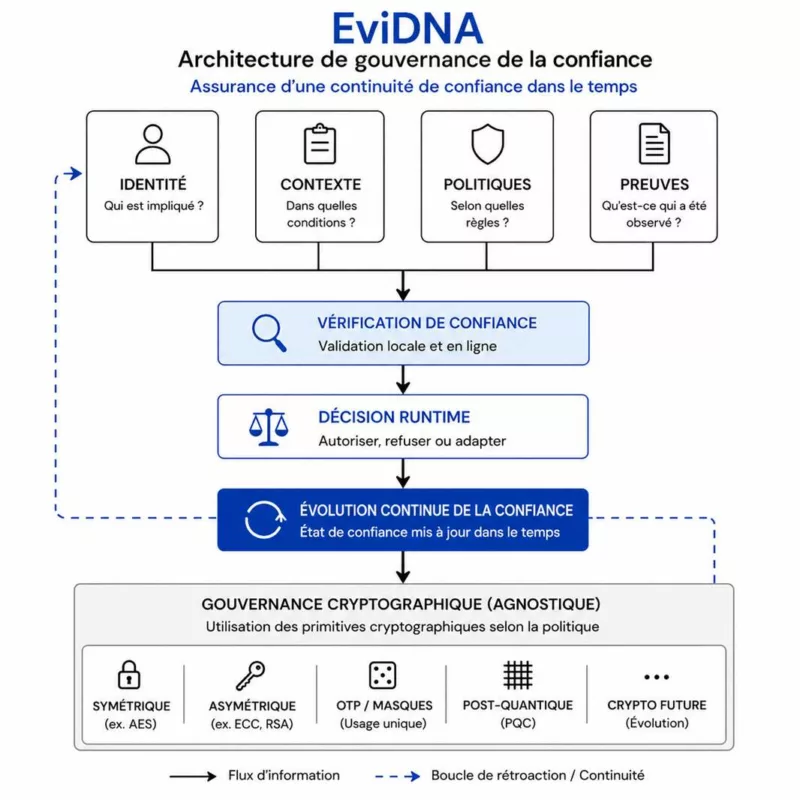
Documents associés

Freemindtronic Eurosatory 2026 | Sovereign Cyber Defense

Freemindtronic Eurosatory 2026 showcasing sovereign cybersecurity technologies developed in Andorra with AMG PRO for data protection, secure communications, authentication and digital trust continuity


Freemindtronic at Eurosatory 2026

Freemindtronic Eurosatory 2026 marks the third participation of Freemindtronic at the world’s leading defence and security exhibition, together with its French partner AMG PRO.

From 15 to 19 June 2026, visitors will discover Freemindtronic’s latest sovereign cybersecurity and counter-espionage innovations at Eurosatory 2026.

Hall 4 — Stand C286 — Cyber Pole

View Freemindtronic’s official Eurosatory 2026 exhibitor profile

Freemindtronic

Freemindtronic is a research and development company specializing in patented technologies for cybersecurity, security, traceability and dual-use counter-espionage.

The company develops sovereign technologies intended for civilian, industrial, governmental and defense environments.

20 Years of Innovation and R&D

Eurosatory 2026 is expected to be the most ambitious edition ever organized, bringing together global defence, security and resilience stakeholders across more than 185,000 m² of exhibition space.

Over two decades, this journey has resulted in:

  • 42 international patents granted
  • 24 international awards and distinctions
  • Technologies deployed in cybersecurity, cyber safety, traceability and counter-espionage

In 2026, PassCypher received the award for Best Cybersecurity Solution.

Freemindtronic Eurosatory 2026 Technologies

DataShielder

Data protection and encryption technologies.
DataShielder NFC HSM
DataShielder HSM PGP

PassCypher

Award-winning cybersecurity solutions.
PassCypher NFC HSM
PassCypher HSM PGP

EviKey NFC

Contactless trusted authentication technologies.
EviKey NFC Rugged USB Sticks

CryptPeer

Secure peer-to-peer communications.
CryptPeer web site clic here

CryptPeer Defense

Sovereign communications and trust architecture for defense environments.

[/row]

CryptPeer Defense & EviSKMS

CryptPeer Defense integrates EviSKMS, Freemindtronic’s sovereign trust technology designed to support resilient communications, secure identities and autonomous trust services.

Designed for connected, disconnected, hybrid and degraded environments, EviSKMS enables segmented-key management without dependency on centralized infrastructure.
The architecture is intended for defence, critical infrastructure, industrial resilience and autonomous operational environments.
It addresses emerging challenges related to operational resilience, digital sovereignty, secure communications and future autonomous systems.

Visitors interested in evaluating CryptPeer technologies can access a dedicated online environment and discover sovereign communication services designed for trusted operational environments.

EviSKMS combines:

  • Segmented Key Management
  • PKI Compatibility
  • HSM Compatibility
  • TPM Compatibility
  • Sovereign Trust Architecture
  • Offline Operational Capability

From Human DNA to Sovereign Digital Trust

Research initiated in 2022 around Human DNA as a trust material led to the EviDNA program and the exploration of new approaches to digital trust.

In 2024, Freemindtronic demonstrated operational cryptographic workflows using Human DNA Material as a trust foundation.

These works progressively evolved toward broader concepts of:

  • Identity
  • Lineage
  • Inheritance
  • Evolution
  • Continuity

Today these concepts contribute to the development of future sovereign trust architectures designed for resilience, autonomy and trusted digital interactions.

The next evolution of these research works will be discussed during Eurosatory 2026.
Interview Eurosatory 2026

Jacques Gascuel will be interviewed by Aude Leroy during Eurosatory 2026.

The interview will explore the evolution of Freemindtronic’s research from the EviDNA program and Human DNA-based cryptographic trust experiments presented at Eurosatory 2024 to a new generation of sovereign trust technologies that have not yet been publicly disclosed.

This new interview continues the discussion initiated with Aude Leroy at Eurosatory 2024 and highlights the evolution of concepts originally presented around digital identity, cryptographic trust and segmented-key architectures.

Moreover, some of these advances will be discussed publicly for the first time during Eurosatory 2026.
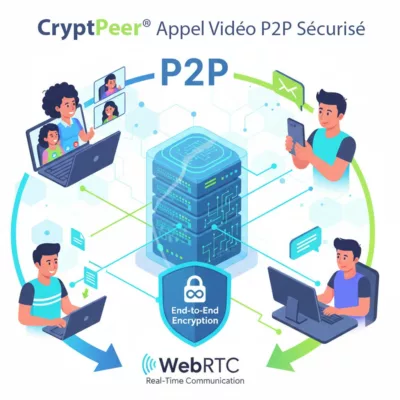
Eurosatory 2024 Interview with Aude Leroy

Watch the official Eurosatory 2024 interview conducted by defence and security journalist Aude Leroy.

During this interview, Jacques Gascuel presented DataShielder Defense, segmented-key technologies, counter-espionage innovations and the EviDNA program, including the use of Human DNA as a cryptographic trust material and the concept of Digital Human DNA.

This interview provides the historical foundation for the technologies and research developments that will be presented at Eurosatory 2026.
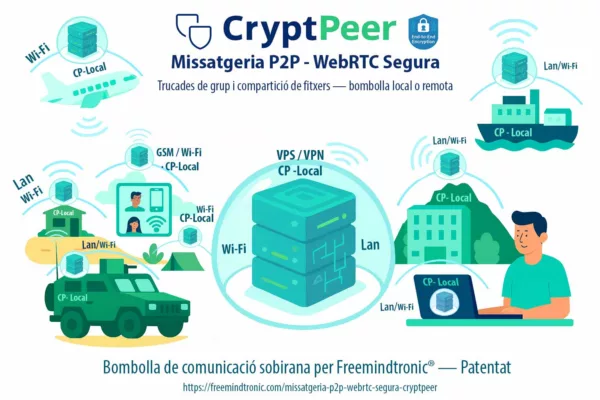
Meet Freemindtronic at Eurosatory 2026

Discover CryptPeer Defense live demonstrations and sovereign communication services at Hall 4 – Stand C286.

Hall 4 — Stand C286
AMG PRO — Cyber Pole

Official Eurosatory Exhibitor Profile
Contact CryptPeer Team
Test CryptPeer Online

WhatsApp zero-click vulnerability and runtime compromise

WhatsApp zero-click vulnerability infographic showing runtime compromise, malicious DNG images, linked-device synchronization and Zero-DOM sovereign E2EE protection

WhatsApp zero-click vulnerability — the critical flaw CVE-2025-55177, chained with Apple CVE-2025-43300, enables remote code execution through malicious DNG images abusing linked-device synchronization and automatic media processing. This attack highlights the limits of traditional E2EE once the mobile runtime itself becomes compromised. Update WhatsApp and your operating system immediately.

Executive Summary — WhatsApp Zero-Click Vulnerability, Runtime Compromise & Sovereign E2EE

The WhatsApp zero-click vulnerability (CVE-2025-55177 chained with Apple CVE-2025-43300) enables arbitrary remote code execution through a specially crafted DNG image without requiring any user interaction. By abusing linked-device synchronization and automatic media processing, attackers can remotely trigger malicious parsing operations capable of compromising the runtime itself.

This attack is strategically important because it demonstrates a growing reality in modern cybersecurity: end-to-end encryption protects communications during transport, but it does not necessarily protect already decrypted data once the runtime environment becomes compromised.

Meta confirmed active exploitation against high-risk targets. Patched versions are available:

  • WhatsApp for iOS ≥ 2.25.21.73
  • WhatsApp Business iOS ≥ 2.25.21.78
  • WhatsApp for Mac ≥ 2.25.21.78

Critical advisory — immediate action required

This vulnerability should not be viewed solely as a messaging application flaw, but as a runtime compromise threat capable of exposing already decrypted information.

High-risk users should:

  • update WhatsApp and the operating system immediately;
  • temporarily disable linked devices and automatic media downloads;
  • enable Apple Lockdown Mode or Android Advanced Protection;
  • isolate sensitive communications using sovereign Zero-DOM architectures and NFC/HSM segmented-key protection.

Reading Parameters

Executive summary reading time: 3 minutes
Full article estimated reading time: 18 minutes
Initial publication: 30 September 2025
Last update: 26 May 2026
Complexity level: Expert
Languages available: FR · EN · ES · CAT
Editorial format: Strategic cybersecurity analysis
Primary topic: WhatsApp zero-click vulnerability
Secondary topics: runtime compromise, sovereign E2EE, post-decryption security, Zero-DOM
About the author: Jacques Gascuel, inventor and founder of Freemindtronic®, architect of sovereign cybersecurity infrastructures and creator of NFC & PGP HSM technologies dedicated to Zero-DOM protection of critical secrets.

Diagram showing how WhatsApp axolotl.sqlite database exposes messages after delivery through local decryption, runtime compromise and plaintext storage risks
Diagram illustrating CVE-2025-55177 chained with Apple CVE-2025-43300 showing WhatsApp zero-click exploitation through malicious DNG media, linked-device synchronization and Apple ImageIO memory corruption

Key takeaways

The WhatsApp zero-click vulnerability reveals a much broader evolution in mobile cybersecurity. Modern attacks increasingly target the runtime environment itself rather than the encrypted transport channel alone.

Once a runtime becomes compromised, already decrypted information may become exposed through memory buffers, synchronization mechanisms, media parsers or local caches.

This fundamentally changes the security model of modern E2EE communications and validates the growing importance of:

  • Zero-DOM architectures;
  • segmented key infrastructures;
  • offline HSM protection;
  • post-decryption security models;
  • sovereign runtime trust architectures.

New warning — local runtime exposure and unencrypted chat concerns

Recent analyses suggest that some WhatsApp conversations may become locally accessible without effective encryption in specific runtime contexts associated with the Meta ecosystem.

This does not directly break transport-layer E2EE. However, it confirms a critical strategic reality, the WhatsApp zero-click vulnerability becomes dramatically more dangerous once a compromised runtime gains access to already decrypted data.

Transport encryption alone is no longer sufficient when the operating environment itself can become hostile.

2022 2026 Digital Security

EviDNA cryptographie ADN | mémoire Jacques Gascuel

EviDNA cryptographie ADN : mémoire complémentaire de référence Freemindtronic — EviDNA, ADN Digital, génome cryptographique, [...]

2026 Digital Security

EviDNA DNA Cryptography | Jacques Gascuel Memory

EviDNA DNA cryptography: Freemindtronic complementary reference memory — EviDNA, Digital DNA, cryptographic genome, cybersecurity and [...]

2022 2026 Digital Security

Predictive Artificial Intelligence Architectures: Freemindtronic EviSKMS R&D Memorandum

Predictive Artificial Intelligence Architectures: Freemindtronic reference memorandum on Artificial Intelligence, World Models, LAMP-C, Cybersecurity and [...]

2022 2026 Digital Security

Architectures intelligence artificielle prédictive : mémoire EviSKMS R&D Freemindtronic

Architectures intelligence artificielle prédictive : mémoire de référence Freemindtronic sur l’IA, les modèles du monde, [...]

2025 2026 Digital Security Technical News

Quantum computer 6100 qubits ⮞ Historic 2025 breakthrough

A 6,100-qubit neutral-atom array marks a major scaling milestone in quantum computing, raising new strategic [...]

2025 2026 Digital Security

Vulnérabilité WhatsApp zero-click — Actions, contremesures et sécurité E2EE souveraine

Vulnérabilité WhatsApp zero-click — la faille critique CVE-2025-55177, associée à Apple CVE-2025-43300, permet l’exécution de [...]

2025 2026 Digital Security

WhatsApp zero-click vulnerability and runtime compromise

WhatsApp zero-click vulnerability — the critical flaw CVE-2025-55177, chained with Apple CVE-2025-43300, enables remote code [...]

2026 Cyber Doctrine Digital Security

Whisper Leak side-channel and LLM token leakage

Whisper Leak side-channel: token-length leakage, semantic inference, and the structural limits of HTTPS in large [...]

2023 2026 Digital Security Phishing

BITB Attacks: How to Avoid Phishing by iFrame

Browser-in-the-Browser (BITB) attacks: interface forgery through redirection iframes and the structural limits of browser trust. [...]

2026 Digital Security

Zero-knowledge vulnérable : attaques par downgrade contre Bitwarden, LastPass et Dashlane

Zero-knowledge vulnérable : les attaques par downgrade contre Bitwarden, LastPass et Dashlane révèlent comment la [...]

2026 Digital Security

Zero-Knowledge Downgrade Attacks — Structural Risks

Zero-Knowledge Downgrade Attacks: downgrade paths against Bitwarden, LastPass, and Dashlane show how cryptographic backward compatibility [...]

2025 Digital Security

Clickjacking des extensions DOM : DEF CON 33 révèle 11 gestionnaires vulnérables

Clickjacking d’extensions DOM : DEF CON 33 révèle une faille critique et les contre-mesures Zero-DOM

2025 Cyberculture Digital Security

Browser Fingerprinting Tracking: Metadata Surveillance in 2026

Browser Fingerprinting Tracking today represents one of the true cores of metadata intelligence. Far beyond [...]

2026 Digital Security

Browser Fingerprinting : le renseignement par métadonnées en 2026

Le browser fingerprinting constitue aujourd’hui l’un des instruments centraux du renseignement par métadonnées appliqué aux [...]

2023 2026 Digital Security

CVE-2023-32784 : Pourquoi PassCypher protège vos secrets

PassCypher HSM protège les secrets numériques. Il protège vos secrets numériques hors du périmètre du [...]

2023 2026 Digital Security

CVE-2023-32784 Protection with PassCypher NFC HSM

CVE-2023-32784 Protection with PassCypher NFC HSM safeguards your digital secrets. It protects your secrets beyond [...]

2026 Digital Security

Cyber espionnage zero day : marché, limites et doctrine souveraine

Cyber espionnage zero day : la fin des spywares visibles marque l’entrée dans une économie [...]

2026 Digital Security

Cyberattaque HubEE : Rupture silencieuse de la confiance numérique

Cyberattaque HubEE : rupture silencieuse de la confiance numérique. Cette attaque, qui a permis l’exfiltration [...]

2025 Digital Security

Persistent OAuth Flaw: How Tycoon 2FA Hijacks Cloud Access

Persistent OAuth Flaw — Tycoon 2FA Exploited — When a single consent becomes unlimited cloud [...]

2025 Digital Security

Tycoon 2FA failles OAuth persistantes dans le cloud | PassCypher HSM PGP

Faille OAuth persistante — Tycoon 2FA exploitée — Quand une simple autorisation devient un accès [...]

2025 Digital Security

OpenAI fuite Mixpanel : métadonnées exposées, phishing et sécurité souveraine

OpenAI fuite Mixpanel rappelle que même les géants de l’IA restent vulnérables dès qu’ils confient [...]

2025 Digital Security

OpenAI Mixpanel Breach Metadata – phishing risks and sovereign security with PassCypher

AI Mixpanel breach metadata is a blunt reminder of a simple rule: the moment sensitive [...]

2026 Crypto Currency Cryptocurrency Digital Security

Ledger Security Breaches from 2017 to 2026: How to Protect Yourself from Hackers

Ledger Security Breaches have become a major indicator of vulnerabilities in the global crypto ecosystem. [...]

2026 Digital Security

Failles de sécurité Ledger : Analyse 2017-2026 & Protections

Les failles de sécurité Ledger sont au cœur des préoccupations des investisseurs depuis 2017. Cette [...]

2025 Digital Security

Bot Telegram Usersbox : l’illusion du contrôle russe

Le bot Telegram Usersbox n’était pas un simple outil d’OSINT « pratique » pour curieux [...]

2025 Digital Security

Espionnage invisible WhatsApp : quand le piratage ne laisse aucune trace

Espionnage invisible WhatsApp n’est plus une hypothèse marginale, mais une réalité technique rendue possible par [...]

2025 Digital Security

Fuite données ministère interieur : messageries compromises et ligne rouge souveraine

Fuite données ministère intérieur. L’information n’est pas arrivée par une fuite anonyme ni par un [...]

2026 Digital Security

Silent Whisper espionnage WhatsApp Signal : une illusion persistante

Silent Whisper espionnage WhatsApp Signal est présenté comme une méthode gratuite permettant d’espionner des communications [...]

2026 Awards Cyberculture Digital Security Distinction Excellence EviOTP NFC HSM Technology EviPass EviPass NFC HSM technology EviPass Technology finalists PassCypher PassCypher

Quantum-Resistant Passwordless Manager — PassCypher finalist, Intersec Awards 2026 (FIDO-free, RAM-only)

Quantum-Resistant Passwordless Manager 2026 (QRPM) — Best Cybersecurity Solution Finalist by PassCypher sets a new [...]

2025 Cyberculture Cybersecurity Digital Security EviLink

CryptPeer messagerie P2P WebRTC : appels directs chiffrés de bout en bout

La messagerie P2P WebRTC sécurisée constitue le fondement technique et souverain de la communication directe [...]

2025 CyptPeer Digital Security EviLink

Missatgeria P2P WebRTC segura — comunicació directa amb CryptPeer

Missatgeria P2P WebRTC segura al navegador és l’esquelet tècnic i sobirà de la comunicació directa [...]

2025 Digital Security

Russia Blocks WhatsApp: Max and the Sovereign Internet

Step by step, Russia blocks WhatsApp and now openly threatens to “completely block” the messaging [...]

2020 Digital Security

WhatsApp Gold arnaque mobile : typologie d’un faux APK espion

WhatsApp Gold arnaque mobile — clone frauduleux d’application mobile, ce stratagème repose sur une usurpation [...]

2025 Digital Security

Spyware ClayRat Android : faux WhatsApp espion mobile

Spyware ClayRat Android illustre la mutation du cyberespionnage : plus besoin de failles, il exploite [...]

2025 Digital Security

Android Spyware Threat Clayrat : 2025 Analysis and Exposure

Android Spyware Threat: ClayRat illustrates the new face of cyber-espionage — no exploits needed, just [...]

2023 Digital Security

WhatsApp Hacking: Prevention and Solutions

WhatsApp hacking zero-click exploit (CVE-2025-55177) chained with Apple CVE-2025-43300 enables remote code execution via crafted [...]

2025 Digital Security Technical News

Sovereign SSH Authentication with PassCypher HSM PGP — Zero Key in Clear

SSH Key PassCypher HSM PGP establishes a sovereign SSH authentication chain for zero-trust infrastructures, where [...]

2025 Digital Security Tech Fixes Security Solutions Technical News

SSH Key PassCypher HSM PGP — Sécuriser l’accès multi-OS à un VPS

SSH Key PassCypher HSM PGP fournit une chaîne souveraine : génération locale de clés SSH [...]

2025 Digital Security Technical News

Générateur de mots de passe souverain – PassCypher Secure Passgen WP

Générateur de mots de passe souverain PassCypher Secure Passgen WP pour WordPress — le premier [...]

2025 Digital Security Technical News

Ordinateur quantique 6100 qubits ⮞ La percée historique 2025

Ordinateur quantique 6100 qubits marque un tournant dans l’histoire de l’informatique, soulevant des défis sans [...]

2025 Cyberculture Digital Security

Authentification multifacteur : anatomie, OTP, risques

Authentification Multifacteur : Anatomie souveraine Explorez les fondements de l’authentification numérique à travers une typologie [...]

2025 Digital Security

Clickjacking extensions DOM: Vulnerabilitat crítica a DEF CON 33

DOM extension clickjacking — el clickjacking d’extensions basat en DOM, mitjançant iframes invisibles, manipulacions del [...]

2025 Digital Security

DOM Extension Clickjacking — Risks, DEF CON 33 & Zero-DOM fixes

DOM extension clickjacking — a technical chronicle of DEF CON 33 demonstrations, their impact, and [...]

2025 Digital Security

Chrome V8 Zero-Day CVE-2025-10585 — Ton navigateur était déjà espionné ?

Chrome V8 zero-day CVE-2025-10585 — Votre navigateur n’était pas vulnérable. Vous étiez déjà espionné !

2025 Digital Security

Confidentialité métadonnées e-mail — Risques, lois européennes et contre-mesures souveraines

La confidentialité des métadonnées e-mail est au cœur de la souveraineté numérique en Europe : [...]

2025 Digital Security

Email Metadata Privacy: EU Laws & DataShielder

Email metadata privacy sits at the core of Europe’s digital sovereignty: understand the risks, the [...]

2025 Digital Security

Chrome V8 confusió RCE — Actualitza i postura Zero-DOM

Chrome V8 confusió RCE: aquesta edició exposa l’impacte global i les mesures immediates per reduir [...]

2025 Digital Security

Chrome V8 confusion RCE — Your browser was already spying

Chrome v8 confusion RCE: This edition addresses impacts and guidance relevant to major English-speaking markets [...]

2025 Digital Security

Passkeys Faille Interception WebAuthn | DEF CON 33 & PassCypher

Conseil RSSI / CISO – Protection universelle & souveraine EviBITB (Embedded Browser‑In‑The‑Browser Protection) est une [...]

2025 Cyberculture Digital Security

Reputation Cyberattacks in Hybrid Conflicts — Anatomy of an Invisible Cyberwar

Synchronized APT leaks erode trust in tech, alliances, and legitimacy through narrative attacks timed with [...]

2025 Digital Security

APT28 spear-phishing: Outlook backdoor NotDoor and evolving European cyber threats

Russian cyberattack on Microsoft by Midnight Blizzard (APT29) highlights the strategic risks to digital sovereignty. [...]

2024 Cyberculture Digital Security

Russian Cyberattack Microsoft: An Unprecedented Threat

Russian cyberattack on Microsoft by Midnight Blizzard (APT29) highlights the strategic risks to digital sovereignty. [...]

2024 Digital Security

Midnight Blizzard Cyberattack Against Microsoft and HPE: What are the consequences?

Midnight Blizzard Cyberattack against Microsoft and HPE: A detailed analysis of the facts, the impacts [...]

2025 Digital Security

eSIM Sovereignty Failure: Certified Mobile Identity at Risk

  Runtime Threats in Certified eSIMs: Four Strategic Blind Spots While geopolitical campaigns exploit the [...]

2025 Digital Security

APT29 Exploits App Passwords to Bypass 2FA

A silent cyberweapon undermining digital trust Two-factor authentication (2FA) was supposed to be the cybersecurity [...]

2015 Digital Security

Darknet Credentials Breach 2025 – 16+ Billion Identities Stolen

Underground Market: The New Gold Rush for Stolen Identities The massive leak of over 16 [...]

2025 Digital Security

Signal Clone Breached: Critical Flaws in TeleMessage

TeleMessage: A Breach That Exposed Cloud Trust and National Security Risks TeleMessage, marketed as a [...]

2025 Digital Security

APT29 Spear-Phishing Europe: Stealthy Russian Espionage

APT29 SpearPhishing Europe: A Stealthy LongTerm Threat APT29 spearphishing Europe campaigns highlight a persistent and [...]

2025 Digital Security

APT36 SpearPhishing India: Targeted Cyberespionage | Security

Understanding Targeted Attacks of APT36 SpearPhishing India APT36 cyberespionage campaigns against India represent a focused [...]

2025 Digital Security

Microsoft Outlook Zero-Click Vulnerability: Secure Your Data Now

Microsoft Outlook Zero-Click Vulnerability: How to Protect Your Data Now A critical Zero-Click vulnerability (CVE-2025-21298) [...]

2025 Digital Security

Microsoft Vulnerabilities 2025: 159 Flaws Fixed in Record Update

Microsoft: 159 Vulnerabilities Fixed in 2025 Microsoft has released a record-breaking security update in January [...]

2025 Digital Security

APT44 QR Code Phishing: New Cyber Espionage Tactics

APT44 Sandworm: The Elite Russian Cyber Espionage Unit Unmasking Sandworm’s sophisticated cyber espionage strategies and [...]

2025 Digital Security

BadPilot Cyber Attacks: Russia’s Threat to Critical Infrastructures

BadPilot Cyber Attacks: Sandworm’s New Weaponized Subgroup Understanding the rise of BadPilot and its impact [...]

2024 Digital Security

Salt Typhoon & Flax Typhoon: Cyber Espionage Threats Targeting Government Agencies

Salt Typhoon – The Cyber Threat Targeting Government Agencies Salt Typhoon and Flax Typhoon represent [...]

2024 Digital Security

BitLocker Security: Safeguarding Against Cyberattacks

Introduction to BitLocker Security If you use a Windows computer for data storage or processing, [...]

2024 Digital Security

Cyberattack Exploits Backdoors: What You Need to Know

Cyberattack Exploits Backdoors: What You Need to Know In October 2024, a cyberattack exploited backdoors [...]

2021 Cyberculture Digital Security Phishing

Phishing Cyber victims caught between the hammer and the anvil

Phishing is a fraudulent technique that aims to deceive internet users and to steal their [...]

2024 Digital Security

Google Sheets Malware: The Voldemort Threat

Sheets Malware: A Growing Cybersecurity Concern Google Sheets, a widely used collaboration tool, has shockingly [...]

2024 Articles Digital Security News

Russian Espionage Hacking Tools Revealed

Russian Espionage Hacking Tools: Discovery and Initial Findings Russian espionage hacking tools were uncovered by [...]

2024 Digital Security Spying Technical News

Side-Channel Attacks via HDMI and AI: An Emerging Threat

Understanding the Impact and Evolution of Side-Channel Attacks in Modern Cybersecurity Side-channel attacks, also known [...]

Digital Security Spying Technical News

Are fingerprint systems really secure? How to protect your data and identity against BrutePrint

Fingerprint Biometrics: An In-Depth Exploration of Security Mechanisms and Vulnerabilities It is a widely recognized [...]

2024 Digital Security Technical News

Apple M chip vulnerability: A Breach in Data Security

Apple M chip vulnerability: uncovering a breach in data security Researchers at the Massachusetts Institute [...]

Digital Security Technical News

Brute Force Attacks: What They Are and How to Protect Yourself

Brute-force Attacks: A Comprehensive Guide to Understand and Prevent Them Brute Force: danger and protection [...]

2024 Digital Security

OpenVPN Security Vulnerabilities Pose Global Security Risks

Critical OpenVPN Vulnerabilities Pose Global Security Risks OpenVPN security vulnerabilities have come to the forefront, [...]

2024 Digital Security

Google Workspace Vulnerability Exposes User Accounts to Hackers

How Hackers Exploited the Google Workspace Vulnerability Hackers found a way to bypass the email [...]

2023 Digital Security

Predator Files: The Spyware Scandal That Shook the World

Predator Files: How a Spyware Consortium Targeted Civil Society, Politicians and Officials Cytrox: The maker [...]

2023 Digital Security

5Ghoul: 5G NR Attacks on Mobile Devices

5Ghoul: How Contactless Encryption Can Secure Your 5G Communications from Modem Attacks 5Ghoul is a [...]

2024 Digital Security

Leidos Holdings Data Breach: A Significant Threat to National Security

A Major Intrusion Unveiled In July 2024, the Leidos Holdings data breach came to light, [...]

2024 Digital Security

RockYou2024: 10 Billion Reasons to Use Free PassCypher

RockYou2024: A Cybersecurity Earthquake The RockYou2024 data leak has shaken the very foundations of global [...]

2024 Digital Security

Europol Data Breach: A Detailed Analysis

May 2024: Europol Security Breach Highlights Vulnerabilities In May 2024, Europol, the European law enforcement [...]

2024 Digital Security

Dropbox Security Breach 2024: Phishing, Exploited Vulnerabilities

Phishing Tactics: The Bait and Switch in the Aftermath of the Dropbox Security Breach The [...]

Digital Security EviToken Technology Technical News

EviCore NFC HSM Credit Cards Manager | Secure Your Standard and Contactless Credit Cards

EviCore NFC HSM Credit Cards Manager is a powerful solution designed to secure and manage [...]

2024 Digital Security

Kapeka Malware: Comprehensive Analysis of the Russian Cyber Espionage Tool

Kapeka Malware: The New Russian Intelligence Threat   In the complex world of cybersecurity, a [...]

2024 Cyberculture Digital Security News Training

Andorra National Cyberattack Simulation: A Global First in Cyber Defense

Andorra Cybersecurity Simulation: A Vanguard of Digital Defense Andorra-la-Vieille, April 15, 2024 – Andorra is [...]

Articles Digital Security EviVault Technology NFC HSM technology Technical News

EviVault NFC HSM vs Flipper Zero: The duel of an NFC HSM and a Pentester

EviVault NFC HSM vs Flipper Zero: The duel of an NFC HSM and a Pentester [...]

Articles Cryptocurrency Digital Security Technical News

Securing IEO STO ICO IDO and INO: The Challenges and Solutions

Securing IEO STO ICO IDO and INO: How to Protect Your Crypto Investments Cryptocurrencies are [...]

2023 Articles Digital Security Technical News

Remote activation of phones by the police: an analysis of its technical, legal and social aspects

What is the new bill on justice and why is it raising concerns about privacy? [...]

Articles Cyberculture Digital Security Technical News

Protect Meta Account Identity Theft with EviPass and EviOTP

Protecting Your Meta Account from Identity Theft Meta is a family of products that includes [...]

2024 Digital Security

Cybersecurity Breach at IMF: A Detailed Investigation

Cybersecurity Breach at IMF: A Detailed Investigation Cybersecurity breaches are a growing concern worldwide. The [...]

2023 Articles Cyberculture Digital Security Technical News

Strong Passwords in the Quantum Computing Era

How to create strong passwords in the era of quantum computing? Quantum computing is a [...]

2024 Digital Security

PrintListener: How to Betray Fingerprints

PrintListener: How this Technology can Betray your Fingerprints and How to Protect yourself PrintListener revolutionizes [...]

The chronicles displayed above belong to the Digital Security section. They extend the analysis of zero-click exploits, mobile spyware, runtime compromise, sovereign E2EE and post-decryption security. This selection complements the present chronicle dedicated to the WhatsApp zero-click vulnerability, CVE-2025-55177, Apple CVE-2025-43300 and the systemic risks linked to linked-device synchronization, malicious DNG media processing and compromised mobile runtimes.

Why the WhatsApp Zero-Click Vulnerability Goes Beyond Traditional E2EE

What makes this attack exceptional?

Unlike traditional phishing campaigns, victims may never see the malicious payload. A single crafted DNG image processed automatically through linked-device synchronization can silently trigger runtime compromise without any click, download confirmation or visible warning.

The WhatsApp zero-click vulnerability demonstrates a fundamental limitation of modern messaging architectures: end-to-end encryption primarily protects data during transport, but not necessarily once information has already been decrypted inside the runtime environment.

For the first time, a mainstream messaging ecosystem demonstrates at scale how transport-layer E2EE can remain technically intact while already decrypted information becomes exposed through runtime compromise.

Recent findings concerning potentially unencrypted local WhatsApp chat exposure reinforce this issue. A compromised runtime may potentially access:

  • memory buffers;
  • temporary cryptographic material;
  • local caches;
  • media processing pipelines;
  • linked-device synchronization mechanisms.
Key insight: an E2EE application running inside a compromised runtime becomes an exposure terminal for already decrypted information.

This vulnerability also illustrates a broader phenomenon: the gradual collapse of implicit trust in modern mobile runtimes.

Smartphones now integrate:

  • complex media parsers;
  • cloud synchronization layers;
  • cross-application communication;
  • persistent session management;
  • AI-assisted processing pipelines.
  • AI-assisted media classification;

As a result, protecting communications alone is no longer sufficient. Security architectures must also protect the operational environment manipulating sensitive information after decryption.

Critical distinction — software vulnerability vs structural runtime exposure

A software vulnerability and a runtime exposure problem are not the same category of risk.

For example, macOS CVE-2026-28910 involved a genuine sandbox bypass vulnerability requiring active exploitation of a software flaw.

By contrast, analyses such as the Mysk findings reveal a structural trust problem: already decrypted data may remain exposed because of runtime assumptions, local storage models and application-level permissions.

A fully patched system may therefore still expose sensitive information if runtime memory and local processing mechanisms remain accessible.

Critical Update — WhatsApp Zero-Click Vulnerability CVE-2025-55177

The vulnerability chain combines WhatsApp CVE-2025-55177 with Apple CVE-2025-43300 through malicious DNG media processing. By abusing linked-device synchronization and automatic media parsing, attackers can remotely trigger runtime compromise without any user interaction. Meta confirmed active exploitation in real-world spyware campaigns targeting high-risk profiles. The vulnerability is also listed in the CISA Known Exploited Vulnerabilities catalog, confirming its operational relevance.

Affected versions

  • WhatsApp for iOS prior to 2.25.21.73
  • WhatsApp Business for iOS prior to 2.25.21.78
  • WhatsApp for Mac prior to 2.25.21.78

Immediate defensive actions

The first priority remains immediate patching of WhatsApp and the operating system. For sensitive environments, additional measures are recommended:

  • disable linked-device synchronization temporarily;
  • disable automatic media downloads;
  • activate Apple Lockdown Mode or Android Advanced Protection;
  • rotate critical credentials from a clean environment;
  • monitor suspicious linked-device activity.

Forensics & Incident ResponseIf compromise is suspected:

  • preserve logs, timestamps, filenames and suspicious URLs;
  • capture affected network traces and DNS resolutions;
  • revoke WhatsApp Web sessions immediately;
  • rotate sensitive credentials from a clean device;
  • perform forensic acquisition before any factory reset.

Human Error Remains a Persistent Attack Vector

Social-engineering attacks requesting six-digit verification codes remain extremely effective. Trusted-contact impersonation and fake support operations continue enabling account takeover despite modern security improvements. Two-step verification reduces the risk but cannot eliminate social-engineering exposure entirely.

Modern Attack Techniques Behind WhatsApp Zero-Click Campaigns

Modern zero-click attacks no longer target messaging applications alone. They increasingly seek to compromise the mobile runtime itself in order to access already decrypted information, active sessions and memory-resident secrets. Attackers now exploit:

  • linked-device synchronization abuse;
  • trusted-group delivery and auto-download trust abuse;
  • malicious DNG image parsing;
  • automatic media processing;
  • runtime memory corruption;
  • remote arbitrary URL fetching;
  • cross-runtime spyware delivery chains.

Some campaigns also targeted Samsung image parsers through DNG files delivered via WhatsApp, demonstrating that the attack surface extends far beyond the messaging application itself. Other campaigns abuse official WhatsApp pairing mechanisms through so-called GhostPairing techniques, silently attaching remote browsers or systems to an active victim session.

Emerging account-hijacking techniques targeting trusted mobile sessions

Recent security reports describe increasingly sophisticated WhatsApp account hijacking campaigns targeting mobile users through linked-device abuse, trusted-session persistence and runtime manipulation techniques.

These reports should be distinguished from the officially documented vulnerability chain involving WhatsApp CVE-2025-55177 and Apple CVE-2025-43300, which concerns malicious DNG media processing, linked-device synchronization abuse and runtime compromise.

While distinct from officially documented zero-click CVEs, these operations reinforce a broader strategic trend:
modern messaging attacks increasingly target synchronization trust mechanisms and runtime exposure rather than transport-layer encryption itself.

Weak Signals Observed

  • Steganographic payloads embedded inside DNG/RAW media targeting mobile parsers.
  • QR-to-Web attack loops abusing trusted redirect wrappers.
  • Growing demand for zero-days targeting messaging media-processing pipelines.

Legitimate Monitoring Tools and Misuse Risks

Some parental-control and monitoring applications may also be abused for covert surveillance or privacy violations. Examples include:

  • mSpy
  • FlexiSPY
  • Spyera
  • Hoverwatch
  • KidsGuard

While some uses may be legitimate under legal supervision frameworks, these ecosystems increasingly intersect with spyware, credential theft and covert runtime surveillance practices.

Sovereign Countermeasures — CryptPeer & EviSKMS

The WhatsApp zero-click vulnerability demonstrates why traditional application-layer E2EE is no longer sufficient against modern runtime compromise attacks. Traditional E2EE messaging platforms primarily secure communications during transport. However, once the runtime, operating system or application becomes compromised, already decrypted information may remain accessible through memory, caches or synchronization services.

Why Zero-DOM Architectures Are Becoming Necessary

Zero-DOM architectures are not designed to replace traditional E2EE, but to address one of its fundamental limitations: once information has already been decrypted inside a compromised runtime, it may remain exploitable. The objective therefore shifts from protecting transport confidentiality alone toward materially limiting post-decryption exposure. CryptPeer/EviSKMS adopts a fundamentally different security model. Critical secrets never depend on a single software context. Keys are segmented, isolated and contextually validated through Zero-DOM architectures and NFC HSM infrastructures. Reconstruction only exists ephemerally in RAM without persistent exploitable storage. This architecture significantly reduces exposure to runtime compromise, memory exfiltration, linked-device abuse, post-decryption attacks and mobile spyware persistence.

Fundamental difference: WhatsApp primarily protects the communication channel. CryptPeer/EviSKMS also protects the operational environment manipulating the secret itself.

Even in the event of browser-side arbitrary code execution, zero-click compromise or encrypted blob exfiltration, attackers cannot reconstruct or operationally exploit secrets without sovereign hardware proof provided by the HSM environment.

Recent WhatsApp Vulnerabilities Related to Runtime Exposure

CVE-2025-55179

WhatsApp also patched CVE-2025-55179 affecting WhatsApp for iOS, WhatsApp Business for iOS and WhatsApp for Mac.

This vulnerability involved incomplete validation of rich response messages, potentially allowing arbitrary remote media processing through attacker-controlled URLs.

While Meta reported no active exploitation, the flaw remains strategically linked to:

  • runtime exposure;
  • automatic media processing;
  • linked-device synchronization abuse.

CVE-2025-30401 — WhatsApp for Windows

WhatsApp also patched a spoofing vulnerability affecting WhatsApp for Windows.

An inconsistency between displayed MIME type and actual file handling behavior could lead users to execute arbitrary code disguised as benign content.

Even though this was not a pure zero-click attack, it further illustrates the growing risks associated with excessive trust in runtime content-processing mechanisms.

FAQ — WhatsApp Zero-Click Vulnerability

Yes. The attack chain abuses linked-device synchronization and automatic media parsing to trigger malicious processing without user interaction.

No. E2EE mainly protects communications during transport. Once the runtime itself becomes compromised, already decrypted information may become exposed.

For high-risk profiles and sensitive environments, temporarily disabling linked devices is strongly recommended.

Post-decryption security refers to the protection of sensitive information after it has already been decrypted inside a runtime environment.

Zero-DOM is a sovereign runtime security architecture designed to isolate secrets from browser DOMs, persistent application memory and cloud telemetry surfaces.

Strategic Doctrine


“The future of cybersecurity no longer depends exclusively on encrypted transport, but on preventing secret exploitation after decryption.”

Strategic Outlook — Toward Sovereign Runtime Security

The WhatsApp zero-click vulnerability illustrates a major transformation in cybersecurity doctrine. Modern attacks no longer primarily seek to break encryption itself. They increasingly target the runtime environments capable of manipulating already decrypted information. This evolution marks the emergence of post-decryption cybersecurity. Application memory, synchronization layers, temporary buffers and runtime processing pipelines have become critical exposure surfaces. Protecting only the transport channel is no longer sufficient. Security architectures must now survive partial runtime compromise.

Toward Sovereign E2EE and Post-Decryption Cybersecurity

The future of secure communications no longer depends exclusively on transport confidentiality, but on the ability to prevent secret exploitation after decryption. CryptPeer/EviSKMS addresses this shift through:

  • segmented key infrastructures;
  • Zero-DOM isolation;
  • contextual hardware validation;
  • ephemeral RAM-only decryption;
  • distributed sovereign runtime trust.

The future of cybersecurity no longer relies solely on encrypting communications, but on preserving sovereign control over the runtime environment manipulating critical secrets.

Zero-Knowledge Downgrade Attacks — Structural Risks

Zero-Knowledge Downgrade Attacks illustration showing a cracked PBKDF2 padlock under server compromise, highlighting password manager downgrade risk and KDF parameter governance failure

Zero-Knowledge Downgrade Attacks: downgrade paths against Bitwarden, LastPass, and Dashlane show how cryptographic backward compatibility can structurally weaken a zero-knowledge architecture. When KDF parameters can be influenced server-side, zero-knowledge becomes conditionally vulnerable under an active compromise assumption. This dossier explains why encryption primitives are not “broken”, but why parameter governance, version discipline, and cryptographic sovereignty matter beyond marketing. It distinguishes a theoretically sound zero-knowledge design from a zero-knowledge implementation made vulnerable by downgrade-capable choices. It also clarifies why architectures that remove server negotiation entirely—plus Freemindtronic’s patented offline segmented-key authentication mechanism developed in Andorra—cannot, by construction, fall within the downgrade perimeter studied here.

Executive Summary

Context

Academic researchers affiliated with ETH Zurich and USI reviewed the robustness of the zero-knowledge model in several major password managers. Their objective was not to defeat cryptographic primitives, but to test how downgrade attacks can exploit legacy compatibility layers.

Primary Finding

Zero-knowledge remains cryptographically valid. However, real-world resilience depends on strict governance of parameters and on preventing a compromised server from imposing degraded negotiation paths.

Scope

The study focuses on Bitwarden, LastPass, and Dashlane. It highlights how historical PBKDF2 configurations and backward compatibility can reduce brute-force resistance under a server-compromise assumption.

Doctrinal Implication

Zero-knowledge protects against passive compromise. It does not inherently protect against active protocol manipulation if the client accepts weakened parameters.

Strategic Differentiator

Security maturity is no longer measured only by “strong encryption.” It depends on KDF parameter governance, version discipline, and eliminating downgrade-capable negotiation paths. The debate shifts from “Is it encrypted?” to “Who controls the cryptographic floor?”

Essential Point

Zero-knowledge is not broken.
It becomes structurally fragile when backward compatibility allows a compromised server to enforce weaker KDF parameters.
True resilience requires strict client-side validation, a non-negotiable minimum cryptographic floor, and elimination of downgrade negotiation.

Technical Note
Reading time (summary): ~4 minutes
Full reading time: ~29–33 minutes
Publication date: 2026-02-18
Level: Cryptography / Audit / Security Architecture
Positioning: Zero-Knowledge Governance & Downgrade Resilience
Category: Digital Security
Languages available: · FR · EN
Impact level: 9.1 / 10 — trust model & cryptographic governance

Editorial note — This dossier targets no vendor. It examines a structural tension between backward compatibility and cryptographic hardening. The research shows how downgrade paths can exist even in correctly designed zero-knowledge systems and why parameter enforcement must be non-negotiable. This aligns with Freemindtronic Andorra’s AI transparency statement — AI-2025-11-SMD5
Zero-Knowledge Downgrade Attacks diagram showing server compromise hypothesis, legacy PBKDF2 iterations, backward compatibility risk and password manager downgrade surface

2026 Tech Fixes Security Solutions

Service premier plan Android : Sécurité et contrôle utilisateur

2025 Tech Fixes Security Solutions Technical News

SSH VPS Sécurisé avec PassCypher HSM

2025 Tech Fixes Security Solutions

Secure SSH key for VPS with PassCypher HSM PGP

2024 Tech Fixes Security Solutions

Unlock Write-Protected USB Easily (Free Methods Only)

2025 Digital Security Tech Fixes Security Solutions Technical News

SSH Key PassCypher HSM PGP — Sécuriser l’accès multi-OS à un VPS

2023 EviKey & EviDisk EviKey NFC HSM NFC HSM technology Tech Fixes Security Solutions Technical News

Secure SSH Key Storage with EviKey NFC HSM

2025 Tech Fixes Security Solutions

NFC HSM SSL Cert IP: Trigger HTTPS Certificate Issuance DNS-less

2025 Tech Fixes Security Solutions

Let’s Encrypt IP SSL: Secure HTTPS Without a Domain

2025 Tech Fixes Security Solutions

Emoji and Character Equivalence: Accessible & Universal Alternatives

2024 Tech Fixes Security Solutions

How to Defending Against Keyloggers: A Complete Guide

In cybersecurity and digital architecture, this analysis belongs to the Digital Security category available in the slider above . It continues Freemindtronic’s work on cryptographic sovereignty, user control, and resilient architectures.

Why Zero-Knowledge Can Become Vulnerable

Concise definition: A zero-knowledge model becomes vulnerable when a server can influence or degrade cryptographic parameters accepted by the client. The flaw does not affect the encryption algorithm itself, but the structural possibility of a downgrade negotiation that weakens real-world strength.

A zero-knowledge system becomes vulnerable when a server can influence the cryptographic parameters used by the client.
The vulnerability is not “broken encryption.” It is downgrade negotiation allowed by architecture.

The zero-knowledge model rests on a simple principle: the server never holds the decryption key.

In the ideal version:

  • The key is derived from a master password via PBKDF2 / Argon2
  • The server stores only encrypted data
  • Decryption happens client-side

This model protects against:

  • Malicious employees
  • Passive server compromise

It does not protect against:

  • Active protocol manipulation
  • Downgrade to weaker parameters

Downgrade Attacks: Technical Mechanism

A downgrade attack forces an application to use an earlier, less robust version of a cryptographic protocol or parameter set.

In this study:

Step Description Consequence
1 Server compromise Attacker controls API responses
2 Legacy KDF parameters enforced Weakened key derivation strength
3 Optimized brute-force Credential recovery becomes cheaper

Core problem: backward compatibility preserves historically weaker cryptographic settings.

Product-Level Analysis

Summary table:

Password Manager KDF Model Downgrade Surface Corrective Measures
Bitwarden Configurable PBKDF2 Legacy parameters can be activated Higher iterations & minimum floors
LastPass PBKDF2 (legacy accounts) Old iteration counts on historical vaults Forced migration & parameter uplift
Dashlane Proprietary architecture Older-generation compatibility Progressive hardening

Important: Researchers informed vendors before publication. The identified weaknesses led to hardening measures (iteration increases, minimum floors, migration guidance). However, downgrade surface linked to backward compatibility cannot be fully removed without breaking access for certain legacy vaults. This structural constraint is about maintaining legacy access, not failing cryptography.

Scope & representativeness
The academic study covers only three password managers: Bitwarden, LastPass and Dashlane. Together they account for tens of millions of users worldwide. However, conclusions should not be generalized to all zero-knowledge implementations. The research demonstrates a structural risk under an active server compromise assumption, not a publicly confirmed mass exploitation event.

A Systemic Reading of “Vulnerable Zero-Knowledge”

This case reveals three structural tensions:

  • Innovation vs backward compatibility
  • Zero-knowledge marketing vs operational reality
  • Cloud security vs server dependency

Zero-knowledge is not “false.”
It is dependent on cryptographic governance.

As long as a server can impose parameters, it influences real-world strength. This does not mean every password manager is vulnerable. It highlights a general architectural tension in cloud-mediated zero-knowledge systems: backward compatibility vs strict enforcement of a non-negotiable cryptographic floor.

A “vulnerable zero-knowledge” system does not mean the algorithm is weak. It means the architecture still contains downgrade negotiation paths that become exploitable under specific conditions.

Threat Model for Vulnerable Zero-Knowledge

The studied scenario assumes no “magic break” in encryption. It relies on a structured assumption: active compromise of the server or partial control over API infrastructure.

In this architecture:

  • The attacker controls server responses
  • They can enforce historical KDF parameters
  • The client accepts them if they are still considered valid
  • Offline brute-force becomes economically easier

This is not a consumer opportunistic attack. It is a targeted post-compromise scenario requiring server control or active interception.

Key point: the risk appears only if the client accepts downgrade negotiation. If the client rejects weak parameters, the downgrade fails.

Threat Model Summary

Condition Required? Impact
Server compromise Yes Weakened parameters can be enforced
Client acceptance Yes Brute-force surface opens
Mass exploitation Not observed Targeted scenario

Strategic Signals of Vulnerable Zero-Knowledge

🔴 Strong Signal

  • Backward compatibility becomes a structural attack surface.
  • KDF parameter governance is now a strategic security issue.
  • “Absolute zero-knowledge” marketing must account for negotiable parameters.

🟠 Medium Signal

  • Legacy or weakly configured accounts are more exposed.
  • Migration to Argon2id becomes a priority.
  • Minimum iteration policies must be hardened.

🟢 Weak Signal

  • No public large-scale exploitation has been observed.
  • Vendors responded quickly and transparently.
  • Cryptographic primitives remain solid.

Overall reading: this is not the collapse of zero-knowledge. It is a reminder that security depends on implementation discipline.

Limits & Clarifications

It is essential to define the perimeter precisely:

  • The scenario relies on an active server compromise assumption.
  • No public mass exploitation has been documented.
  • Vendors hardened their parameter floors.
  • Risk varies with the adopted threat model.

This research reveals a structural tension—not a generalized compromise of all zero-knowledge password managers.

Practical User Impact

For end users, risk depends primarily on account configuration and the hardening level in place.

Practical recommendations

  • Check PBKDF2 iteration count or whether Argon2id is enabled.
  • Increase the minimum cryptographic floor if configurable.
  • Use a long, random master password.
  • Update legacy accounts configured with historical parameters.

A correctly configured account using modern parameters drastically reduces downgrade risk in practice.

What This Does Not Mean

  • AES is broken
  • PBKDF2 is not broken as a standardized key derivation function.
  • All zero-knowledge password managers are compromised
  • A mass exploitation wave is underway
  • Zero-knowledge is obsolete

Structural Countermeasures

In a vulnerable zero-knowledge scenario, the response is not only “stronger algorithms.” It is removing server-side negotiation surfaces.

Three mitigation layers:

1 — Software Hardening

  • Enforce minimum parameters
  • Disable legacy schemes
  • Make Argon2id mandatory where possible

2 — Client-Side Validation

  • Reject weak parameters
  • Cryptographic version locking

3 — Sovereign Architecture

  • Secrets outside the browser
  • Offline HSM
  • No server negotiation
Strategic view: the real rupture is not “better zero-knowledge.” It is eliminating server dependency.

Architectural Comparison: Cloud Zero-Knowledge vs Segmented Architecture

Criterion Cloud Zero-Knowledge PassCypher Segmented Architecture
Master key Yes (master password) No central master key
KDF derivation Negotiable across versions No server negotiation
Server dependency Yes No
Downgrade surface Possible if backward compatibility exists Non-existent
Cleartext persistence Not intended but implementation-dependent RAM-only
Single point of failure Server / identity plane None

Sovereign Alternative: Centralization Without SSO & Segmented Keys

Unlike standard cloud architectures, PassCypher HSM PGP enables voluntary centralization without an identity server, without SSO, and without a global master key.

Sovereign Zero-Knowledge Architecture diagram showing segmented key A and B assembly in RAM only, encrypted container, and no server negotiation security model
Sovereign Zero-Knowledge Architecture: segmented cryptographic keys assembled in RAM only, eliminating server negotiation and downgrade attack surfaces.

The principle relies on autonomous segmented keys combined at the user’s discretion.

Cryptographic Principle

Example:

  • Two independent 256-bit key segments
  • Stored separately (e.g., local storage + USB key)
  • Assembled dynamically via concatenation

Concatenating two 256-bit keys yields:

2²⁵⁶ × 2²⁵⁶ = 2⁵¹² possibilities
1.34 × 10¹⁵⁴ combinations

This exceeds any realistic exhaustive attack capacity.

Segment Generation & Protection

Each segment is:

  • Randomly generated by a cryptographically secure RNG
  • Independent from other segments
  • Encrypted at rest when stored

This is not “splitting a master key.”
Each segment has full entropy (256 bits each in this example). Even alone, a segment remains computationally infeasible to guess.

RAM-Only Encryption & Decryption

In the PassCypher architecture, encryption and decryption occur exclusively in volatile memory (RAM), only for the minimal time required for auto-login.

This means:

  • No clear secret is written to disk
  • No decrypted data is persisted
  • Containers stay encrypted at rest at all times
  • The full key exists only temporarily in memory

This holds across:

  • Android smartphones via NFC
  • Windows
  • macOS

Once the operation ends:

  • Memory is released
  • The concatenated key disappears
  • The container remains encrypted
Strategic point:
In cloud models, critical elements transit server layers and remote sync. In PassCypher, the secret exists in clear only in volatile memory, only for the action duration.

International Patent Protection — Segmented-Key Authentication

The segmented-key authentication architecture used by PassCypher HSM PGP is protected by an international patent.

It covers:

  • Independent randomly generated key segments
  • Separate protected storage
  • Local dynamic assembly via concatenation
  • No centralized master key
  • No server dependency or SSO

The mechanism is not identity-driven. It is possession-and-combination driven.

Key clarification:
Patent protection does not cover AES-256-CBC itself (an open standard). It covers the segmented authentication architecture and its offline operating model.

Masterless Architecture

The PassCypher model relies on:

  • No centralized master key
  • No password-derived global key
  • No server negotiation
  • No central authorization database

Without the correct set of segments:

  • The full key cannot be reconstructed
  • The container remains permanently encrypted
  • No partial exploitable secret is exposed
Architectural conclusion:
Centralization becomes a voluntary construct based on user-controlled segmented keys, protected at rest. This eliminates downgrade surfaces tied to server-side negotiation.

Doctrinal Evolution of the Zero-Knowledge Model

For a decade, the promise sounded simple: the server never holds the key.

Today the question is tougher: Can the server influence the parameters that determine real-world strength?

This shift is observable in recent technical literature: the debate no longer focuses only on whether the server can see the key, but whether it can influence the cryptographic floor via negotiable parameters.

In parallel, the industry hardens toward memory-hard Argon2id and stronger client-side enforcement. Effective resilience increasingly depends on a non-negotiable cryptographic floor.

This evolution shifts the center of gravity:

  • From encryption to parameter governance
  • From marketing to implementation discipline
  • From promise to enforceable invariance

A zero-knowledge model becomes truly sovereign when:

  • Minimum parameters are non-negotiable
  • Backward compatibility permits no degradation
  • Architecture prevents any external influence on derivation

Strategic Perspective: Beyond “Vulnerable Zero-Knowledge”

Zero-knowledge is not an absolute guarantee. It is a conditional trust model.

A “vulnerable zero-knowledge” finding is not a cryptographic failure. It is a consequence of architectural choices and compatibility constraints.

As long as a server can influence cryptographic parameters, resilience depends on implementation discipline.

Cryptographic sovereignty begins when:

  • Downgrade negotiation becomes impossible.
  • The cryptographic floor is non-negotiable.
  • The secret never exists outside user control.

The debate is not “encrypted vs not encrypted.”
It is “negotiable governance vs sovereign architecture.”

Key Takeaways

  • A vulnerable zero-knowledge outcome is not broken encryption—it is backward compatibility debt.
  • The risk appears only under an active server compromise assumption.
  • KDF governance becomes a strategic security issue.
  • Removing downgrade negotiation improves resilience.
  • A no-server-dependency architecture eliminates downgrade surfaces by design.

Glossary

Zero-knowledge

Core definition

A security model where the provider never holds the decryption keys. Cryptographic operations occur client-side.

Vulnerable zero-knowledge

Architectural qualification

A situation where zero-knowledge remains mathematically sound but becomes structurally exposed due to backward compatibility or downgrade-capable parameter negotiation.

Downgrade attack

Attack mechanism

Forcing the use of older, weaker protocol versions or parameters to reduce brute-force resistance or enable cheaper offline attacks.

KDF (Key Derivation Function)

Derivation function

An algorithm that converts a password into a cryptographic key using tunable parameters (iterations, memory, parallelism). Security depends directly on those parameters.

PBKDF2

Legacy standard

A standardized key derivation function based on repeated iterations. Its security depends heavily on iteration count.

Argon2id

Modern standard

A memory-hard key derivation function designed to resist GPU/ASIC attacks through controlled memory cost.

Cryptographic backward compatibility

Version constraint

Maintaining support for older parameters or configurations to preserve access for legacy accounts—sometimes creating downgrade surfaces.

Downgrade negotiation

Degradation path

A client accepting parameters below a modern minimum floor, potentially opening an attack surface.

Active server compromise

Threat scenario

An attacker manipulates server responses to influence client cryptographic behavior.

Sovereign architecture

Independence principle

Secrets, keys, and parameters remain fully user-controlled, with no negotiable server dependency.

Segmented keys

Authentication mechanism

Independent random key segments assembled locally in memory to avoid a centralized master key.

FAQ — Vulnerable Zero-Knowledge

Is zero-knowledge broken by a downgrade attack?

No — zero-knowledge isn’t “broken”.

Encryption primitives remain intact. The risk appears when backward compatibility lets a compromised server enforce historically weaker KDF parameters that the client still accepts.

What is a downgrade attack in a password manager?

How it works

It forces older cryptographic parameters to reduce brute-force cost. It requires active server compromise or manipulation of API responses.

Are all zero-knowledge password managers affected?

No — scope matters.

This analysis covers specific implementations. Risk depends on architecture, parameter enforcement, and threat model.

Why does backward compatibility become an attack surface?

The hidden cost of continuity

Supporting legacy vaults can preserve weaker parameters. If they remain activatable, they form downgrade surfaces under active compromise.

What is “parameter governance” in practical terms?

Governance means enforceability.

Who sets minimum floors? Who can lower them? Is the client allowed to reject? Governance turns math into operational security.

Does this mean PBKDF2 is insecure?

Not as a standardized key derivation function.

PBKDF2 security is parameter-dependent. Weak iteration counts and downgrade paths create risk, not PBKDF2 itself.

Why does Argon2id reduce downgrade risk?

Memory-hard cost matters.

Argon2id forces attackers to pay memory cost. But it still needs strict minimum settings and client enforcement to stop downgrades.

What should users check first?

Fast checks

Verify KDF type and settings (PBKDF2 iterations, Argon2id configuration). Update legacy accounts and use a strong master password.

Is this a mass exploitation event?

No public mass exploitation is documented.

This is a post-compromise threat model and typically targeted rather than opportunistic.

How can vendors eliminate downgrade surfaces?

Make floors non-negotiable.

Enforce strict minimum parameters client-side, disable legacy schemes, and prevent server-controlled negotiation.

Why do no-negotiation architectures fall outside this perimeter?

Design removes the attack class.

If keys are assembled locally and no server can influence parameters, downgrade negotiation cannot occur.

What does “cryptographic sovereignty” mean here?

Sovereignty is control over the floor.

It means the user controls secrets and parameters, and architecture prevents external degradation.

Zero-knowledge governance 2026: cryptographic floors

Zero-knowledge gouvernance 2026 illustration académique sur l’émergence cryptographique et la souveraineté des paramètres cryptographiques

Zero-knowledge gouvernance 2026 : l’expression ne décrit plus seulement une confidentialité “sans clé côté fournisseur”. Désormais, elle engage une gouvernance cryptographique complète : plancher cryptographique non négociable, résistance au downgrade, négociation des paramètres KDF (PBKDF2, Argon2), entropie matérielle (hardware-rooted entropy) fondée sur une évaluation shannonienne de l’incertitude, et agilité cryptographique dans un monde post-quantique. Par conséquent, cette chronique clarifie la polysémie du terme et propose un cadre doctrinal, fondé sur des standards publics, sans posture polémique.


Résumé exécutif — Zero-knowledge gouvernance 2026

Constat

Le terme zero-knowledge s’est dilué. D’un côté, il renvoie aux Zero-Knowledge Proofs (ZKP) issus de la cryptographie académique. De l’autre, il désigne un modèle de chiffrement côté client où le fournisseur ne détient pas la clé. Cependant, ces deux acceptions restent conceptuellement distinctes.

Thèse doctrinale

En 2026, la question déterminante n’est plus seulement « le fournisseur voit-il la clé ? ». Désormais, on doit demander : « qui contrôle les paramètres cryptographiques et les chemins de négociation descendante ? » Ainsi, la discussion bascule vers la souveraineté des paramètres cryptographiques.

Ce que cette chronique apporte

Elle clarifie la différence entre ZKP et zero-knowledge encryption model. Ensuite, elle explicite pourquoi la gouvernance des paramètres KDF (itérations, mémoire, sel) définit un plancher cryptographique. Enfin, elle introduit deux pivots souvent absents : l’entropie matérielle et la gouvernance du cycle de vie des clés.

Angle moderne

La négociation descendante (downgrade) devient un angle doctrinal central : même si la clé reste côté client, un protocole tolérant des paramètres affaiblis peut réduire la robustesse effective sous certaines hypothèses de menace.

Point essentiel

Le zero-knowledge ne devient pas plus “vrai” parce qu’un éditeur l’affirme. En revanche, il devient plus robuste lorsque l’architecture impose un plancher cryptographique non négociable, documente les paramètres, verrouille les chemins de downgrade et explicite l’origine de l’entropie. Autrement dit, la maturité ne se mesure plus au slogan, mais à la gouvernance.

Note technique

Temps de lecture (express) : ~1 minutes
Temps de lecture (avancé) : ~2 minutes
Temps de lecture complet : ~50 minutes
Date de publication : 2026-02-21
Niveau : Cryptographie / Gouvernance / Architecture
Posture : Clarification doctrinale & gouvernance cryptographique
Catégorie : Digital Security
Langues disponibles : FR · EN (à venir)
Niveau d’impact : élevé (invariance paramétrique & modèle de confiance)

Note éditoriale —
Cette chronique n’évalue aucun fournisseur en particulier. Elle propose un cadre conceptuel pour qualifier l’usage du terme zero-knowledge à l’ère de la gouvernance cryptographique et l’émergence cryptographique. Cela s’inscrit dans la continuité de la déclaration de transparence de l’IA de de Freemindtronic (Andorre) — AI-2025-11-SMD5

Cartographie conceptuelle : le terme zero-knowledge recouvre en 2026 trois réalités distinctes — propriété de preuve (ZKP), modèle de chiffrement côté client, et régime de gouvernance cryptographique. L’illustration suivante synthétise cette évolution doctrinale.

Schéma principe d’émergence cryptographique : clé non persistante issue de segments autonomes en architecture zero-knowledge
Représentation simplifiée du principe d’émergence cryptographique : la clé effective émerge localement de segments autonomes et disparaît après usage.

2022 2026 Digital Security

EviDNA cryptographie ADN | mémoire Jacques Gascuel

2026 Digital Security

EviDNA DNA Cryptography | Jacques Gascuel Memory

2025 2026 Digital Security Technical News

Quantum computer 6100 qubits ⮞ Historic 2025 breakthrough

2024 2025 2026 Cyber Doctrine Cyberculture

Quantum Threats to Encryption: RSA, AES & ECC Defense

2025 2026 Digital Security

WhatsApp zero-click vulnerability and runtime compromise

2026 Cyber Doctrine Digital Security

Whisper Leak side-channel and LLM token leakage

2023 2026 Digital Security Phishing

BITB Attacks: How to Avoid Phishing by iFrame

2025 Cyber Doctrine Cyberculture

Souveraineté individuelle numérique : fondements et tensions globales

Cette chronique doctrinale appartient à la catégorie Digital Security. Elle prolonge le travail de clarification conceptuelle sur la souveraineté des paramètres cryptographiques et la robustesse des architectures zero-knowledge.

Résumé avancé — De la promesse “sans clé” à la gouvernance cryptographique

⮞ Reading Note

Ce résumé avancé prend ~6 minutes. Il relie la sémantique du zero-knowledge aux standards publics, puis introduit la gouvernance des paramètres et les limites irréversibles.

D’abord, la cryptographie académique définit le zero-knowledge comme une propriété formelle de preuve. Ensuite, l’industrie a transposé le terme à des architectures de chiffrement côté client. Pourtant, cette transposition a créé une polysémie : on parle du même mot pour des objets conceptuels différents. Or, dès que la confiance repose sur une expression ambiguë, le débat se fragmente.

Ainsi, on doit qualifier le terme. Lorsque l’on parle de ZKP, on traite de vérification sans divulgation. En revanche, lorsque l’on parle de zero-knowledge encryption model, on traite de confidentialité des données, de possession de clé et de modèle de menace. Cependant, même dans ce second cas, la possession de clé ne suffit plus.

En 2026, la robustesse dépend fortement de la gouvernance des paramètres cryptographiques : choix du KDF, itérations, mémoire, parallélisme, sel, rétrocompatibilité. Par conséquent, une architecture peut rester “zero-knowledge” au sens de la clé, tout en devenant fragile au sens du plancher cryptographique si elle tolère des paramètres affaiblis ou des chemins de downgrade.

⮞ Summary
Le débat se déplace : au lieu de demander si un fournisseur “voit la clé”, on doit vérifier s’il contrôle — ou influence — les paramètres et les rétrocompatibilités qui définissent la résistance réelle.

Chronique — Zero-knowledge en 2026 : ce que le terme signifie réellement

Constat : dilution du terme et polysémie

Le terme zero-knowledge s’est diffusé parce qu’il résume une promesse intuitive : “le service ne peut pas lire”. Toutefois, cette promesse se décline en plusieurs mécanismes. D’une part, elle renvoie à des preuves cryptographiques formelles. D’autre part, elle renvoie à des systèmes de stockage chiffré. En conséquence, le débat mélange parfois preuve, chiffrement et gouvernance.

Pour éviter les affirmations absolues, on doit donc préciser l’objet : parle-t-on d’une preuve, d’un modèle de chiffrement, ou d’un régime de gouvernance des paramètres ? Cette chronique propose un cadre d’analyse, sans prétendre imposer une norme.

Mutation doctrinale : de propriété cryptographique à régime de gouvernance

Pendant plusieurs décennies, le zero-knowledge a désigné une propriété : une preuve sans divulgation. Ensuite, l’industrie a transposé le terme vers une architecture : le chiffrement côté client avec non-possession de clé.

Cependant, en 2026, une troisième étape apparaît. Le zero-knowledge devient un régime de gouvernance cryptographique.

Autrement dit, il ne décrit plus uniquement :

  • Une propriété mathématique (ZKP),
  • Ni un modèle technique (clé côté client),

Il décrit désormais :

  • Un système de décision sur les paramètres,
  • Un contrôle des planchers cryptographiques,
  • Une gestion explicite des rétrocompatibilités,
  • Une invariance paramétrique documentée.

Ainsi, le débat contemporain ne porte plus seulement sur la visibilité des secrets, mais sur l’autorité exercée sur les paramètres qui conditionnent leur robustesse.

Thèse centrale reformulée :
En 2026, le zero-knowledge n’est plus seulement une propriété d’accès aux clés. Il devient un régime de gouvernance des paramètres cryptographiques et de leurs invariants.

Définition historique : origine académique du zero-knowledge (ZKP)

Les Zero-Knowledge Proofs (ZKP) décrivent une propriété où un vérificateur apprend uniquement la validité d’une assertion, sans obtenir d’information sur le secret. Goldwasser, Micali et Rackoff ont formalisé ce cadre et l’ont publié dans le Journal of the ACM. Ainsi, le “zero-knowledge” historique concerne un régime de preuve.

Référence académique : The Knowledge Complexity of Interactive Proof Systems (JACM).

Afin de clarifier la distinction entre la définition académique du Zero-Knowledge Proof (ZKP) et le modèle industriel de chiffrement zero-knowledge, le schéma suivant illustre le principe fondamental de vérification sans révélation du secret.

Schéma explicatif Zero-Knowledge Proof (ZKP) : vérification sans révélation du secret entre prouveur et vérificateur en cryptographie
Illustration pédagogique du fonctionnement d’un Zero-Knowledge Proof (ZKP) : le prouveur démontre qu’il connaît un secret sans jamais le divulguer au vérificateur.

Définition opérationnelle : modèle zero-knowledge de chiffrement côté client

Dans son sens opérationnel, le zero-knowledge signifie généralement que le fournisseur ne détient pas la clé de déchiffrement. Par conséquent, le déchiffrement s’effectue côté client. Toutefois, cette définition suppose un modèle de menace souvent passif : le serveur stocke du chiffré, mais ne manipule pas activement les paramètres.

Or, en pratique, la dérivation de clé dépend de standards paramétrables. Ainsi, PBKDF2 et Argon2 définissent des réglages qui modifient directement la résistance au brute force. Références officielles :

Limites contemporaines : négociation KDF, rétrocompatibilité, downgrade

Lorsque l’architecture laisse le protocole négocier des paramètres (itérations, mémoire, modes hérités), elle crée un espace de gouvernance. Ainsi, un système peut préserver la non-possession de clé tout en tolérant des paramètres affaiblis pour des raisons de compatibilité. Par conséquent, on doit distinguer “confidentialité nominale” et “robustesse effective”.

Autrement dit, la question moderne devient : le client accepte-t-il une négociation descendante ? Si oui, alors le plancher cryptographique devient négociable. Or, une fois que des paramètres faibles ont servi à dériver une clé, la correction exige généralement re-dérivation et re-chiffrement : on ne “répare” pas rétroactivement la robustesse.

La résistance au downgrade cryptographique constitue aujourd’hui un critère déterminant de maturité zero-knowledge. Le schéma ci-dessous synthétise les trois piliers d’un plancher cryptographique non négociable : verrouillage, renforcement paramétrique et auditabilité.

Schéma résistance au downgrade cryptographique : verrouillage des paramètres KDF et plancher cryptographique non négociable
Schéma simplifié illustrant la résistance à la négociation descendante (downgrade) grâce au verrouillage des paramètres cryptographiques et à l’auditabilité.

Modèle de menace explicite du zero-knowledge en 2026

Toute qualification du zero-knowledge suppose un modèle de menace clairement défini. En l’absence de cette explicitation, le terme risque de devenir purement déclaratif.

En 2026, plusieurs hypothèses d’attaque doivent être distinguées :

1 — Attaquant passif côté serveur

Le fournisseur stocke des données chiffrées sans chercher à influencer les paramètres. Dans ce modèle classique, la non-possession de clé constitue la condition principale.

2 — Attaquant actif négociateur

Le serveur ou un intermédiaire peut influencer la négociation des paramètres (KDF, algorithmes, rétrocompatibilités). Ici, la robustesse dépend de l’invariance paramétrique et de la résistance au downgrade.

3 — Attaquant matériel ou local

L’attaquant cible la mémoire volatile, les dispositifs physiques ou les segments autonomes. Dans ce cas, la volatilité stricte et l’autonomie entropique deviennent déterminantes.

4 — Attaquant à capacité étendue (post-quantique)

L’hypothèse d’un adversaire disposant de capacités computationnelles avancées impose une réflexion sur l’agilité cryptographique et la migration ascendante.

Clarification doctrinale : Le zero-knowledge ne constitue pas une propriété absolue. Il est toujours qualifié relativement à un modèle de menace explicite.

Ainsi, la gouvernance cryptographique consiste à aligner les paramètres, l’entropie et les mécanismes d’invariance sur les hypothèses d’attaque retenues.

ISO/IEC 11770 : gouvernance du cycle de vie des clés

Ensuite, la doctrine de sécurité doit intégrer la gestion du cycle de vie des clés : génération, distribution, stockage, révocation. ISO/IEC 11770 formalise ces mécanismes. Ainsi, la sécurité ne se limite pas à l’algorithme : elle dépend aussi des processus et des responsabilités.

Référence officielle : ISO/IEC 11770 — Key Management.

Responsabilité et imputabilité cryptographique

À mesure que le zero-knowledge devient une question de gouvernance, une interrogation supplémentaire apparaît : qui assume la responsabilité du plancher cryptographique ?

Les standards définissent des mécanismes. Cependant, ils ne désignent pas toujours clairement l’autorité décisionnelle sur les paramètres.

Or, dans une architecture zero-knowledge contemporaine :

  • Quel acteur fixe le nombre minimal d’itérations ?
  • Qui décide de supprimer un mode hérité ?
  • Qui documente publiquement le plancher ?
  • Qui engage sa responsabilité en cas de paramètre insuffisant ?

Ainsi, la gouvernance cryptographique devient une question d’imputabilité.

En effet, un plancher non documenté rend la responsabilité diffuse. À l’inverse, un plancher explicitement publié crée un engagement technique et éditorial.

Point doctrinal : La maturité zero-knowledge implique une responsabilité explicite sur les paramètres, et non seulement une déclaration de non-possession de clé.

Vérifiabilité du plancher cryptographique

Déclarer un plancher cryptographique ne suffit pas. Encore faut-il qu’il soit vérifiable.

La robustesse doctrinale du zero-knowledge dépend de la capacité d’un utilisateur, d’un auditeur ou d’un expert indépendant à constater :

  • Les paramètres KDF effectivement utilisés (itérations, mémoire, parallélisme).
  • L’absence de modes hérités activables.
  • L’impossibilité technique d’un downgrade silencieux.
  • La conformité aux standards publics annoncés.

Auditabilité

La vérifiabilité peut reposer sur :

  • Une documentation publique des paramètres.
  • Des audits indépendants.
  • Une inspection du code lorsque cela est possible.
  • Des mécanismes d’attestation ou de preuve de configuration.

Limite doctrinale

Un plancher non documenté ou non vérifiable reste une déclaration unilatérale.

Principe :
En 2026, un zero-knowledge mature ne se contente pas d’affirmer la non-possession de clé. Il rend son plancher paramétrique observable et contrôlable.

La vérifiabilité devient ainsi un prolongement naturel de la gouvernance cryptographique.

Agilité cryptographique : perspective ENISA

Par ailleurs, la transition post-quantique réactive la notion d’agilité cryptographique. ENISA souligne l’intérêt d’architectures capables d’évoluer sans rupture systémique. Cependant, l’agilité ne justifie pas la permissivité au downgrade : elle organise la migration ascendante, pas la dégradation.

Référence ENISA : Post-Quantum Cryptography: current state and quantum mitigation.

Dimension quantique et gouvernance cryptographique

L’émergence des capacités de calcul quantique ne remet pas en cause l’ensemble de la cryptographie contemporaine. Elle affecte principalement certaines primitives asymétriques (RSA, ECC, Diffie–Hellman) via l’algorithme de Shor, ainsi que la recherche exhaustive via l’algorithme de Grover.

Impact différencié

Il convient de distinguer :

  • Cryptographie asymétrique classique : vulnérable à long terme (Shor).
  • Cryptographie symétrique bien dimensionnée : résistance réduite quadratiquement (Grover), mais conservant une sécurité exponentielle si les tailles de clés sont adaptées (ex. 256 bits).
  • Fonctions mémoire-hard (Argon2) : dépendance au coût matériel et énergétique, moins favorable aux accélérations quantiques massives.

Ainsi, le risque quantique impose une gouvernance adaptative des paramètres, mais ne rend pas obsolètes les architectures symétriques correctement dimensionnées.

Harvest now, decrypt later

Le risque stratégique majeur réside dans la capture actuelle de données chiffrées destinées à être déchiffrées ultérieurement lorsque les capacités quantiques seront suffisantes.

Dans ce contexte :

  • Les architectures à secret persistant sont structurellement exposées.
  • Les architectures à clé émergente strictement volatile réduisent la surface de captation différée.

Une clé qui n’existe qu’au moment de l’usage, puis disparaît, limite mécaniquement l’intérêt d’une captation longue durée.

Conséquence doctrinale

En 2026, la maturité zero-knowledge implique :

  • Une capacité de migration ascendante vers des primitives post-quantiques si nécessaire.
  • Une augmentation anticipée des tailles de clés symétriques.
  • Un refus des mécanismes asymétriques vulnérables à long terme.
  • Une réduction structurelle des secrets persistants.

Le quantique ne redéfinit pas le zero-knowledge ; il renforce l’exigence de gouvernance paramétrique et de limitation ontologique des secrets durables.

Approfondissements techniques

Pour une analyse détaillée des vulnérabilités asymétriques face aux capacités quantiques émergentes : Quantum threats to encryption

Pour une étude spécifique de la robustesse d’AES-256, de la segmentation de clé et de la résilience face à Grover : AES-256 CBC quantum security & key segmentation

Analyse des implications du quantique sur RSA et les mécanismes asymétriques classiques : Quantum computing and RSA encryption

Pour un aperçu des avancées récentes en calcul quantique et de leur portée réelle en matière cryptographique : Quantum computer 6100 qubits – Historic 2025 breakthrough.

Entropie informationnelle et entropie matérielle — Fondement shannonien

La robustesse d’un système zero-knowledge ne dépend pas uniquement d’un algorithme, ni même d’un nombre d’itérations KDF. Elle dépend en amont d’un paramètre plus fondamental : l’entropie.

Pour une application concrète de cette limite entropique dans le contexte de l’ère quantique et des mots de passe à haute imprévisibilité, voir : How to create and protect strong passwords in the age of quantum computing.

Claude Shannon a défini l’entropie informationnelle comme mesure mathématique de l’incertitude d’une source. En cryptographie, cette incertitude conditionne directement la résistance aux attaques exhaustives. Autrement dit, un secret à faible entropie reste structurellement vulnérable, quel que soit l’algorithme employé.

Ainsi, dans une architecture zero-knowledge, l’entropie initiale devient une frontière irréversible. Si la génération de clé repose sur une source faiblement entropique, aucune augmentation ultérieure du nombre d’itérations, ni aucun ajustement paramétrique, ne peut restaurer l’imprévisibilité perdue.

Cette réalité rejoint les exigences des standards contemporains, notamment la série NIST SP 800-90 relative aux générateurs de bits aléatoires. Cependant, au-delà des implémentations techniques, le principe reste shannonien : la sécurité ne peut dépasser l’entropie de sa source.

Principe doctrinal :
Le plancher cryptographique réel d’un système zero-knowledge est borné par l’entropie effective à la génération des clés. Si cette entropie est insuffisante, la limite devient structurelle et irréversible.

Par conséquent, lorsqu’on analyse la gouvernance cryptographique zero-knowledge, il ne suffit pas de vérifier la non-possession de clé ou la résistance au downgrade. Il faut également examiner la qualité informationnelle de la source d’entropie.

Pourquoi un cadre shannonien plutôt qu’une simple “méthode d’entropie” ?

Lorsqu’une architecture affirme générer de l’entropie, elle peut se référer à des méthodes techniques concrètes : générateur pseudo-aléatoire, TRNG matériel, bruit thermique, oscillations physiques, etc. Toutefois, ces mécanismes décrivent une implémentation. Ils ne définissent pas, en eux-mêmes, un cadre théorique de mesure.

Claude Shannon, dans sa théorie mathématique de l’information (1948), a introduit une mesure formelle de l’incertitude : l’entropie informationnelle. Cette mesure ne dépend pas d’un dispositif particulier ; elle modélise le degré d’imprévisibilité d’une source.

En se référant à Shannon, une architecture ne revendique pas un procédé spécifique de génération d’aléa. Elle adopte un cadre d’évaluation : la sécurité effective ne peut excéder l’entropie mesurable du secret initial.

Ainsi, le choix d’un cadre shannonien ne remplace pas les standards techniques (NIST SP 800-90, ISO/IEC 11770, RFC 9106). Il les précède conceptuellement. Il rappelle que :

  • Un secret de faible entropie reste vulnérable, même avec un algorithme robuste.
  • Un nombre élevé d’itérations KDF n’augmente pas l’espace de clés si l’entropie initiale est bornée.
  • La résistance exponentielle dépend directement du nombre effectif de bits d’incertitude.

Autrement dit, la référence à Shannon n’est pas un argument marketing. C’est un rappel mathématique : la sécurité cryptographique est plafonnée par l’entropie informationnelle du secret généré.

Dans cette perspective, la gouvernance cryptographique zero-knowledge doit examiner non seulement les algorithmes, mais aussi la qualité mesurable de la source d’incertitude. C’est pourquoi un cadre shannonien offre une base conceptuelle plus fondamentale qu’une simple description de méthode.

Entropie informationnelle : Shannon face aux méthodes de génération

Lorsqu’une architecture cryptographique affirme « générer de l’entropie », elle peut en réalité désigner des mécanismes très différents. Avant de comparer les approches, il convient de rappeler la base théorique.

1 — Le cadre fondamental : l’entropie selon Shannon (1948)

Claude Shannon a défini l’entropie informationnelle comme mesure mathématique de l’incertitude d’une variable aléatoire. Elle s’exprime par la formule :

H(X) = − Σ p(x) log₂ p(x)

Cette équation mesure le nombre moyen de bits d’incertitude d’une source. En cryptographie, cela signifie que la résistance théorique d’un secret dépend directement du nombre effectif de bits d’imprévisibilité.

Ainsi, si un secret possède 128 bits d’entropie réelle, sa résistance maximale correspond à un espace de 2¹²⁸ possibilités. En revanche, si l’entropie effective n’est que de 40 bits, l’espace réel n’est plus que de 2⁴⁰, indépendamment de l’algorithme utilisé.

Principe shannonien : La sécurité d’un système ne peut excéder l’entropie informationnelle du secret initial.

2 — Méthodes courantes de génération d’entropie

En pratique, plusieurs mécanismes techniques sont utilisés pour produire de l’aléa :

  • PRNG (Pseudo-Random Number Generator) : générateurs déterministes initialisés par une graine.
  • DRBG conformes NIST SP 800-90A : générateurs déterministes sécurisés.
  • TRNG (True Random Number Generator) : bruit thermique, oscillations électroniques, jitter.
  • HRNG (Hardware Random Number Generator) : circuits dédiés intégrés aux processeurs.
  • Sources environnementales : mouvements de souris, timings clavier, événements système.

Ces méthodes décrivent comment l’aléa est produit. Toutefois, elles ne répondent pas directement à la question fondamentale : quelle est l’entropie mesurable réellement obtenue ?

3 — Limites structurelles des approches purement techniques

Un PRNG, par définition, ne crée pas d’entropie ; il l’étend à partir d’une graine initiale. Si cette graine est faible, toute la séquence devient prédictible.

Un TRNG matériel peut produire un bruit physique robuste, mais il nécessite une validation statistique continue pour éviter les biais.

Les sources environnementales offrent souvent une entropie limitée et difficilement quantifiable.

Autrement dit, ces méthodes décrivent des mécanismes physiques ou logiciels. Elles ne constituent pas, en elles-mêmes, un cadre théorique de mesure de la sécurité.

4 — Pourquoi un cadre shannonien est plus pertinent doctrinalement

Se référer à Shannon ne signifie pas ignorer les méthodes techniques. Au contraire, cela impose une exigence supplémentaire : mesurer et borner l’entropie effective.

Le cadre shannonien permet :

  • De quantifier l’incertitude réelle d’un secret.
  • D’évaluer l’espace de recherche effectif d’un attaquant.
  • D’identifier une limite théorique indépendante des implémentations.
  • D’éviter la confusion entre « complexité algorithmique » et « imprévisibilité réelle ».

Ainsi, alors qu’une méthode technique décrit un processus, le cadre shannonien définit une borne mathématique. Il précède l’implémentation et structure son évaluation.

En conséquence, dans une analyse de gouvernance cryptographique zero-knowledge, la question pertinente devient :

Combien de bits d’entropie informationnelle mesurable possède réellement le secret généré ?

Cette question dépasse la simple description d’un générateur. Elle engage la sécurité exponentielle du système.

Application pratique d’un cadre shannonien — Freemindtronic

Dans le cadre de ses architectures de sécurité, Freemindtronic a fait le choix méthodologique d’utiliser un référentiel shannonien pour évaluer l’entropie lors de la génération de clés, de mots de passe et de segments cryptographiques.

Ce choix ne concerne pas l’algorithme de chiffrement lui-même — lequel repose sur des standards ouverts — mais la manière dont l’incertitude initiale est mesurée et contrôlée au moment de la génération du secret.

Concrètement, l’objectif est d’estimer le nombre effectif de bits d’entropie informationnelle produits au moment de la création. Cette évaluation s’inscrit dans une logique mathématique : la sécurité maximale atteignable ne peut excéder l’entropie mesurable du secret généré.

Ainsi, plutôt que de se limiter à la description d’un générateur pseudo-aléatoire ou matériel, l’architecture adopte une approche fondée sur la quantification de l’incertitude selon la théorie de l’information.

Ce positionnement s’inscrit dans une continuité académique. Il ne constitue pas une rupture avec les standards techniques (NIST SP 800-90, ISO/IEC 11770, RFC 9106), mais une couche conceptuelle supplémentaire visant à encadrer la génération des secrets.

Position méthodologique : L’entropie est évaluée comme une grandeur informationnelle mesurable, et non uniquement comme un processus technique de génération.

En conséquence, ce choix doctrinal vise à assurer une cohérence entre génération de secret, borne mathématique de sécurité et gouvernance cryptographique globale.

Zero-knowledge émergent non médié

Le système décrit dans le brevet WO2018154258A1 repose sur une segmentation de clé distribuée sur plusieurs dispositifs physiques NFC, avec reconstruction locale et stockage exclusivement volatile.

Contrairement à un schéma classique de partage de secret, aucun secret maître persistant n’est découpé. Chaque segment constitue une entité cryptographique autonome.

La clé effective n’existe pas en permanence. Elle émerge temporairement d’une composition locale volontaire, puis disparaît après usage.

Schéma synthétique : dans une architecture à clé segmentée, la clé opérationnelle n’est jamais stockée de manière persistante. Elle est reconstruite localement en mémoire volatile, par concaténation contrôlée de segments cryptographiques autonomes (ex. dispositifs NFC, clé USB, SSD), puis effacée immédiatement après usage. Aucun serveur, aucune base de données centrale, aucune clé maîtresse persistante n’existent dans l’architecture.

Schéma zero-knowledge gouvernance 2026 : système à clé segmentée NFC, reconstruction locale en mémoire volatile, sans serveur ni base de données centrale
Architecture zero-knowledge émergente : clé segmentée sur dispositifs NFC autonomes, reconstruction locale temporaire en mémoire volatile, absence de serveur central — illustration du principe d’émergence cryptographique dans la gouvernance cryptographique 2026.
Cette architecture peut être qualifiée, au sens analytique, de « zero-knowledge émergent non médié ».

Elle ne repose pas sur la non-possession d’un tiers, mais sur l’inexistence structurelle de tout intermédiaire susceptible de détenir ou de négocier les paramètres.

La confidentialité découle donc d’une absence ontologique de médiation et d’une volatilité stricte de la clé effective.

5 — Intégration dans la matrice de gouvernance

Dans la matrice doctrinale, la dimension « entropie » doit donc être évaluée en termes shannoniens :

Dimension Question Risque si faible Irréversibilité
Entropie informationnelle Nombre effectif de bits d’incertitude mesurable ? Réduction exponentielle de l’espace de clés Critique

Une fois qu’un secret a été généré avec une entropie limitée, aucune augmentation ultérieure du nombre d’itérations KDF ni aucun changement d’algorithme ne peut restaurer rétroactivement l’incertitude perdue.

Limite irréversible : La perte d’entropie à la génération constitue une borne mathématique définitive. Elle ne peut être corrigée sans régénération complète du secret.

Par conséquent, le recours à Shannon ne relève pas d’un choix marketing ni d’une préférence technologique. Il s’agit d’un positionnement conceptuel : évaluer la sécurité à partir de sa limite informationnelle fondamentale.

Axiomes du zero-knowledge émergent

Afin de clarifier la nature spécifique d’une architecture à segments autonomes, on peut formuler quatre axiomes analytiques. Ces axiomes ne constituent pas une norme, mais un cadre de compréhension.

Axiome 1 — Inexistence persistante de la clé

La clé effective n’existe pas de manière durable. Elle apparaît uniquement lors de la composition volontaire des segments, puis disparaît après usage. Ainsi, il n’existe aucun secret central stocké en permanence.

Axiome 2 — Autonomie entropique des segments

Chaque segment possède une entropie propre et mesurable. La compromission d’un segment ne révèle ni la totalité de l’espace combinatoire ni les autres segments.

Axiome 3 — Composition locale non médiée

La reconstruction s’effectue localement, sans tiers intermédiaire, sans serveur et sans base de données centralisée. Par conséquent, aucune négociation distante des paramètres n’est possible.

Axiome 4 — Volatilité stricte post-usage

La clé effective et les données sensibles sont stockées exclusivement en mémoire volatile et effacées immédiatement après usage. Cette volatilité constitue une limite structurelle contre la persistance involontaire.

Formulation synthétique :
Le zero-knowledge émergent repose sur l’absence ontologique de clé persistante et sur une composition entropique locale strictement volatile.

Principe d’émergence cryptographique

Formulation analytique

On peut désigner comme émergence cryptographique toute architecture dans laquelle un secret opérationnel ne possède pas d’existence persistante préalable, mais résulte d’une composition locale temporaire de composants cryptographiques autonomes.

Voir le schéma de reconstruction locale à clé segmentée : Zero-knowledge émergent non médié.

Dans ce modèle :

  • Le secret effectif n’est pas stocké durablement.
  • Il apparaît uniquement au moment de l’usage.
  • Il disparaît immédiatement après l’opération.

Cette propriété distingue les architectures protégeant un secret préexistant des architectures produisant un secret temporaire par composition.

Hypothèses structurantes

L’émergence cryptographique suppose cumulativement :

  • L’absence de clé maîtresse persistante.
  • L’autonomie entropique des segments.
  • Une reconstruction strictement locale.
  • Une volatilité post-usage.

Conséquence informationnelle

Si l’on adopte un cadre shannonien, la robustesse maximale correspond à l’espace combinatoire résultant des entropies segmentaires mobilisées.

La sécurité devient alors fonction :

  • De l’indépendance entropique des segments.
  • De l’absence de secret global stocké.
  • De la suppression de surface d’attaque persistante.

Formalisation minimale

Considérons un ensemble fini de segments cryptographiques autonomes :

S = {S₁, S₂, …, Sₙ}, avec n ≥ 2

Le nombre minimal de segments est fixé à deux (n ≥ 2), condition nécessaire pour qu’il y ait composition et non simple stockage. Toutefois, n n’est pas borné supérieurement.

Chaque segment Sᵢ est associé à une variable aléatoire indépendante Xᵢ possédant une entropie informationnelle H(Xᵢ).

La clé opérationnelle K est obtenue par une fonction de composition locale :

K = f(S₁, S₂, …, Sₙ)

Dans le cas d’une concaténation contrôlée et sous hypothèse d’indépendance statistique :

H(K) ≥ Σ H(Xᵢ), pour i = 1 à n

La propriété d’émergence cryptographique peut alors être exprimée temporellement :

∀ t ∉ Δt : K(t) = ∅

Autrement dit, la clé opérationnelle n’a pas d’existence persistante globale ; elle est instanciée exclusivement en mémoire volatile pendant une fenêtre d’usage Δt.

On distingue ainsi formellement :

  • Les architectures à secret global persistant K₀,
  • Des architectures à secret émergent K(t) défini uniquement pour t ∈ Δt.

Cette formalisation constitue une modélisation informationnelle minimale. Elle ne prétend pas démontrer une sécurité formelle complète, mais permet de caractériser analytiquement l’émergence cryptographique comme absence structurelle de secret persistant.

Attribution et origine conceptuelle

Le principe d’émergence cryptographique formulé ci-dessus trouve son origine dans l’invention de Jacques Gascuel, mise en œuvre dans le brevet international WO2018154258 et déployée au sein de plusieurs produits conçus et fabriqués par Freemindtronic. Cette invention repose sur une architecture de clés segmentées autonomes, sans serveur, sans base de données centralisée et sans clé maîtresse persistante. La formalisation doctrinale proposée dans cette chronique ne constitue pas un élément du brevet en tant que tel, mais une conceptualisation analytique a posteriori visant à qualifier le modèle dans le cadre plus large du débat sur le zero-knowledge en 2026. Autrement dit :

  • L’architecture technique relève de l’invention de Jacques Gascuel.
  • La formalisation en « principe d’émergence cryptographique » constitue une mise en perspective théorique de cette invention.

Cette précision permet de distinguer clairement :

  • L’antériorité inventive (brevet),
  • La formalisation doctrinale (analyse conceptuelle).

Positionnement méthodologique

La formalisation présentée ici constitue une analyse conceptuelle a posteriori d’une architecture existante. Elle vise à proposer un cadre d’interprétation dans le débat contemporain sur la gouvernance cryptographique.

Elle ne revendique pas un statut de théorie mathématique formellement démontrée, mais une structuration analytique destinée à clarifier les distinctions architecturales.

Discussion critique et limites

Toute formalisation doctrinale doit expliciter ses limites.

1 — Limite de validation formelle

Le principe d’émergence cryptographique constitue une grille analytique. Il ne remplace pas une preuve de sécurité formelle ni une démonstration mathématique complète au sens académique.

2 — Dépendance à l’implémentation

L’absence de clé persistante réduit certaines surfaces d’attaque, mais la robustesse effective dépend toujours :

  • De la qualité entropique réelle des segments.
  • De l’absence de fuite mémoire.
  • De la résistance matérielle des dispositifs physiques.

3 — Hypothèse d’indépendance entropique

Le modèle suppose que les segments conservent une indépendance statistique suffisante. Toute corrélation non maîtrisée pourrait réduire l’espace combinatoire réel.

4 — Champ d’application

Le principe ne prétend pas s’appliquer universellement à toutes les architectures zero-knowledge. Il qualifie un sous-ensemble spécifique d’architectures compositionnelles non médiées.

Une architecture émergente ne devient robuste que si ses hypothèses sont effectivement vérifiées en pratique.

Distinction avec les modèles cryptographiques classiques

Pour éviter toute confusion doctrinale, il convient de distinguer cette architecture des modèles existants.

  • Shamir Secret Sharing : un secret préexistant est fragmenté. Ici, aucun secret maître persistant n’est découpé.
  • HSM split key : une clé centrale existe et est protégée par fragmentation. Ici, la clé n’existe qu’au moment de l’usage.
  • Multi-signature : validation distribuée par consensus. Ici, il n’existe ni réseau, ni validation distribuée.
  • Zero-knowledge cloud : modèle médié par un fournisseur non détenteur. Ici, l’absence structurelle de tiers supprime la médiation.

Ainsi, le modèle relève d’une logique compositionnelle émergente et non d’un simple partage de secret.

Matrice de gouvernance cryptographique

Pour structurer l’analyse sans imposer une classification officielle, la matrice suivante isole les dimensions de gouvernance. Ainsi, elle clarifie où se situe l’autorité : dans la clé, dans les paramètres, dans la rétrocompatibilité, ou dans la transparence.

Dimension Question Risque si faible Irréversibilité
Possession de clé Le fournisseur détient-il la clé ? Rupture de confidentialité Élevée
Gouvernance KDF Qui fixe itérations et mémoire ? Brute force facilité Moyenne à élevée
Résistance au downgrade Des modes faibles restent-ils acceptables ? Dégradation forcée Élevée
Origine de l’entropie La source est-elle matériellement robuste ? Secrets prédictibles Critique
Agilité cryptographique Migration ascendante maîtrisée ? Obsolescence / rupture Moyenne
Transparence Plancher documenté publiquement ? Opacité du modèle Variable

Typologie analytique (cadre d’analyse, non norme)

Enfin, pour qualifier les discours sans juger les acteurs, on peut utiliser une typologie analytique. Elle sert de grille, non de label. Ainsi, elle aide à comparer des architectures sans affirmer qu’une seule catégorie serait “la bonne”.

  • Zero-knowledge déclaratif — non-possession de clé revendiquée, gouvernance paramétrique peu explicitée.
  • Zero-knowledge négociable — paramètres ajustés par compatibilité, négociations possibles.
  • Zero-knowledge à paramètres verrouillésplancher cryptographique non négociable, refus explicite des modes faibles.
  • Zero-knowledge souverain — contrôle utilisateur + invariance paramétrique + transparence, avec gouvernance clairement documentée.

Limites contemporaines et points d’arrêt

Lorsqu’un système laisse l’incertitude régner sur les paramètres, il crée une dette cryptographique. Par conséquent, la prudence impose un point d’arrêt : on ne scelle pas des données critiques sous des hypothèses fragiles. De plus, lorsque des paramètres faibles ont déjà servi, on doit envisager une migration complète plutôt qu’un simple “réglage”.

Quand ne pas agir : Si les paramètres cryptographiques sont incertains, non documentés ou downgradeables, évite de déployer un chiffrement irréversible à grande échelle. Stoppe avant le scellement des données, puis clarifie le plancher cryptographique.

Limite humaine et gouvernance comportementale

Une architecture zero-knowledge peut être mathématiquement robuste et néanmoins fragilisée par des comportements humains inadéquats.

1 — Entropie comportementale insuffisante

Un mot de passe faible ou réutilisé réduit l’entropie effective, indépendamment des paramètres KDF.

2 — Sauvegarde non sécurisée

Exporter des secrets vers un support non protégé peut neutraliser les garanties architecturales.

3 — Mauvaise gestion des dispositifs physiques

Dans une architecture segmentée, la perte simultanée ou la conservation non maîtrisée de segments peut créer un risque opérationnel.

4 — Confusion entre simplicité et robustesse

La recherche d’ergonomie peut conduire à des compromis paramétriques.

Conclusion intermédiaire :
Le zero-knowledge n’est pas uniquement une propriété cryptographique. Il constitue également une discipline comportementale.

Ainsi, la gouvernance cryptographique doit intégrer non seulement les paramètres techniques, mais aussi les usages réels et les pratiques humaines.

Bibliographie académique

FAQ doctrinale

Zero-knowledge : ZKP et chiffrement côté client, c’est la même chose ?Définition

Deux concepts distincts

Non. Les ZKP décrivent une propriété de preuve sans divulgation. En revanche, le zero-knowledge de chiffrement décrit une architecture de confidentialité où le fournisseur ne détient pas la clé. Ainsi, les deux notions partagent un vocabulaire, mais elles ne décrivent pas le même objet.

Pourquoi la gouvernance des paramètres KDF devient-elle centrale ?Paramètres

Le plancher cryptographique définit la résistance

Parce que PBKDF2 et Argon2 dépendent d’itérations, de mémoire et d’un sel. Par conséquent, si ces paramètres sont négociables ou rétrocompatibles, la résistance au brute force peut baisser. Ainsi, la gouvernance des paramètres devient une condition de robustesse.

L’agilité cryptographique justifie-t-elle la négociation descendante ?Agilité

Agilité ≠ downgrade

Non. L’agilité organise une migration ascendante (post-quantique, modernisation). En revanche, le downgrade autorise une dégradation. Ainsi, même si l’agilité est nécessaire, elle ne doit pas ouvrir des chemins vers des paramètres faibles.

Pourquoi l’entropie est-elle une limite irréversible ?Entropie

La cryptographie dépend d’un phénomène physique

Parce que l’entropie détermine l’imprévisibilité. Ainsi, si la génération repose sur une source faible, augmenter les itérations plus tard ne reconstitue pas l’imprévisibilité initiale. Par conséquent, l’entropie constitue une frontière matérielle.

Glossaire

Zero-knowledge
Concept

Définition

Terme polysémique. Historiquement, il renvoie à une propriété de preuve (ZKP) où l’on démontre une assertion sans révéler le secret. En usage industriel, il désigne souvent un modèle de chiffrement côté client où le fournisseur ne détient pas la clé. En 2026, il implique aussi une gouvernance cryptographique : plancher non négociable, verrouillage du downgrade, paramètres KDF et entropie documentée.

Ancre interne : #zero-knowledge-definition

Zero-Knowledge Proofs (ZKP)
Preuve

Définition

Famille de protocoles permettant de prouver la validité d’une assertion sans divulguer l’information secrète. Les ZKP traitent de vérifiabilité et de non-divulgation, mais ne décrivent pas, à eux seuls, la gestion du cycle de vie des clés ni la gouvernance des paramètres.

Ancre interne : #zkp-definition

Gouvernance cryptographique
Doctrine

Définition

Ensemble des règles, responsabilités et mécanismes qui déterminent qui fixe les paramètres cryptographiques, comment ils évoluent, et ce qui est refusé (downgrade, modes hérités, paramètres faibles). Elle définit la robustesse effective plus sûrement qu’un slogan “sans clé côté fournisseur”.

Ancre interne : #gouvernance-cryptographique

Plancher cryptographique
Paramètres

Définition

Seuil minimal non négociable de paramètres (KDF, itérations, mémoire, longueurs de clés, politiques de refus, retrait des modes hérités). Il empêche qu’une architecture reste “zero-knowledge” nominalement tout en devenant fragile par compatibilité.

Ancre interne : #plancher-cryptographique

KDF (Key Derivation Function)
Dérivation

Définition

Fonction transformant un secret initial (mot de passe, matériau cryptographique) en clé exploitable. Les paramètres (itérations, mémoire, parallélisme, sel) conditionnent la résistance au brute force. Une gouvernance mature documente ces paramètres et interdit leur affaiblissement.

Ancre interne : #kdf-definition

Négociation descendante (downgrade)
Risque

Définition

Acceptation de paramètres plus faibles (ou d’algorithmes hérités) pour raisons de compatibilité. Même sans accès à la clé, un downgrade peut abaisser le plancher réel et créer une dette cryptographique difficile à corriger.

Ancre interne : #downgrade-definition

Agilité cryptographique
Migration

Définition

Capacité d’une architecture à migrer vers de nouveaux paramètres ou algorithmes sans rupture. L’agilité organise la montée en robustesse ; elle ne doit pas ouvrir des chemins de dégradation (downgrade).

Ancre interne : #agilite-cryptographique

entropie informationnelle (Shannon)
Mesure

Définition

Mesure mathématique de l’incertitude d’une source. En cryptographie, elle borne la sécurité maximale atteignable : un secret à faible entropie reste structurellement vulnérable, même avec un algorithme robuste ou un grand nombre d’itérations.

Ancre interne : #entropie-informationnelle

Entropie matérielle (hardware-rooted entropy)
Physique

Définition

Entropie issue de phénomènes physiques (TRNG/HRNG, bruit thermique, jitter). Elle renforce l’imprévisibilité à la génération. Une entropie insuffisante à la source crée une limite irréversible au niveau de sécurité.

Ancre interne : #entropie-materielle

Invariance paramétrique
Garantie

Définition

Propriété selon laquelle les paramètres critiques ne peuvent pas être réduits dynamiquement (par compatibilité, pression produit, ou interop legacy). Elle matérialise un plancher non négociable et rend le “zero-knowledge” plus robuste doctrinalement.

Ancre interne : #invariance-parametrique

principe d’émergence cryptographique
Architecture

Définition

Cadre analytique où la clé effective n’existe pas de manière persistante : elle émerge temporairement d’une composition locale de segments autonomes, puis est dissoute après usage. La sécurité dépend alors de l’autonomie entropique des segments et de l’absence de secret global stocké.

Ancre interne : #emergence-cryptographique

Cycle de vie des clés
Gestion

Définition

Ensemble des phases : génération, distribution, stockage, rotation, révocation et destruction. Une gouvernance zero-knowledge mature documente ces phases et identifie l’autorité responsable des décisions.

Ancre interne : #cycle-vie-cles

What We Didn’t Cover

Cette chronique a volontairement laissé de côté l’exposé mathématique détaillé de protocoles ZKP spécifiques (zk-SNARKs, zk-STARKs) et les preuves de sécurité formelles. Elle s’est concentrée sur la doctrine d’usage et la gouvernance des paramètres dans les architectures numériques.

Critère de qualification analytique

Pour qu’une architecture puisse être qualifiée de zero-knowledge en 2026, elle doit satisfaire cumulativement :

  • Non-possession de clé par un tiers.
  • plancher cryptographique documenté.
  • Refus explicite du downgrade.
  • Entropie mesurable à la génération.
  • Gouvernance explicite du cycle de vie.
  • Responsabilité clairement identifiable.

À défaut, le terme relève d’un usage déclaratif et non d’un régime de gouvernance.

Définition stabilisée du zero-knowledge en 2026

Afin d’éviter la confusion sémantique, on peut proposer une définition qualifiée :

Zero-knowledge (2026) désigne une architecture dans laquelle :

  • Le fournisseur ne détient pas la clé de déchiffrement,
  • Les paramètres cryptographiques disposent d’un plancher non négociable,
  • Les chemins de downgrade sont explicitement verrouillés,
  • L’entropie à la génération est mesurable et documentée,
  • La gouvernance des clés est conforme aux standards publics.

Cette définition ne constitue pas une norme officielle. Elle propose un cadre d’analyse destiné à clarifier le débat.

Ainsi, le terme retrouve une précision conceptuelle adaptée aux exigences contemporaines.

Perspective stratégique : vers une maturité sémantique

Le zero-knowledge ne disparaît pas. Il évolue.

D’abord, il fut une propriété mathématique.
Ensuite, il devint un modèle de chiffrement côté client.
Aujourd’hui, il s’inscrit dans une gouvernance paramétrique.

Par conséquent, la maturité du débat exige une précision sémantique.

Si l’industrie souhaite préserver la confiance :

  • Elle devra qualifier le terme au lieu de l’étendre indéfiniment.
  • Elle devra publier les planchers cryptographiques.
  • Elle devra verrouiller les rétrocompatibilités descendantes.
  • Elle devra expliciter la qualité entropique à la génération.

En 2026, la cryptographie ne se limite plus aux algorithmes. Elle devient une discipline de gouvernance, de responsabilité et de limites irréversibles.

Le zero-knowledge ne se mesure plus au slogan. Il se mesure à l’invariance des paramètres.

Zero-knowledge vulnérable : attaques par downgrade contre Bitwarden, LastPass et Dashlane

Zero-knowledge vulnérable illustré par une affiche cinéma montrant une attaque par downgrade contre un gestionnaire de mots de passe avec cadenas brisé et serveur compromis

Zero-knowledge vulnérable : les attaques par downgrade contre Bitwarden, LastPass et Dashlane révèlent comment la rétrocompatibilité cryptographique peut fragiliser une architecture zero-knowledge. Lorsque les paramètres KDF peuvent être influencés côté serveur, le modèle zero-knowledge devient potentiellement vulnérable sous hypothèse de compromission active. Ce dossier analyse pourquoi un système zero-knowledge vulnérable ne remet pas en cause le chiffrement lui-même, mais interroge la gouvernance des paramètres, la discipline des versions et la souveraineté cryptographique au-delà des arguments marketing. Cette analyse distingue ainsi un zero-knowledge théoriquement solide d’un zero-knowledge vulnérable en raison de choix d’implémentation. Elle explore les contre-mesures envisageables et précise pourquoi les architectures reposant sur une absence totale de négociation serveur, ainsi que sur un mécanisme breveté d’authentification à clés segmentées hors ligne développé par Freemindtronic en Andorre, ne peuvent, par construction architecturale, entrer dans le périmètre étudié.

Résumé exécutif

Contexte

Des chercheurs académiques affiliés à l’ETH Zurich et à l’USI ont analysé la robustesse du modèle zero-knowledge implémenté dans plusieurs gestionnaires de mots de passe majeurs. L’objectif n’était pas de casser les primitives cryptographiques, mais d’examiner comment des attaques par downgrade peuvent exploiter des couches de compatibilité historique.

Constat principal

Le principe zero-knowledge reste valide sur le plan cryptographique. Toutefois, sa résilience effective dépend d’une gouvernance stricte des paramètres et de l’impossibilité pour un serveur compromis d’imposer une négociation dégradée.

Périmètre

L’étude porte sur Bitwarden, LastPass et Dashlane. Elle met en évidence comment certaines configurations historiques de PBKDF2 et la rétrocompatibilité peuvent réduire la résistance au brute force sous hypothèse de compromission serveur.

Implication doctrinale

Le zero-knowledge protège contre une compromission passive. Il ne protège pas intrinsèquement contre une manipulation active du protocole si le client accepte des paramètres affaiblis.

Différenciateur stratégique

La maturité sécuritaire ne se mesure plus uniquement à la force du chiffrement. Elle repose sur la gouvernance des paramètres, la discipline des versions et l’élimination des chemins de négociation descendante. Le débat se déplace ainsi de « est-ce chiffré ? » vers « qui contrôle le plancher cryptographique ? ».

Point essentiel

Le modèle zero-knowledge n’est pas cassé.
Il devient structurellement fragile lorsque la rétrocompatibilité permet à un serveur d’imposer des paramètres KDF affaiblis.
La résilience réelle exige une validation stricte côté client, un plancher d’itérations minimum et l’élimination de toute négociation descendante.

Note technique

Temps de lecture (résumé) : ~3 minutes
Temps de lecture complet : ~28–32 minutes
Date de publication : 2026-02-18
Niveau : Cryptographie / Audit / Architecture de sécurité
Posture : Gouvernance zero-knowledge & résilience au downgrade
Catégorie : Digital Security
Langues disponibles : · FR · EN
Niveau d’impact : 9.1 / 10 — modèle de confiance & gouvernance cryptographique

Note éditoriale — Ce dossier ne vise aucun éditeur. Il analyse une tension structurelle entre rétrocompatibilité et durcissement cryptographique. La recherche montre comment des chemins de downgrade peuvent exister même dans des systèmes zero-knowledge correctement conçus et pourquoi l’enforcement des paramètres doit être non négociable. Cela s’inscrit dans la continuité de la déclaration de transparence de l’IA de Freemindtronic Andorre — AI-2025-11-SMD5
Schéma Zero-knowledge vulnérable illustrant une downgrade attack contre des gestionnaires de mots de passe via paramètres KDF rétrocompatibles
Schéma conceptuel illustrant comment une attaque par downgrade peut exploiter la rétrocompatibilité cryptographique dans un modèle zero-knowledge et affaiblir les paramètres KDF côté client.

2026 Tech Fixes Security Solutions

Service premier plan Android : Sécurité et contrôle utilisateur

2025 Tech Fixes Security Solutions Technical News

SSH VPS Sécurisé avec PassCypher HSM

2025 Tech Fixes Security Solutions

Secure SSH key for VPS with PassCypher HSM PGP

2024 Tech Fixes Security Solutions

Unlock Write-Protected USB Easily (Free Methods Only)

2025 Digital Security Tech Fixes Security Solutions Technical News

SSH Key PassCypher HSM PGP — Sécuriser l’accès multi-OS à un VPS

2023 EviKey & EviDisk EviKey NFC HSM NFC HSM technology Tech Fixes Security Solutions Technical News

Secure SSH Key Storage with EviKey NFC HSM

2025 Tech Fixes Security Solutions

NFC HSM SSL Cert IP: Trigger HTTPS Certificate Issuance DNS-less

2025 Tech Fixes Security Solutions

Let’s Encrypt IP SSL: Secure HTTPS Without a Domain

2025 Tech Fixes Security Solutions

Emoji and Character Equivalence: Accessible & Universal Alternatives

2024 Tech Fixes Security Solutions

How to Defending Against Keyloggers: A Complete Guide

En cybersécurité et architecture numérique, cette analyse appartient à la catégorie Digital Security directement accessible dans le slider ci-dessus Elle s’inscrit dans la continuité des travaux de Freemindtronic sur la souveraineté cryptographique, le contrôle utilisateur et les architectures résilientes.

Pourquoi un zero-knowledge peut devenir vulnérable

Définition synthétique : Un modèle zero-knowledge devient vulnérable lorsqu’un serveur peut influencer ou dégrader les paramètres cryptographiques acceptés par le client. La faille ne concerne pas l’algorithme de chiffrement lui-même, mais la possibilité structurelle d’une négociation descendante affaiblissant la robustesse effective.

Un zero-knowledge devient vulnérable lorsqu’un serveur peut influencer ou dégrader les paramètres cryptographiques utilisés par le client.
La vulnérabilité ne provient pas du chiffrement lui-même, mais de la négociation descendante autorisée par l’architecture.

Le modèle zero-knowledge repose sur un principe simple : le serveur ne possède jamais la clé de déchiffrement.

Dans sa version idéale :

  • La clé est dérivée du mot de passe maître via PBKDF2 / Argon2
  • Le serveur stocke uniquement des données chiffrées
  • Le déchiffrement s’effectue côté client

Ce modèle protège contre :

  • Employé malveillant
  • Compromission serveur passive

Il ne protège pas contre :

  • Manipulation active du protocole
  • Downgrade vers un schéma affaibli

Attaques par downgrade : principe technique

Une downgrade attack consiste à forcer une application à utiliser une version antérieure et moins robuste d’un protocole cryptographique.

Dans le cas étudié :

Étape Description Conséquence
1 Compromission serveur Contrôle des réponses API
2 Forçage d’anciens paramètres KDF Affaiblissement de la dérivation
3 Attaque brute force optimisée Extraction d’identifiants

Le problème central : la rétrocompatibilité conserve des paramètres cryptographiques historiquement plus faibles.

Analyse par produit

Tableau de synthèse :

Gestionnaire Modèle KDF Surface downgrade Mesures correctives
Bitwarden PBKDF2 configurable Paramètres historiques activables Augmentation itérations & plancher minimum
LastPass PBKDF2 (comptes legacy) Itérations anciennes sur coffres historiques Migration forcée & élévation paramètres
Dashlane Architecture propriétaire Compatibilité génération antérieure Durcissement progressif des configurations

Important : Les chercheurs ont informé les éditeurs avant publication. Les vulnérabilités identifiées ont donné lieu à des mesures de durcissement (augmentation des itérations, élévation des paramètres minimum, recommandations de migration). Toutefois, la surface de downgrade liée à la rétrocompatibilité ne peut être totalement supprimée sans rompre la compatibilité avec certains coffres historiques. La contrainte structurelle observée est liée au maintien de la compatibilité avec des coffres historiques, et non à une défaillance de l’algorithme cryptographique lui-même.

Périmètre & représentativité
L’étude académique porte uniquement sur trois gestionnaires : Bitwarden, LastPass et Dashlane. Ensemble, ces services représentent plusieurs dizaines de millions d’utilisateurs dans le monde. Les conclusions ne peuvent toutefois pas être généralisées à toutes les implémentations zero-knowledge. La recherche démontre un risque structurel sous hypothèse de compromission serveur, et non un scénario d’exploitation massive avéré.

Lecture systémique d’un zero-knowledge vulnérable

Ce cas révèle trois tensions structurelles :

  • Innovation vs compatibilité
  • Marketing zero-knowledge vs réalité opérationnelle
  • Sécurité cloud vs dépendance serveur

Le zero-knowledge n’est pas faux.
Il est dépendant de la gouvernance cryptographique.

Tant qu’un serveur peut imposer des paramètres, il influence la robustesse effective. Cela ne signifie pas que l’ensemble des gestionnaires de mots de passe seraient vulnérables. Cette observation met en lumière une tension architecturale générale entre rétrocompatibilité et enforcement strict du plancher cryptographique dans les systèmes zero-knowledge médiés par le cloud.
Un zero-knowledge vulnérable ne signifie pas que l’algorithme est faible. Cela signifie que l’architecture autorise encore des chemins de négociation descendante exploitables sous certaines conditions.

Modèle de menace d’un zero-knowledge vulnérable

Le scénario étudié ne suppose pas une faille magique dans le chiffrement. Il repose sur une hypothèse structurée : compromission active du serveur ou contrôle partiel de l’infrastructure API.

Dans cette architecture étudiée :

  • L’attaquant contrôle les réponses serveur
  • Il peut imposer des paramètres KDF historiques
  • Le client accepte ces paramètres s’ils restent valides
  • Une attaque hors-ligne devient économiquement plus accessible

Il ne s’agit pas d’une attaque opportuniste grand public. Il s’agit d’un scénario ciblé, post-compromission, nécessitant contrôle serveur ou interception active.

Point clé : le risque apparaît uniquement si le client accepte une négociation descendante. Sans acceptation côté client, le downgrade échoue.

Synthèse du modèle de menace

Tableau de synthèse :

Condition Nécessaire pour l’attaque Impact
Compromission serveur Oui Imposition paramètres affaiblis
Acceptation client Oui Ouverture surface brute force
Exploitation massive Non observée Scénario ciblé

Signaux stratégiques d’un zero-knowledge vulnérable

🔴 Signal fort

  • La rétrocompatibilité devient une surface d’attaque structurelle.
  • La gouvernance des paramètres cryptographiques est désormais un enjeu de sécurité stratégique.
  • Le marketing “zero-knowledge absolu” doit intégrer la question des paramètres négociables.

🟠 Signal moyen

  • Les comptes anciens ou mal configurés sont plus exposés.
  • La migration vers Argon2id devient prioritaire.
  • Les politiques de minimum d’itérations doivent être durcies.

🟢 Signal faible

  • Aucune exploitation massive observée publiquement.
  • Réaction rapide et transparente des éditeurs concernés.
  • Les primitives cryptographiques restent solides.

Lecture globale : il ne s’agit pas d’un effondrement du modèle zero-knowledge, mais d’un rappel que la sécurité dépend de la discipline d’implémentation.

Limites et clarifications sur le modèle zero-knowledge vulnérable

Il est essentiel de préciser le périmètre exact de cette analyse.

  • Le scénario repose sur une hypothèse de compromission serveur active.
  • Aucune exploitation massive publique n’a été documentée.
  • Les éditeurs concernés ont réagi et renforcé leurs paramètres.
  • Le risque dépend du modèle de menace adopté.

La recherche met en évidence une tension architecturale structurelle, et non une compromission généralisée des gestionnaires de mots de passe zero-knowledge.

Impact concret pour l’utilisateur face à un zero-knowledge vulnérable

Pour un utilisateur final, le risque dépend principalement de la configuration du compte et du niveau de durcissement appliqué.

Recommandations pratiques

  • Vérifier le nombre d’itérations PBKDF2 ou l’activation d’Argon2id.
  • Augmenter le plancher d’itérations si configurable.
  • Utiliser un mot de passe maître long et aléatoire.
  • Mettre à jour les comptes anciens configurés avec des paramètres historiques.

Un compte correctement configuré avec des paramètres modernes réduit fortement le risque théorique lié à une attaque par downgrade.

Ce que cela ne signifie pas

  • Que le chiffrement AES ou PBKDF2 serait cassé
  • Que tous les gestionnaires zero-knowledge sont compromis
  • Qu’une exploitation massive est en cours
  • Que le modèle zero-knowledge est obsolète

Contre-mesures structurelles

Face à un scénario de zero-knowledge vulnérable, la réponse ne consiste pas uniquement à renforcer les algorithmes, mais à supprimer les surfaces de négociation serveur.
Trois niveaux de mitigation :

1 — Durcissement logiciel

  • Forcer paramètres minimum
  • Désactiver anciens schémas
  • Argon2id obligatoire

2 — Validation côté client

  • Refus paramètres faibles
  • Version locking cryptographique

3 — Architecture souveraine

  • Secrets hors navigateur
  • HSM offline
  • Aucune négociation serveur
D’un point de vu stratégique : La vraie rupture n’est pas l’amélioration du zero-knowledge, mais la suppression de la dépendance serveur.

Comparaison architecturale : zero-knowledge vs architecture segmentée

Tableau de synthèse :

Critère Modèle zero-knowledge cloud Architecture PassCypher segmentée
Clé maîtresse Oui (mot de passe maître) Aucune clé maîtresse centrale
Dérivation KDF Négociable selon version Aucune négociation serveur
Dépendance serveur Oui Non
Surface downgrade Possible si rétrocompatibilité Inexistante
Persistance en clair Non prévue mais dépend implémentation RAM uniquement
Point central de défaillance Serveur / identité Aucun

Alternative à un zero-knowledge vulnérable : centralisation sans SSO et clés segmentées

Contrairement aux architectures cloud classiques, PassCypher HSM PGP permet une centralisation volontaire sans serveur d’identité, sans SSO et sans clé maître globale.

Schéma zero-knowledge souverain Freemindtronic illustrant une architecture segmentée hors serveur avec assemblage en RAM A+B et suppression de la clé temporaire
Zero-knowledge souverain : architecture segmentée hors serveur avec assemblage RAM A+B

Le principe repose sur des clés segmentées autonomes combinables à la discrétion de l’utilisateur.

Principe cryptographique

Le système peut utiliser, par exemple :

  • Deux segments de clé indépendants de 256 bits
  • Stockés séparément (ex. stockage local + clé USB)
  • Assemblés dynamiquement par concaténation

La concaténation de deux clés de 256 bits produit un espace de combinaison de :

2²⁵⁶ × 2²⁵⁶ = 2⁵¹² combinaisons possibles

Soit environ :

1,34 × 10¹⁵⁴ combinaisons

Ce nombre dépasse largement toute capacité réaliste d’attaque exhaustive.

Génération et protection des segments

Chaque segment de clé est :

  • Généré de manière aléatoire par un générateur cryptographiquement sûr
  • Indépendant des autres segments
  • Chiffré au repos lorsqu’il est stocké

Il ne s’agit donc pas d’un simple découpage d’une clé maîtresse.

Chaque segment possède sa propre entropie complète (256 bits par segment dans l’exemple décrit).
Même isolé, un segment reste mathématiquement impraticable à deviner.

Chiffrement et déchiffrement en RAM uniquement

Dans l’architecture PassCypher, le chiffrement et le déchiffrement s’effectuent exclusivement en mémoire volatile (RAM), et uniquement pendant la durée strictement nécessaire à l’auto-connexion.

Cela signifie :

  • Aucun secret en clair n’est écrit sur disque
  • Aucune donnée déchiffrée n’est persistée
  • Les conteneurs restent chiffrés au repos en permanence
  • La clé complète n’existe que temporairement en mémoire

Ce fonctionnement est identique :

  • Sur smartphone Android via NFC
  • Sur ordinateur Windows
  • Sur macOS

Une fois l’opération terminée :

  • La mémoire est libérée
  • La clé concaténée disparaît
  • Le conteneur reste chiffré

Conséquence sécuritaire

Ce modèle réduit considérablement :

  • Le risque d’extraction par analyse disque
  • Le risque lié aux sauvegardes involontaires
  • La persistance accidentelle de secrets

La fenêtre d’exposition est limitée à la durée d’exécution en mémoire.

Point stratégique :
Dans une architecture cloud classique, des éléments critiques transitent par des couches serveur, stockage distant ou synchronisation.
Dans le modèle PassCypher, le secret n’existe en clair qu’en mémoire volatile et uniquement le temps strictement nécessaire à l’action utilisateur.

Protection par brevet international — authentification à clé segmentée

L’architecture d’authentification à clés segmentées utilisée par PassCypher HSM PGP fait l’objet d’une protection par brevet international.

Ce brevet couvre le principe suivant :

  • Segments de clés générés aléatoirement et indépendants
  • Segments stockés séparément et protégés
  • Assemblage dynamique par concaténation locale
  • Absence de clé maîtresse centralisée
  • Absence de dépendance serveur ou SSO

Le mécanisme d’authentification ne repose donc pas sur une identité centralisée, mais sur la possession et la combinaison correcte de segments cryptographiques autonomes.

Différence fondamentale

Dans les architectures classiques :

  • L’authentification repose sur un mot de passe maître
  • Ou sur un serveur d’identité
  • Ou sur une fédération SSO

Dans l’architecture brevetée PassCypher :

  • L’authentification est purement cryptographique
  • Elle est indépendante d’un tiers de confiance
  • Elle repose sur la combinaison volontaire de segments aléatoires
Point stratégique :
La protection par brevet ne porte pas sur l’algorithme AES-256-CBC lui-même, qui est un standard ouvert, mais sur l’architecture d’authentification segmentée et son mode opératoire hors ligne.

Architecture sans clé maîtresse

Le modèle PassCypher ne repose sur :

  • Aucune clé maîtresse centrale
  • Aucune clé dérivée d’un mot de passe global
  • Aucune négociation serveur
  • Aucune base de données centrale

La clé effective utilisée pour AES-256-CBC est construite dynamiquement par concaténation locale des segments valides.

Sans l’ensemble correct des segments :

  • La clé complète ne peut être reconstituée
  • Le conteneur reste chiffré en permanence
  • Aucune information partielle exploitable n’est exposée

Conséquence stratégique

Dans une architecture cloud classique :

  • La sécurité dépend d’un mot de passe maître
  • La dérivation dépend d’un KDF négociable
  • Le serveur influence potentiellement les paramètres

Dans l’architecture segmentée :

  • Il n’existe pas de secret unique à forcer
  • Il n’existe pas de paramètre négociable
  • Il n’existe pas de point central de défaillance
Point clé :
La centralisation devient une construction volontaire fondée sur la possession physique ou logique de segments cryptographiques aléatoires, eux-mêmes protégés au repos.
Ce modèle élimine la surface d’attaque par downgrade liée à la négociation serveur.

Fonctionnement opérationnel

  • Les conteneurs restent chiffrés en permanence
  • Aucune base centrale ne détient les clés
  • Aucun serveur ne valide l’accès
  • La combinaison correcte des segments permet l’ouverture

PassCypher réalise la concaténation localement en mémoire vive uniquement pour chiffrer et déchiffrer les conteneurs protégés en AES-256-CBC.

Contrôle d’accès par combinaison

Il devient alors possible de :

  • Déployer plusieurs conteneurs
  • Rendre chaque conteneur accessible à un groupe spécifique
  • Définir l’accès uniquement par possession de la bonne combinaison segmentée

Aucun SSO.
Aucune fédération d’identité.
Aucun serveur d’autorisation.

L’accès est purement cryptographique.

Différence stratégique

Dans les modèles cloud :

  • La centralisation dépend d’un serveur
  • L’identité dépend d’un fournisseur
  • La gouvernance dépend d’une infrastructure

Dans le modèle PassCypher :

  • La centralisation est optionnelle
  • La combinaison est maîtrisée par l’utilisateur
  • La surface d’attaque distante est inexistante
Point stratégique :
La centralisation n’est plus un service. Elle devient une propriété mathématique basée sur la combinaison volontaire de segments cryptographiques. Le débat sur le zero-knowledge vulnérable marque une évolution doctrinale : la sécurité ne se mesure plus uniquement à la force mathématique du chiffrement, mais à l’impossibilité structurelle d’en négocier les paramètres.

Références officielles sur le zero-knowledge vulnérable et les KDF

Les analyses techniques s’appuient sur des standards publics et des documentations officielles :

Ces documents confirment que le risque ne réside pas dans la rupture des primitives cryptographiques, mais dans la gestion des versions et paramètres.

Évolution doctrinale du modèle zero-knowledge

Le débat sur un zero-knowledge vulnérable marque une transition conceptuelle.

Pendant une décennie, la promesse était simple : le serveur ne possède pas la clé.

Aujourd’hui, la question devient plus exigeante : le serveur peut-il influencer la robustesse effective du chiffrement ?

Ce déplacement du débat est désormais observable dans la littérature académique récente : la question ne se limite plus à savoir si le serveur voit la clé, mais s’il peut influencer les paramètres cryptographiques qui conditionnent la robustesse effective du chiffrement
(RFC 9106 – Argon2 Memory-Hard Function, arXiv:2504.17121 – Evaluating Argon2 Adoption, Springer – Optimal Argon2 Parameters). Cette évolution ne relève pas d’un incident isolé, mais d’un changement progressif de paradigme dans l’évaluation des architectures zero-knowledge médiées par le cloud.

En parallèle, on observe un durcissement généralisé vers Argon2id memory-hard, ainsi qu’un verrouillage croissant des paramètres côté client. Les évolutions récentes tendent vers l’imposition d’un plancher cryptographique non négociable, confirmant que la résilience effective dépend désormais de l’impossibilité structurelle de négocier ou d’abaisser le plancher cryptographique.

Cette évolution déplace le centre de gravité :

  • Du chiffrement vers la gouvernance des paramètres
  • Du marketing vers la discipline d’implémentation
  • De la promesse vers la preuve d’invariance cryptographique

Un modèle zero-knowledge devient réellement souverain lorsque :

  • Les paramètres minimum sont non négociables
  • La rétrocompatibilité ne permet aucune dégradation
  • L’architecture empêche toute influence externe sur la dérivation

Perspective stratégique : au-delà du zero-knowledge vulnérable

Le zero-knowledge n’est pas une garantie absolue. C’est un modèle de confiance conditionnel.
Un zero-knowledge vulnérable n’est pas un échec cryptographique, mais une conséquence de choix d’architecture et de compatibilité.

Tant qu’un serveur peut influencer des paramètres cryptographiques, la résilience dépend de la discipline d’implémentation.

La souveraineté cryptographique commence lorsque :

  • La négociation descendante devient impossible.
  • Le plancher cryptographique est non négociable.
  • Le secret n’existe jamais hors contrôle utilisateur.

Le débat n’oppose pas chiffrement et non chiffrement.
Il oppose gouvernance négociable et architecture souveraine.

À retenir

  • Un zero-knowledge vulnérable n’est pas un échec du chiffrement, mais une conséquence de la rétrocompatibilité.
  • Le risque apparaît uniquement sous hypothèse de compromission serveur active.
  • La gouvernance des paramètres KDF devient un enjeu stratégique majeur.
  • La suppression de toute négociation descendante renforce la résilience.
  • Une architecture sans dépendance serveur élimine structurellement la surface de downgrade.

Glossaire

Zero-knowledge

Définition fondamentale

Modèle de sécurité dans lequel le fournisseur de service ne détient jamais les clés de déchiffrement des données utilisateur. Les opérations cryptographiques s’effectuent exclusivement côté client.

Zero-knowledge vulnérable

Qualification architecturale

Situation dans laquelle un modèle zero-knowledge reste mathématiquement solide mais devient structurellement exposé en raison d’une rétrocompatibilité ou d’une négociation descendante des paramètres cryptographiques.

Downgrade attack

Mécanisme d’attaque

Attaque consistant à forcer l’usage d’une version antérieure ou d’un paramètre cryptographique plus faible afin de réduire la résistance au brute force ou à l’analyse hors ligne.

KDF (Key Derivation Function)

Fonction de dérivation

Algorithme transformant un mot de passe en clé cryptographique via des paramètres contrôlés (itérations, mémoire, parallélisme). La robustesse dépend directement de ces paramètres.

PBKDF2

Standard historique

Fonction standardisée de dérivation de clé basée sur des itérations répétées. Sa sécurité dépend principalement du nombre d’itérations configuré.

Argon2id

Standard moderne

Fonction moderne de dérivation de clé résistante aux attaques GPU et ASIC grâce à son approche memory-hard.

Rétrocompatibilité cryptographique

Contraintes de version

Maintien de la compatibilité avec des paramètres ou configurations anciennes afin de préserver l’accès aux comptes historiques, pouvant introduire une surface de downgrade.

Négociation descendante

Processus de dégradation

Acceptation par le client de paramètres cryptographiques inférieurs à un plancher moderne, ouvrant potentiellement une surface d’attaque.

Compromission serveur active

Scénario de menace

Situation dans laquelle un attaquant contrôle ou manipule les réponses du serveur afin d’influencer le comportement cryptographique du client.

Architecture souveraine

Principe d’indépendance

Architecture dans laquelle les secrets, les clés et les paramètres cryptographiques restent sous contrôle exclusif de l’utilisateur, sans dépendance serveur négociable.

Clés segmentées

Mécanisme d’authentification

Génération de segments de clés indépendants combinés dynamiquement en mémoire locale afin d’éviter l’existence d’une clé maîtresse centralisée.

FAQ — Zero-knowledge vulnérable

Un modèle zero-knowledge est-il cassé par une attaque par downgrade ?

Non le zero-knowledge n’est pas cassé, pourquoi !

Le chiffrement lui-même n’est pas cassé. En effet, le risque apparaît lorsque la rétrocompatibilité permet à un serveur compromis d’imposer des paramètres KDF historiquement plus faibles acceptés par le client. De fait, le problème relève donc de la gouvernance des paramètres, et non de la rupture des primitives cryptographiques.

Qu’est-ce qu’une attaque par downgrade dans un gestionnaire de mots de passe ?

Comprendre le mécanisme en pratique

Concrètement, une attaque par downgrade consiste à forcer l’utilisation d’anciens paramètres cryptographiques afin de réduire la résistance au brute force. Autrement dit, l’attaquant cherche à faire fonctionner le système avec un niveau de sécurité historiquement plus faible. Toutefois, un tel scénario suppose une compromission active du serveur ou une manipulation des réponses API.

Tous les gestionnaires zero-knowledge sont-ils concernés ?

Remettre le périmètre en perspective

Non, et il est important de le préciser. L’analyse porte sur un périmètre précis et ne permet pas de généraliser à toutes les implémentations zero-knowledge. En réalité, le risque dépend étroitement de l’architecture retenue, du contrôle des paramètres et du modèle de menace considéré.

Pourquoi la rétrocompatibilité peut-elle devenir une surface d’attaque ?

Une conséquence indirecte de la continuité technique

À première vue, la rétrocompatibilité est une bonne pratique puisqu’elle garantit l’accès aux comptes historiques. Cependant, elle conserve parfois des paramètres cryptographiques plus anciens. Dès lors, si ces paramètres restent activables, ils peuvent constituer une surface de downgrade sous certaines conditions de compromission active.

Pourquoi une architecture sans négociation serveur n’entre-t-elle pas dans ce périmètre ?

Une différence structurelle déterminante

Dans une architecture sans négociation serveur, l’assemblage des clés s’effectue localement en mémoire volatile. Par conséquent, aucune influence externe ne peut modifier les paramètres cryptographiques. En supprimant toute négociation descendante, la surface d’attaque par downgrade est éliminée par conception.

Que doit vérifier un utilisateur pour réduire son exposition ?

Des mesures simples mais essentielles

Avant tout, il convient de vérifier le nombre d’itérations PBKDF2 ou l’activation d’Argon2id. Ensuite, si cela est possible, il est recommandé d’augmenter les paramètres minimum et d’utiliser un mot de passe maître long et aléatoire. Ainsi, une configuration moderne réduit fortement le risque théorique lié à une attaque par downgrade.

Cyber espionnage zero day : marché, limites et doctrine souveraine

Illustration du cyber espionnage zero day montrant un marché de vulnérabilités, un terminal compromis et une intrusion furtive à portée mondiale

Cyber espionnage zero day : la fin des spywares visibles marque l’entrée dans une économie mondiale de vulnérabilités inconnues, d’exploits modulaires et de capacités d’intrusion difficilement attribuables. Cette chronique analyse comment le marché du zero day transforme le cyber-espionnage, fait s’effondrer la confiance logicielle et impose des points d’arrêt souverains hors OS, hors réseau et hors automatisation.

Résumé express — Cyber espionnage zero day

⮞ Reading Note

D’abord, ce résumé express (≈ 4 minutes) fournit une compréhension autonome des enjeux du cyber espionnage zero day. Ensuite, le résumé avancé détaillera les mécanismes, les zones permissives et les points d’arrêt.

⚡ Découverte

Depuis quelques années, le cyber-espionnage ne se résume plus aux spywares médiatisés. Au contraire, une transformation plus discrète s’impose : le marché du zero day alimente des intrusions fondées sur des vulnérabilités inconnues, donc non détectables par les mécanismes habituels au moment critique. Ainsi, l’attaque ne dépend plus d’un « produit » unique, mais d’un assemblage de capacités d’exploitation, de livraison et de furtivité.

✦ Impacts immédiats

  • D’une part, la compromission devient un état durable du terminal, et non un incident ponctuel.
  • D’autre part, les agents de sécurité logiciels perdent leur capacité à prouver qu’ils fonctionnent correctement sur un environnement potentiellement compromis.
  • Par conséquent, l’attribution et la réponse deviennent plus incertaines, tandis que la fenêtre d’exposition s’allonge.

⚠ Message stratégique

Cependant, l’essentiel n’est pas le “zero day” comme prouesse technique. En effet, ce qui change, c’est la logique de confiance : si l’OS peut être compromis sans signature connue, il ne peut plus servir de fondation à une preuve logicielle fiable. Dès lors, la sécurité devient une question de limites irréversibles : ce que l’on peut contenir, ce que l’on ne peut plus vérifier, et ce que l’on doit refuser de réintroduire sur un terminal suspect.

🛑 Quand ne pas agir

  • Tout d’abord, ne réintroduisez pas de secrets (identifiants, clés, codes, données sensibles) sur un terminal dont l’intégrité n’est pas attestable.
  • Ensuite, n’empilez pas des couches de sécurité logicielle “pour compenser” : sur un environnement compromis, cela peut augmenter la surface d’attaque et la complexité d’audit.
  • Enfin, ne confondez pas retour au service et restauration de confiance : une reprise rapide peut masquer une persistance invisible.

✓ Principe de contre-espionnage souverain

Ainsi, la réduction de risque ne consiste pas à “nettoyer” l’OS, mais à déplacer la confiance hors de l’environnement compromis : hors OS, hors mémoire, et si nécessaire hors réseau. Par conséquent, l’objectif devient de protéger ce qui ne doit pas être exposé — secrets, identité, décision — même lorsque le terminal est potentiellement hostile.

Paramètres de lecture

Temps de lecture résumé express : ≈ 4 minutes
Temps de lecture résumé avancé : ≈ 6 minutes
Temps de lecture chronique complète : ≈ 35–40 minutes
Date de publication : 2026-01-16
Dernière mise à jour : 2026-01-23
Niveau de complexité : Avancé — cyber-espionnage & souveraineté numérique
Densité technique : ≈ 65 %
Langue principale : FR. EN.
Spécificité : Chronique stratégique — marché du zero day & contre-espionnage
Ordre de lecture : Résumé express → Résumé avancé → Marché du zero day → Zones permissives → Limites irréversibles → Points d’arrêt → Cas d’usage souverain
Accessibilité : Optimisé pour lecteurs d’écran — ancres & balises structurées
Type éditorial : Chronique stratégique — Digital Security
Niveau d’enjeu : 9.2 / 10 — compromission structurelle & perte d’attestation logicielle
À propos de l’auteur : Jacques Gascuel, inventeur, fondateur de Freemindtronic Andorre, titulaire de brevets en protection électrique intelligente, authentification sans fil et segmentation de clés.

Note éditoriale

Cette chronique s’inscrit dans la rubrique Digital Security. Elle prolonge les analyses consacrées au cyber-espionnage (Pegasus, Predator) en abordant le niveau supérieur : le marché mondial du zero day et ses effets irréversibles sur la confiance logicielle. Le propos n’est pas de proposer une « solution », mais de définir des limites opérationnelles et des doctrines de contre-espionnage compatibles avec des environnements civils, à double usage et régaliens européens sous autorisation. Ce contenu s’inscrit dans la continuité des travaux publiés dans : Digital Security. Il suit la Déclaration de transparence IA de Freemindtronic Andorra — FM-AI-2025-11-SMD5.

Illustration du cyber espionnage zero day montrant le marché des vulnérabilités inconnues, un terminal compromis et une intrusion furtive difficilement détectable
Pour aller plus loin Ensuite, le Résumé avancé explique comment le marché du zero day se structure, pourquoi les hubs se déplacent, et quelles limites européennes rendent le cyber espionnage difficile à contenir.
Google OAuth2 security flaw: How to Protect Yourself from Hackers

Google OAuth2 security flaw: Strategies Against Persistent Cookie Threats in Online Services Google OAuth2 security [...]

Chinese hackers Cisco routers: how to protect yourself?

How Chinese hackers infiltrate corporate networks via Cisco routers A Chinese-backed hacker group, known as [...]

Zero-Knowledge Downgrade Attacks — Structural Risks

Zero-Knowledge Downgrade Attacks: downgrade paths against Bitwarden, LastPass, and Dashlane show how cryptographic backward compatibility [...]

Architectures intelligence artificielle prédictive : mémoire EviSKMS R&D Freemindtronic

Architectures intelligence artificielle prédictive : mémoire de référence Freemindtronic sur l’IA, les modèles du monde, [...]

APT29 Exploits App Passwords to Bypass 2FA

A silent cyberweapon undermining digital trust Two-factor authentication (2FA) was supposed to be the cybersecurity [...]

Russia Blocks WhatsApp: Max and the Sovereign Internet

Step by step, Russia blocks WhatsApp and now openly threatens to “completely block” the messaging [...]

2 Comments

Cyberattack Exploits Backdoors: What You Need to Know

Cyberattack Exploits Backdoors: What You Need to Know In October 2024, a cyberattack exploited backdoors [...]

Quantum-Resistant Passwordless Manager — PassCypher finalist, Intersec Awards 2026 (FIDO-free, RAM-only)

Quantum-Resistant Passwordless Manager 2026 (QRPM) — Best Cybersecurity Solution Finalist by PassCypher sets a new [...]

4 Comments

Securing IEO STO ICO IDO and INO: The Challenges and Solutions

Securing IEO STO ICO IDO and INO: How to Protect Your Crypto Investments Cryptocurrencies are [...]

WhatsApp Hacking: Prevention and Solutions

WhatsApp hacking zero-click exploit (CVE-2025-55177) chained with Apple CVE-2025-43300 enables remote code execution via crafted [...]

6 Comments

Zero-knowledge vulnérable : attaques par downgrade contre Bitwarden, LastPass et Dashlane

Zero-knowledge vulnérable : les attaques par downgrade contre Bitwarden, LastPass et Dashlane révèlent comment la [...]

2 Comments

Are fingerprint systems really secure? How to protect your data and identity against BrutePrint

Fingerprint Biometrics: An In-Depth Exploration of Security Mechanisms and Vulnerabilities It is a widely recognized [...]

Europol Data Breach: A Detailed Analysis

May 2024: Europol Security Breach Highlights Vulnerabilities In May 2024, Europol, the European law enforcement [...]

Générateur de mots de passe souverain – PassCypher Secure Passgen WP

Générateur de mots de passe souverain PassCypher Secure Passgen WP pour WordPress — le premier [...]

Chrome V8 confusió RCE — Actualitza i postura Zero-DOM

Chrome V8 confusió RCE: aquesta edició exposa l’impacte global i les mesures immediates per reduir [...]

Clickjacking des extensions DOM : DEF CON 33 révèle 11 gestionnaires vulnérables

Clickjacking d’extensions DOM : DEF CON 33 révèle une faille critique et les contre-mesures Zero-DOM

14 Comments

Espionnage invisible WhatsApp : quand le piratage ne laisse aucune trace

Espionnage invisible WhatsApp n’est plus une hypothèse marginale, mais une réalité technique rendue possible par [...]

How to Recover and Protect Your SMS on Android

Recover and Protect Your SMS on Android: A Complete Guide First of all, SMS are [...]

Fuite données ministère interieur : messageries compromises et ligne rouge souveraine

Fuite données ministère intérieur. L’information n’est pas arrivée par une fuite anonyme ni par un [...]

Kismet iPhone: How to protect your device from the most sophisticated spying attack?

Kismet iPhone: How to protect your device from the most sophisticated spying attack using Pegasus [...]

Brute Force Attacks: What They Are and How to Protect Yourself

Brute-force Attacks: A Comprehensive Guide to Understand and Prevent Them Brute Force: danger and protection [...]

Silent Whisper espionnage WhatsApp Signal : une illusion persistante

Silent Whisper espionnage WhatsApp Signal est présenté comme une méthode gratuite permettant d’espionner des communications [...]

Browser Fingerprinting : le renseignement par métadonnées en 2026

Le browser fingerprinting constitue aujourd’hui l’un des instruments centraux du renseignement par métadonnées appliqué aux [...]

Chrome V8 confusion RCE — Your browser was already spying

Chrome v8 confusion RCE: This edition addresses impacts and guidance relevant to major English-speaking markets [...]

2 Comments

Missatgeria P2P WebRTC segura — comunicació directa amb CryptPeer

Missatgeria P2P WebRTC segura al navegador és l’esquelet tècnic i sobirà de la comunicació directa [...]

1 Comment

Darknet Credentials Breach 2025 – 16+ Billion Identities Stolen

Underground Market: The New Gold Rush for Stolen Identities The massive leak of over 16 [...]

How the attack against Microsoft Exchange on December 13, 2023 exposed thousands of email accounts

How the attack against Microsoft Exchange on December 13, 2023 exposed thousands of email accounts [...]

1 Comment

5Ghoul: 5G NR Attacks on Mobile Devices

5Ghoul: How Contactless Encryption Can Secure Your 5G Communications from Modem Attacks 5Ghoul is a [...]

1 Comment

Protect Meta Account Identity Theft with EviPass and EviOTP

Protecting Your Meta Account from Identity Theft Meta is a family of products that includes [...]

BadPilot Cyber Attacks: Russia’s Threat to Critical Infrastructures

BadPilot Cyber Attacks: Sandworm’s New Weaponized Subgroup Understanding the rise of BadPilot and its impact [...]

ViperSoftX How to avoid the malware that steals your passwords

ViperSoftX: The Malware that Steals Your Cryptocurrencies and Passwords ViperSoftX is a malware that steals [...]

1 Comment

Salt Typhoon & Flax Typhoon: Cyber Espionage Threats Targeting Government Agencies

Salt Typhoon – The Cyber Threat Targeting Government Agencies Salt Typhoon and Flax Typhoon represent [...]

2 Comments

Google Sheets Malware: The Voldemort Threat

Sheets Malware: A Growing Cybersecurity Concern Google Sheets, a widely used collaboration tool, has shockingly [...]

Confidentialité métadonnées e-mail — Risques, lois européennes et contre-mesures souveraines

La confidentialité des métadonnées e-mail est au cœur de la souveraineté numérique en Europe : [...]

1 Comment

Pegasus: The cost of spying with one of the most powerful spyware in the world

Pegasus: The Cost of Spying with the Most Powerful Spyware in the World Pegasus is [...]

Sovereign SSH Authentication with PassCypher HSM PGP — Zero Key in Clear

SSH Key PassCypher HSM PGP establishes a sovereign SSH authentication chain for zero-trust infrastructures, where [...]

1 Comment

APT28 spear-phishing: Outlook backdoor NotDoor and evolving European cyber threats

Russian cyberattack on Microsoft by Midnight Blizzard (APT29) highlights the strategic risks to digital sovereignty. [...]

3 Comments

Predictive Artificial Intelligence Architectures: Freemindtronic EviSKMS R&D Memorandum

Predictive Artificial Intelligence Architectures: Freemindtronic reference memorandum on Artificial Intelligence, World Models, LAMP-C, Cybersecurity and [...]

EviVault NFC HSM vs Flipper Zero: The duel of an NFC HSM and a Pentester

EviVault NFC HSM vs Flipper Zero: The duel of an NFC HSM and a Pentester [...]

APT44 QR Code Phishing: New Cyber Espionage Tactics

APT44 Sandworm: The Elite Russian Cyber Espionage Unit Unmasking Sandworm’s sophisticated cyber espionage strategies and [...]

1 Comment

Passkeys Faille Interception WebAuthn | DEF CON 33 & PassCypher

Conseil RSSI / CISO – Protection universelle & souveraine EviBITB (Embedded Browser‑In‑The‑Browser Protection) est une [...]

3 Comments

Ledger Security Breaches from 2017 to 2026: How to Protect Yourself from Hackers

Ledger Security Breaches have become a major indicator of vulnerabilities in the global crypto ecosystem. [...]

5 Comments

Reputation Cyberattacks in Hybrid Conflicts — Anatomy of an Invisible Cyberwar

Synchronized APT leaks erode trust in tech, alliances, and legitimacy through narrative attacks timed with [...]

Predator Files: The Spyware Scandal That Shook the World

Predator Files: How a Spyware Consortium Targeted Civil Society, Politicians and Officials Cytrox: The maker [...]

Dropbox Security Breach 2024: Phishing, Exploited Vulnerabilities

Phishing Tactics: The Bait and Switch in the Aftermath of the Dropbox Security Breach The [...]

Leidos Holdings Data Breach: A Significant Threat to National Security

A Major Intrusion Unveiled In July 2024, the Leidos Holdings data breach came to light, [...]

PrintListener: How to Betray Fingerprints

PrintListener: How this Technology can Betray your Fingerprints and How to Protect yourself PrintListener revolutionizes [...]

Enhancing Crypto Wallet Security: How EviSeed and EviVault Could Have Prevented the $41M Crypto Heist

EviSeed and EviVault NFC HSM Technologies could have prevented the $41 million crypto theft by [...]

Clickjacking extensions DOM: Vulnerabilitat crítica a DEF CON 33

DOM extension clickjacking — el clickjacking d’extensions basat en DOM, mitjançant iframes invisibles, manipulacions del [...]

4 Comments

Signal Clone Breached: Critical Flaws in TeleMessage

TeleMessage: A Breach That Exposed Cloud Trust and National Security Risks TeleMessage, marketed as a [...]

1 Comment

BitLocker Security: Safeguarding Against Cyberattacks

Introduction to BitLocker Security If you use a Windows computer for data storage or processing, [...]

1 Comment

Kevin Mitnick’s Password Hacking with Hashtopolis

Password hacking tool: how it works and how to protect yourself Password hacking is a [...]

Cyberattaque HubEE : Rupture silencieuse de la confiance numérique

Cyberattaque HubEE : rupture silencieuse de la confiance numérique. Cette attaque, qui a permis l’exfiltration [...]

Microsoft Outlook Zero-Click Vulnerability: Secure Your Data Now

Microsoft Outlook Zero-Click Vulnerability: How to Protect Your Data Now A critical Zero-Click vulnerability (CVE-2025-21298) [...]

Strong Passwords in the Quantum Computing Era

How to create strong passwords in the era of quantum computing? Quantum computing is a [...]

2 Comments

Android Spyware Threat Clayrat : 2025 Analysis and Exposure

Android Spyware Threat: ClayRat illustrates the new face of cyber-espionage — no exploits needed, just [...]

1 Comment

CVE-2023-32784 : Pourquoi PassCypher protège vos secrets

PassCypher HSM protège les secrets numériques. Il protège vos secrets numériques hors du périmètre du [...]

1 Comment

Spyware ClayRat Android : faux WhatsApp espion mobile

Spyware ClayRat Android illustre la mutation du cyberespionnage : plus besoin de failles, il exploite [...]

2 Comments

OpenAI fuite Mixpanel : métadonnées exposées, phishing et sécurité souveraine

OpenAI fuite Mixpanel rappelle que même les géants de l’IA restent vulnérables dès qu’ils confient [...]

1 Comment

Terrapin attack: How to Protect Yourself from this New Threat to SSH Security

Protect Yourself from the Terrapin Attack: Shield Your SSH Security with Proven Strategies SSH is [...]

Bot Telegram Usersbox : l’illusion du contrôle russe

Le bot Telegram Usersbox n’était pas un simple outil d’OSINT « pratique » pour curieux [...]

OpenAI Mixpanel Breach Metadata – phishing risks and sovereign security with PassCypher

AI Mixpanel breach metadata is a blunt reminder of a simple rule: the moment sensitive [...]

1 Comment

Failles de sécurité Ledger : Analyse 2017-2026 & Protections

Les failles de sécurité Ledger sont au cœur des préoccupations des investisseurs depuis 2017. Cette [...]

1 Comment

Cyber espionnage zero day : marché, limites et doctrine souveraine

Cyber espionnage zero day : la fin des spywares visibles marque l’entrée dans une économie [...]

BITB Attacks: How to Avoid Phishing by iFrame

Browser-in-the-Browser (BITB) attacks: interface forgery through redirection iframes and the structural limits of browser trust. [...]

Quantum computer 6100 qubits ⮞ Historic 2025 breakthrough

A 6,100-qubit neutral-atom array marks a major scaling milestone in quantum computing, raising new strategic [...]

1 Comment

Protect US emails from Chinese hackers with EviCypher NFC HSM?

How EviCypher NFC HSM technology can protect emails from Chinese hackers The Chinese hack on [...]

Ordinateur quantique 6100 qubits ⮞ La percée historique 2025

Ordinateur quantique 6100 qubits marque un tournant dans l’histoire de l’informatique, soulevant des défis sans [...]

Cybersecurity Breach at IMF: A Detailed Investigation

Cybersecurity Breach at IMF: A Detailed Investigation Cybersecurity breaches are a growing concern worldwide. The [...]

Ivanti Zero-Day Flaws: Comprehensive Guide to Secure Your Systems Now

What are Zero-Day Flaws and Why are They Dangerous? A zero-day flaw is a previously [...]

CVE-2023-32784 Protection with PassCypher NFC HSM

CVE-2023-32784 Protection with PassCypher NFC HSM safeguards your digital secrets. It protects your secrets beyond [...]

Persistent OAuth Flaw: How Tycoon 2FA Hijacks Cloud Access

Persistent OAuth Flaw — Tycoon 2FA Exploited — When a single consent becomes unlimited cloud [...]

1 Comment

Microsoft Vulnerabilities 2025: 159 Flaws Fixed in Record Update

Microsoft: 159 Vulnerabilities Fixed in 2025 Microsoft has released a record-breaking security update in January [...]

ZenRAT: The malware that hides in Bitwarden and escapes antivirus software

How this malware hides in Bitwarden and escapes antivirus software to steal your information ZenRAT [...]

OpenVPN Security Vulnerabilities Pose Global Security Risks

Critical OpenVPN Vulnerabilities Pose Global Security Risks OpenVPN security vulnerabilities have come to the forefront, [...]

Kapeka Malware: Comprehensive Analysis of the Russian Cyber Espionage Tool

Kapeka Malware: The New Russian Intelligence Threat   In the complex world of cybersecurity, a [...]

Chrome V8 Zero-Day CVE-2025-10585 — Ton navigateur était déjà espionné ?

Chrome V8 zero-day CVE-2025-10585 — Votre navigateur n’était pas vulnérable. Vous étiez déjà espionné !

2 Comments

EviDNA cryptographie ADN | mémoire Jacques Gascuel

EviDNA cryptographie ADN : mémoire complémentaire de référence Freemindtronic — EviDNA, ADN Digital, génome cryptographique, [...]

FormBook Malware: How to Protect Your Gmail and Other Data

How to Protect Your Gmail Account from FormBook Malware Introduction Imagine that you receive an [...]

Snake Malware: The Russian Spy Tool

Snake: The Russian malware that steals sensitive information for 20 years Snake is a malware [...]

EviDNA DNA Cryptography | Jacques Gascuel Memory

EviDNA DNA cryptography: Freemindtronic complementary reference memory — EviDNA, Digital DNA, cryptographic genome, cybersecurity and [...]

Apple M chip vulnerability: A Breach in Data Security

Apple M chip vulnerability: uncovering a breach in data security Researchers at the Massachusetts Institute [...]

KingsPawn A Spyware Targeting Civil Society

  QuaDream: KingsPawn spyware vendor shutting down in may 2023 QuaDream was a company that [...]

Phishing Cyber victims caught between the hammer and the anvil

Phishing is a fraudulent technique that aims to deceive internet users and to steal their [...]

SSH Key PassCypher HSM PGP — Sécuriser l’accès multi-OS à un VPS

SSH Key PassCypher HSM PGP fournit une chaîne souveraine : génération locale de clés SSH [...]

1 Comment

Email Metadata Privacy: EU Laws & DataShielder

Email metadata privacy sits at the core of Europe’s digital sovereignty: understand the risks, the [...]

2 Comments

DOM Extension Clickjacking — Risks, DEF CON 33 & Zero-DOM fixes

DOM extension clickjacking — a technical chronicle of DEF CON 33 demonstrations, their impact, and [...]

5 Comments

RockYou2024: 10 Billion Reasons to Use Free PassCypher

RockYou2024: A Cybersecurity Earthquake The RockYou2024 data leak has shaken the very foundations of global [...]

Andorra National Cyberattack Simulation: A Global First in Cyber Defense

Andorra Cybersecurity Simulation: A Vanguard of Digital Defense Andorra-la-Vieille, April 15, 2024 – Andorra is [...]

Midnight Blizzard Cyberattack Against Microsoft and HPE: What are the consequences?

Midnight Blizzard Cyberattack against Microsoft and HPE: A detailed analysis of the facts, the impacts [...]

2 Comments

Coinbase blockchain hack: How It Happened and How to Avoid It

How to Prevent Coinbase Blockchain Hack with EviVault NFC HSM Technology What happened to Coinbase [...]

Google Workspace Vulnerability Exposes User Accounts to Hackers

How Hackers Exploited the Google Workspace Vulnerability Hackers found a way to bypass the email [...]

Les chroniques affichées ci-dessus ↑ appartiennent à la section Digital Security. Cependant, cette sélection ne sert pas d’archive : elle prolonge l’analyse des architectures d’intrusion, des risques systémiques liés aux marchés de vulnérabilités, et des pertes d’attestation logicielle. Ainsi, elle complète la présente chronique dédiée au cyber espionnage zero day et au basculement vers des capacités d’intrusion modulaires, renouvelables et difficilement attribuables. En revanche, l’objectif ici n’est pas de « suivre l’actualité », mais d’identifier des limites irréversibles et des points d’arrêt souverains lorsque le terminal ne peut plus être considéré comme fiable.

Navigation rapide

🔝 Retour en haut

[/col]

Key Insights

  • Tout d’abord, le cyber espionnage zero day ne vend plus un spyware « produit », mais des capacités d’intrusion modulaires et renouvelables.
  • Ensuite, lorsqu’un terminal est compromis par une vulnérabilité inconnue, l’OS ne peut plus attester son propre état ; par conséquent, la sécurité logicielle devient partiellement aveugle.
  • Cependant, l’enjeu n’est pas seulement technique : il est aussi géopolitique, car les hubs et juridictions se déplacent pour réduire la traçabilité et contourner les contraintes.
  • Dès lors, une doctrine de contre-espionnage crédible repose sur des points d’arrêt et des points de confiance hors OS, sous contrôle humain et, si nécessaire, matériel.


Résumé avancé — comprendre le cyber espionnage zero day

⮞ Reading Note

D’abord, ce résumé avancé approfondit les mécanismes du cyber espionnage zero day. Ensuite, la chronique complète démontrera pourquoi ces mécanismes dépassent durablement les cadres juridiques et techniques actuels.

Du spyware visible aux capacités d’intrusion zero day

Tout d’abord, le cyber espionnage s’est longtemps matérialisé sous la forme de logiciels espions identifiables, installés sur des terminaux ciblés. Cependant, ce modèle reposait sur une hypothèse fragile : celle de la détection possible, même tardive, par analyse comportementale ou signature. Aujourd’hui, avec le cyber espionnage zero day, cette hypothèse s’effondre.

En effet, l’exploitation de vulnérabilités inconnues permet une compromission sans alerte préalable, sans indicateur fiable et sans correctif disponible au moment critique. Ainsi, l’intrusion n’est plus un événement observable, mais un état silencieux, potentiellement persistant, qui invalide toute confiance logicielle.

Pourquoi le modèle Pegasus devient obsolète

Ensuite, il est essentiel de comprendre pourquoi des outils emblématiques comme Pegasus ne représentent plus l’avant-garde du cyber espionnage. Certes, ces spywares ont démontré une efficacité redoutable. En revanche, leur exposition médiatique, juridique et politique a révélé leurs limites structurelles.

Par conséquent, les acteurs du cyber espionnage se sont déplacés vers des modèles moins traçables : exploitation ponctuelle de zero day, chaînes d’attaque fragmentées et externalisation des composants critiques. Dès lors, le spyware comme produit fini devient un risque opérationnel, là où la capacité d’intrusion modulable devient un avantage stratégique.

Marché du cyber espionnage et vulnérabilités zero day

Désormais, le cyber espionnage zero day repose sur un marché structuré de vulnérabilités inconnues. En pratique, chercheurs, courtiers et intégrateurs échangent des failles, des preuves de concept et des chaînes d’exploitation. Ainsi, l’attaque n’est plus centralisée, mais distribuée entre acteurs spécialisés.

Cependant, ce marché ne se limite pas à une logique économique. En réalité, il sert aussi de mécanisme de dilution des responsabilités. Par conséquent, l’attribution devient plus complexe, tandis que la frontière entre acteurs étatiques, شبه-étatiques et privés s’estompe.

Implication centrale pour le contre-espionnage numérique

Enfin, l’implication majeure de ce basculement concerne le contre-espionnage lui-même. Autrefois, il s’agissait de détecter, analyser et neutraliser un outil. Aujourd’hui, il faut décider quand un environnement ne peut plus être considéré comme fiable.

Dès lors, la question n’est plus « comment nettoyer », mais « quand s’arrêter ». En conséquence, les doctrines efficaces intègrent des points d’arrêt, des refus explicites et des mécanismes de protection hors environnement compromis.

Transition
À présent, la chronique complète examine en détail le déplacement des hubs, les zones permissives européennes et les limites irréversibles de la sécurité logicielle.

Chronique complète — Cyber espionnage zero day

Désormais, il ne s’agit plus de commenter un outil, ni même une attaque isolée. En effet, le cyber espionnage zero day impose un changement d’échelle : celui d’un système économique mondial fondé sur l’exploitation de vulnérabilités inconnues. Ainsi, pour comprendre les risques actuels, il faut abandonner la logique du spyware visible et analyser la mutation structurelle du modèle.

Cependant, cette mutation ne s’est pas produite brutalement. Au contraire, elle résulte d’une accumulation de signaux faibles : judiciarisation des spywares, exposition médiatique, sanctions internationales et coûts politiques croissants. Dès lors, les acteurs du cyber espionnage ont cherché des modèles plus discrets, plus fragmentés et surtout plus difficiles à attribuer.

Marché du cyber espionnage : anatomie du zero day

D’abord, le marché du cyber espionnage ne se réduit pas à une place de marché visible. Au contraire, il fonctionne comme une chaîne d’approvisionnement : recherche, acquisition, industrialisation, puis intégration dans des capacités d’intrusion. Ainsi, le cyber espionnage zero day se nourrit d’une asymétrie simple : celui qui connaît une vulnérabilité inconnue décide du moment, de la cible et du silence.

Laboratoires de vulnérabilités zero day

Ensuite, les laboratoires de vulnérabilités zero day transforment une connaissance technique en avantage opérationnel. En effet, l’objectif n’est pas seulement de trouver une faille, mais de prouver qu’elle est exploitable, stable et reproductible sur des versions précises d’un système. Par conséquent, cette phase privilégie la discrétion, car la divulgation publique détruit immédiatement la valeur offensive.

Courtiers, intégrateurs et chaînes d exploitation

Cependant, la découverte ne suffit pas. Dès lors, des courtiers et intégrateurs relient laboratoires et opérateurs en assemblant des chaînes d’exploitation complètes : vecteur d’entrée, escalade de privilèges, persistance éventuelle, puis exfiltration. Ainsi, la capacité devient modulaire : si un maillon casse, il est remplacé, tandis que l’intention reste la même.

De plus, cette modularité facilite le double usage : une même vulnérabilité peut alimenter de la recherche défensive, ou bien des intrusions. En revanche, dans le cyber espionnage, la modularité sert surtout à réduire les traces et à accélérer le renouvellement.

Effacement de l attribution et dilution des responsabilités

Or, plus la chaîne est fragmentée, plus l’attribution se complique. En effet, lorsque la vulnérabilité, l’exploit et l’opération sont fournis par des entités distinctes, la responsabilité se dilue mécaniquement. Par conséquent, l’enjeu dépasse la technique : il devient politique, car l’incertitude freine la réponse, la preuve et parfois même la qualification.

Enfin, ce brouillage favorise une zone grise : des acteurs privés peuvent vendre une capacité, tandis que des acteurs étatiques peuvent l’utiliser sans exposition directe. Ainsi, le marché du cyber espionnage zero day sert aussi de mécanisme d’opacité.

Synthèse

En résumé, le marché du cyber espionnage zero day repose sur une chaîne d’approvisionnement discrète : laboratoires → courtiers → intégrateurs. Par conséquent, la fragmentation rend l’attribution instable, tandis que la modularité accélère le renouvellement des capacités d’intrusion.

Transition stratégique
À ce stade, une question devient incontournable : si le marché du cyber espionnage zero day est fragmenté, modulaire et difficilement attribuable, où ces capacités s’installent-elles concrètement ? En effet, les vulnérabilités ne circulent pas dans un vide juridique. Dès lors, pour comprendre leur impact réel, il faut analyser le déplacement géographique et juridictionnel des hubs opérationnels, là où contraintes, sanctions et réputation redessinent les lignes de fuite.

Cyber espionnage zero day : déplacement des hubs opérationnels

À mesure que le marché du cyber espionnage zero day se structure, une dynamique géographique apparaît clairement. En pratique, les capacités d’intrusion ne disparaissent pas sous la pression réglementaire ; elles se déplacent. Ainsi, lorsque des États renforcent les contrôles, imposent des sanctions ou subissent une exposition médiatique excessive, les acteurs réorganisent leurs implantations.

Cependant, ce déplacement ne relève pas uniquement de l’opportunisme. Il répond aussi à une logique de réduction du risque juridique, politique et réputationnel. Dès lors, certains territoires deviennent des points d’ancrage privilégiés pour des activités à la frontière du légal, du toléré et du non-dit.

Sanctions internationales et effets de réputation

Depuis plusieurs années, les sanctions internationales ont modifié l’économie du cyber espionnage. Lorsqu’un acteur devient trop visible, trop documenté ou trop associé à des abus, il perd de la valeur opérationnelle. En conséquence, la réputation devient un facteur de risque aussi important que la technique elle-même.

De ce fait, les entreprises et laboratoires liés au zero day cherchent à éviter les juridictions où la pression médiatique et politique est forte. Ils privilégient alors des environnements où la traçabilité est faible, la coopération judiciaire limitée ou la régulation encore immature.

Arbitrage juridictionnel et zones permissives

Cet environnement favorise un arbitrage juridictionnel assumé. Concrètement, les acteurs du cyber espionnage zero day choisissent des pays où le cadre légal est flou, fragmenté ou peu appliqué. Par ailleurs, certaines juridictions offrent un avantage décisif : la possibilité d’opérer sans obligation claire de transparence ni contrôle effectif des usages finaux.

Ainsi, des zones dites « permissives » émergent. Elles ne sont pas nécessairement illégales, mais elles offrent une combinaison favorable : attractivité économique, tolérance réglementaire et faible exposition internationale. En revanche, cette permissivité crée un effet d’aspiration qui concentre des capacités sensibles hors de tout véritable contrôle démocratique.

Synthèse

En définitive, le cyber espionnage zero day ne disparaît pas sous la contrainte : il se déplace. Les sanctions et la réputation redessinent la carte des hubs opérationnels, tandis que l’arbitrage juridictionnel crée des zones permissives où les capacités d’intrusion peuvent prospérer avec un minimum de visibilité.

Transition stratégique
À ce stade, une question centrale se pose : que se passe-t-il lorsque ces capacités trouvent un terrain favorable à l’intérieur même des États censés les contenir ? Pour répondre, il faut désormais examiner les failles internes, les négligences structurelles et les ruptures de loyauté qui fragilisent l’action publique de l’intérieur.

Cyber espionnage et failles internes de l’État

Au-delà des dynamiques de marché et des arbitrages géographiques, une autre réalité s’impose progressivement : le cyber espionnage zero day ne prospère pas uniquement par sophistication externe. Bien souvent, il s’appuie sur des faiblesses internes, plus discrètes mais tout aussi décisives. Autrement dit, la compromission n’entre pas toujours par effraction ; elle trouve parfois une porte déjà entrouverte.

Dans ce contexte, la question n’est plus seulement de savoir qui attaque, mais dans quelles conditions un État devient perméable. À ce titre, les dysfonctionnements organisationnels, les défauts de gouvernance et les chaînes de responsabilité floues jouent un rôle central. Peu à peu, ces fragilités transforment des infrastructures critiques en surfaces d’exposition silencieuses.

Négligence, loyauté et rupture de confiance

D’un côté, certaines compromissions résultent d’une négligence cumulative : systèmes obsolètes, segmentation inexistante, contrôles internes lacunaires. Pris isolément, ces éléments paraissent gérables. Mis bout à bout, ils créent cependant un environnement où une vulnérabilité zero day peut se déployer sans résistance significative.

De l’autre côté, la question de la loyauté devient incontournable. Sans aller jusqu’à la trahison caractérisée, des conflits d’intérêts, des dépendances industrielles ou des logiques de sous-traitance opaques suffisent parfois à rompre la chaîne de confiance. Dans ces conditions, la frontière entre défaillance et compromission intentionnelle devient difficile à tracer.

À terme, cette ambiguïté fragilise la capacité de réponse de l’État. Lorsqu’une fuite ou une intrusion survient, l’incertitude sur les responsabilités ralentit la décision, dilue l’imputabilité et complique toute remédiation crédible. Le cyber espionnage zero day trouve alors un terrain d’expression particulièrement favorable.

Synthèse

En définitive, les failles internes amplifient l’impact du cyber espionnage zero day. Négligence structurelle, dilution des responsabilités et tensions autour de la loyauté transforment des vulnérabilités techniques en crises de confiance institutionnelles.

Transition stratégique
À partir de là, un constat s’impose : toutes les intrusions ne nécessitent pas un zero day sophistiqué. Il devient donc nécessaire d’examiner comment des architectures centralisées et des pratiques documentaires défaillantes permettent des fuites massives, parfois sans exploitation technique avancée.

Cyber espionnage sans zero day : fuites massives et exfiltration

À première vue, le cyber espionnage est souvent associé à des attaques sophistiquées exploitant des vulnérabilités inconnues. Pourtant, une réalité plus prosaïque se dessine fréquemment. Dans de nombreux cas, des volumes considérables de données sont exfiltrés sans recourir à un zero day, simplement parce que l’architecture elle-même rend la fuite possible.

Dans ce type de scénario, la question n’est pas celle de l’ingéniosité de l’attaquant, mais celle de la concentration des flux et des accès. Lorsque des systèmes agrègent des documents sensibles, des identités et des métadonnées sans cloisonnement réel, l’exfiltration devient une conséquence logique plutôt qu’une prouesse technique.

Quand l’architecture documentaire devient la faille

Très souvent, les plateformes documentaires centralisées sont conçues pour la fluidité administrative plutôt que pour la résilience. En facilitant l’accès, la synchronisation et la mutualisation, elles créent aussi un point de fragilité unique. Une fois l’accès obtenu, même légitimement, l’attaquant n’a plus qu’à collecter.

Dans ce contexte, la distinction entre intrusion et usage abusif devient floue. Un compte compromis, un prestataire mal contrôlé ou un droit excessif suffisent à exposer des milliers de documents. La fuite n’est alors ni instantanée ni spectaculaire, mais progressive, silencieuse et difficile à circonscrire.

Ce glissement est particulièrement préoccupant pour les institutions publiques. À mesure que les données s’accumulent, la valeur de chaque point d’accès augmente. Une simple faiblesse organisationnelle peut alors produire des effets comparables à une attaque avancée, sans déclencher les mécanismes d’alerte traditionnels.

Synthèse

En pratique, une part significative du cyber espionnage contemporain ne repose pas sur des zero day. Des architectures documentaires centralisées, combinées à des contrôles d’accès insuffisants, suffisent à provoquer des fuites massives aux conséquences comparables à celles d’intrusions avancées.

Transition stratégique
Une fois ce constat établi, une limite apparaît nettement : même une détection parfaite n’efface pas la compromission initiale. Il devient alors indispensable d’examiner pourquoi certaines pertes de confiance ne peuvent plus être réparées par des correctifs ou des audits, mais exigent un changement de doctrine.

Cyber espionnage zero day : limites irréversibles de la sécurité logicielle

Après l’analyse des fuites massives sans exploitation avancée, une limite structurelle se dessine nettement. Même lorsque l’attaque repose sur un zero day sophistiqué, la réponse classique — correctif, durcissement, audit — ne restaure pas nécessairement la confiance. En réalité, dès qu’une compromission invisible est plausible, l’environnement logiciel cesse d’être une base de preuve fiable.

Un zero day rend impossible toute attestation logicielle fiable tant que la compromission n’est pas réfutée hors OS.

Cette position n’est pas spéculative. Elle est désormais partagée par plusieurs autorités techniques européennes et internationales. Ainsi, la sécurité logicielle est reconnue comme fondamentalement dépendante de la capacité à détecter et attribuer une compromission, ce que le zero day remet directement en cause. À titre de référence, l’Agence de l’Union européenne pour la cybersécurité souligne que l’exploitation de vulnérabilités inconnues rend toute attestation post-incident incertaine, notamment lorsque les journaux et mécanismes de surveillance résident sur le système compromis lui-même. — Documentation officielle ENISA — Incident Handling.

Dans la même logique, le National Institute of Standards and Technology rappelle que les contrôles logiciels ne peuvent pas, à eux seuls, garantir l’intégrité d’un système après exploitation inconnue. — NIST SP 800-61r2 — Computer Security Incident Handling Guide Après l’analyse des fuites massives sans exploitation avancée, une limite structurelle se dessine nettement. Même lorsque l’attaque repose sur un zero day sophistiqué, la réponse classique — correctif, durcissement, audit — ne restaure pas nécessairement la confiance. En réalité, dès qu’une compromission invisible est plausible, l’environnement logiciel cesse d’être une base de preuve fiable.

Quand ne pas agir face à une compromission zero day

Dans certains cas, la meilleure décision n’est pas l’action immédiate, mais l’arrêt contrôlé. Lorsqu’un système ne peut plus prouver son intégrité, toute tentative de correction peut aggraver l’exposition. Cette approche est explicitement évoquée dans les doctrines de réponse à incident, où l’isolement prévaut sur la remédiation rapide. Ce principe est également repris par les recommandations européennes sur la gestion de crise cyber, notamment lorsqu’il existe un risque de persistance non détectable. — ENISA — Cyber Crisis Management

Pourquoi le correctif ne restaure pas la confiance

Un correctif supprime une vulnérabilité connue, mais il ne démontre pas l’absence d’exploitation antérieure. En outre, lorsque la chaîne d’attaque inclut une élévation de privilèges ou une modification de l’environnement d’exécution, aucune mise à jour logicielle ne peut prouver que l’état antérieur a été intégralement restauré. C’est précisément pour cette raison que les cadres de sécurité récents insistent sur la séparation entre détection, décision et confiance. Lorsque ces trois dimensions reposent sur le même environnement logiciel, la preuve devient circulaire.

Approche Hypothèse implicite Limite face au zero day
Correctif logiciel La faille est connue et unique Ne prouve pas l’absence d’exploitation passée
Audit post-incident Les journaux sont fiables Logs potentiellement altérés
Agent de sécurité L’OS est intègre Agent opère sur environnement compromis
Redémarrage / réinstallation Le support est sain Firmware, boot ou périphériques non vérifiés


Schéma des limites de la sécurité logicielle face au cyber espionnage zero day : compromission invisible, confiance rompue et nécessité de points d’arrêt matériels

style=”text-align: center; font-size: 0.85em;”>→ Voir comment ces limites imposent des points de décision matériels

Synthèse

À ce stade, la limite est claire : lorsqu’un cyber espionnage zero day est plausible, la sécurité logicielle ne peut plus prouver son propre état. Correctifs et audits restent nécessaires, mais ils deviennent insuffisants pour restaurer la confiance sans un point d’ancrage externe.

Transition stratégique Face à cette impasse, une autre approche s’impose progressivement. Il ne s’agit plus de renforcer l’OS, mais de déplacer les décisions critiques hors de l’environnement compromis. La section suivante examine ces points de décision matériels comme fondement du contre-espionnage numérique.

Contre espionnage numérique : points de décision matériels

Lorsque la sécurité logicielle atteint ses limites, une autre approche devient nécessaire. Plutôt que de tenter de restaurer une confiance fragile, il s’agit de déplacer les décisions critiques hors de l’environnement compromis. Dans cette perspective, les points de décision matériels introduisent une séparation nette entre l’OS potentiellement hostile et les éléments qui ne doivent jamais lui être confiés, notamment en contexte de cyber espionnage zero day.

Schéma des points d’arrêt souverains face au cyber espionnage zero day : NFC HSM Android, HSM PGP ordinateur, clé USB EviKey NFC indétectable, chiffrement de bout en bout à clés segmentées et appairage mobile-ordinateur.
✪ Points d’arrêt souverains — écosystème NFC HSM + HSM PGP, clé USB EviKey NFC, chiffrement E2E à clés segmentées, appairage mobile ↔ ordinateur.

style=”text-align: center; font-size: 0.85em;”>→ Voir la déclinaison des cas d’usage souverains

Autrement dit, l’objectif n’est pas de “rendre le terminal sain”, mais de préserver ce qui compte : secrets, identités, décisions et canaux. Pour cela, des dispositifs matériels (dont certains relèvent de logiques HSM selon les cas) et des mécanismes comme le chiffrement segmenté réduisent ce qu’un spyware ou un zero day peut capter, modifier ou automatiser. Repères institutionnels utiles pour cadrer cette doctrine : ENISA — Identity & Access Management · NIST — Hardware Security À ce stade, un point de méthode s’impose : ces mécanismes (contrôle d’accès, authentification à clé segmentée, politiques de confiance et exécution hors infrastructure) reposent sur des technologies protégées par un portefeuille de brevets déposés en France et étendus à l’international. Cette protection n’est pas un argument d’autorité ; en revanche, elle documente l’existence d’une architecture stabilisée et industrialisable, ce qui compte lorsque l’on raisonne en doctrine de contre-espionnage face au zero day.

PassCypher NFC HSM et HSM PGP : secrets hors OS, clés segmentées et auto-login chiffré en mémoire volatile

Dans un contexte de cyber espionnage zero day, la compromission d’un terminal ne vise pas seulement les fichiers. Elle vise surtout l’accès : identifiants, OTP, secrets de connexion, et automatismes d’authentification. Dès que ces secrets sont “manipulés” par l’OS, ils deviennent capturables, rejouables ou industrialisables par un implant. C’est précisément ce point que PassCypher cherche à neutraliser : déplacer la gestion des secrets hors du périmètre où l’OS peut mentir sur son état.

PassCypher NFC HSM : un point d’arrêt matériel pour la gestion de secrets

PassCypher NFC HSM repose sur des dispositifs NFC HSM sans contact pour stocker et délivrer des secrets sous contrôle matériel, sans serveur, sans base de données et sans compte utilisateur. Cette approche réduit la valeur d’un terminal compromis : même si l’attaquant observe l’interface, il ne dispose pas d’un stockage “OS” exploitable à grande échelle. En pratique, cela limite l’escalade post-compromission, car les secrets restent corrélés à une action volontaire et à une présence physique.

PassCypher HSM PGP : conteneurs chiffrés, clé segmentée et déchiffrement éphémère en RAM

PassCypher HSM PGP étend cette logique en introduisant une automatisation complète via des conteneurs chiffrés (URL, identifiant, mot de passe, et paramètres associés). Les données de connexion sont chiffrées en AES-256 CBC PGP puis stockées sur un support choisi par l’utilisateur (USB, SSD, NAS, etc.). Lors de la connexion, le système lit le conteneur, le déchiffre brièvement en mémoire volatile, injecte les champs nécessaires, puis détruit immédiatement les données déchiffrées. L’objectif opérationnel est clair : empêcher qu’un malware récupère des identifiants par affichage, presse-papiers, ou persistance en clair. Le cœur de la défense repose sur une clé segmentée : un segment est conservé localement dans le navigateur, tandis qu’un second segment réside sur un support externe. Sans ce second segment, l’accès automatisé ne peut pas fonctionner. Autrement dit, même si un terminal est compromis, l’attaque ne peut pas industrialiser l’accès sans réunir les conditions matérielles attendues.

Pourquoi c’est pertinent face au cyber espionnage zero day

Dans cette chronique, PassCypher n’est pas présenté comme une “solution miracle”, mais comme un mécanisme de réduction de dégâts. Il vise à casser deux capacités clés du cyber espionnage moderne : la collecte silencieuse de secrets à grande échelle, et l’automatisation des connexions sur un terminal dont l’intégrité n’est plus attestable. Cela transforme la compromission en événement coûteux et moins reproductible, plutôt qu’en avantage durable. Sur le plan industriel et juridique, ces mécanismes s’inscrivent dans un portefeuille de brevets déposés en France et étendus à l’international, couvrant notamment des architectures de contrôle d’accès et d’authentification à clé segmentée. Références officielles : PassCypher NFC HSM · Fonctionnement PassCypher HSM PGP · Brevets internationaux Freemindtronic

DataShielder NFC HSM et HSM PGP : chiffrement segmenté, zéro persistance et anti-automatisation

DataShielder vise une zone rarement traitée correctement face au cyber espionnage zero day : le moment d’usage. Lorsque l’OS ne peut plus être attesté, la question n’est pas seulement de chiffrer, mais d’empêcher la captation des clés, la reproduction des accès et l’automatisation silencieuse des opérations. Dans ce cadre, l’approche DataShielder repose sur une logique centrale : la clé n’est jamais “posée” en entier là où un implant peut la copier.

DataShielder NFC HSM : gestionnaire de clés contactless, hors ligne et à clé segmentée

D’abord, DataShielder NFC HSM se positionne comme un gestionnaire de clés de chiffrement contactless conçu pour fonctionner en environnement zero-trust : entièrement hors ligne, sans serveur, sans cloud et sans base de données. La sécurité ne dépend donc pas d’une infrastructure, mais d’une architecture à clé segmentée et d’une reconstitution en mémoire volatile au moment strictement nécessaire, suivie d’un effacement après usage.

Ensuite, l’accès aux secrets peut être conditionné par des critères locaux : PIN, biométrie locale, QR, géozone, BSSID, empreinte de terminal et politiques d’accès. Autrement dit, même si une compromission logicielle contrôle l’interface, elle ne transforme pas automatiquement l’accès en capacité réutilisable, car l’opération dépend de conditions de confiance non triviales à rejouer.

Par ailleurs, l’intérêt anti-espionnage ne se limite pas au mobile. DataShielder NFC HSM peut aussi opérer dans des scénarios multi-équipements via des mécanismes de transfert contrôlé (proximité ou partage distant), ainsi que des intégrations orientées entreprise (BYOD/COPE/CYOD) lorsque la connectivité devient une vulnérabilité en soi.

DataShielder HSM PGP : chiffrement avancé côté navigateur, clé segmentée (2×256) et automatisation serverless

Ensuite, DataShielder HSM PGP étend cette doctrine au poste de travail via une logique “browser-first”. Le principe reste identique : une clé est segmentée en deux parties indépendantes. Un segment est conservé localement dans le navigateur, tandis que l’autre segment est stocké sur un support externe. La reconstitution ne se produit qu’au moment d’une opération cryptographique, en mémoire volatile, puis disparaît immédiatement après usage.

Cette segmentation produit un matériau de clé issu de deux segments de 256 bits. L’objectif opérationnel n’est pas d’annoncer un algorithme “AES 512”, mais d’augmenter la difficulté d’un attaquant : il doit compromettre deux emplacements distincts et réunir les segments au bon instant, ce qui réduit la valeur d’un implant zero day focalisé sur un seul environnement (OS ou navigateur).

Sur le plan cryptographique, la solution s’appuie sur AES-256 (mode CBC selon la documentation produit) et sur SHA-256 pour l’intégrité. De plus, la compatibilité OpenPGP et l’automatisation côté navigateur permettent des workflows interopérables, sans dépendance à un service tiers. Dans une chronique zero day, c’est un point clé : déplacer la confiance hors des plateformes, sans basculer vers un “cloud de sécurité” qui re-centralise le risque.

Enfin, l’architecture intègre EviEngine et DataShielder Engine pour automatiser des actions et gérer l’activation de fonctions sans serveurs ni bases de données, avec une logique de droits liée au matériel plutôt qu’à un compte utilisateur. Cette approche limite l’exposition aux identifiants, à la collecte et aux répertoires d’utilisateurs, qui deviennent fréquemment des cibles en espionnage.

Références officielles :
DataShielder NFC HSM — gestionnaire de clés contactless ·
DataShielder HSM PGP — chiffrement à clé segmentée ·
DataShielder Defense NFC HSM ·
Écosystème DataShielder.
Repère de conformité dual-use (cadre UE, sans interprétation) :
Règlement (UE) 2021/821 — biens à double usage

EviKey NFC : clé USB de sécurité, invisibilité matérielle et contrôle d’accès physique

EviKey NFC n’est ni un système de chiffrement ni un HSM. Il s’agit d’une clé USB de sécurité matérielle, conçue pour contrôler l’accès aux données par un mécanisme d’invisibilité physique et de verrouillage électronique autonome. Son rôle n’est pas de chiffrer l’information, mais d’empêcher qu’elle soit détectable, accessible ou exploitable tant que les conditions physiques et logiques ne sont pas réunies.

Lorsque l’EviKey est verrouillée, le support USB devient invisible pour tout ordinateur ou système hôte : aucun périphérique de stockage n’est détecté, aucun volume n’apparaît, et une exfiltration automatisée ne peut pas démarrer parce que le support n’existe pas du point de vue de l’OS. Cette propriété est directement pertinente face au cyber espionnage zero day, car elle réduit la capacité d’industrialisation de l’attaque sur un poste compromis.

Le déverrouillage repose sur une authentification NFC de proximité via un smartphone Android appairé et l’application Fullkey ou Fullkey Plus. Cette opération peut combiner appairage, code administrateur, code utilisateur ou PIN selon le niveau de sécurité défini. Tant que la séquence n’est pas validée, la clé demeure indétectable.

EviKey NFC n’embarque aucun chiffrement interne : l’utilisateur reste libre d’appliquer le chiffrement de son choix (BitLocker, Opal 2.0, PGP, chiffrement logiciel ou matériel externe). EviKey agit donc en amont, comme une barrière d’accès et de visibilité compatible avec tout système cryptographique.

Références officielles :
EviKey NFC — caractéristiques ·
EviKey NFC pour clés USB ·
EviKey USB — mode indétectable.
Cette invisibilité matérielle introduit un point d’arrêt non scriptable, ce qui constitue une rupture directe avec les chaînes d’attaque zero day automatisées.

CryptPeer : communications chiffrées de bout en bout, collaboration et réduction des intermédiaires

CryptPeer couvre un périmètre plus large que le simple échange de messages. Il intègre une messagerie instantanée chiffrée de bout en bout, des appels audio et vidéo — y compris en mode groupe — ainsi que des mécanismes de transfert de fichiers sécurisés. L’ensemble est conçu pour fonctionner sans dépendre de plateformes centralisées exposant les flux, les contenus ou les métadonnées.

Le service inclut également un client de messagerie électronique chiffrée de bout en bout, compatible avec tous les systèmes acceptant OpenPGP (formats .asc). Le chiffrement est appliqué automatiquement côté expéditeur, avant tout transit réseau. Ainsi, même lorsque l’acheminement du courrier repose sur des serveurs tiers, le contenu demeure inaccessible aux intermédiaires.

En complément, CryptPeer propose un bloc-notes collaboratif chiffré de bout en bout. Cette fonctionnalité vise un angle souvent négligé du cyber espionnage : les espaces de travail partagés et les outils collaboratifs, qui constituent des gisements de données à forte valeur lorsqu’ils sont centralisés ou indexables.

Dans une chronique consacrée au cyber espionnage zero day, cet ensemble répond à une problématique précise : la compromission ne se limite pas au terminal. Elle s’étend aux canaux de communication, aux services de visioconférence, aux transferts de fichiers et aux plateformes collaboratives. En réduisant la dépendance à ces intermédiaires, CryptPeer diminue la surface exploitable par l’espionnage indirect, même lorsque l’environnement logiciel ne peut plus être pleinement attesté. Site web officiel :
CryptPeer® — Messagerie & Appels P2P Auto-Hébergés Chiffrés de Bout en Bout.

Clé de sécurité segmentée en plusieurs parties, illustrant le principe de clé chiffrée fragmentée et reconstituée hors OS face au cyber espionnage zero day

Lecture systémique face au cyber espionnage zero day

Dans ces modèles de contre-espionnage, la sécurité ne repose plus sur la confiance accordée aux plateformes, mais sur la maîtrise locale et matérielle des clés, des décisions et des canaux. Autrement dit, même en cas de compromission partielle du terminal, l’attaquant ne peut ni automatiser l’accès ni étendre l’attaque sans réunir des conditions hors OS. De cette manière, l’industrialisation du cyber espionnage zero day devient plus coûteuse, plus lente et plus risquée.

Point de vigilance éditorial — L’expression cyber espionnage zero day apparaît fréquemment, ce qui est cohérent avec le sujet central. Il ne s’agit pas de cannibalisation sémantique. La diversité des co-occurrences (perte d’attestation, compromission invisible, capacités d’intrusion, points d’arrêt hors OS) garantit l’équilibre éditorial sans sur-optimisation.
Composant Point de décision déplacé Apport en contexte zero day
PassCypher (NFC HSM / HSM PGP) Accès aux identifiants et “moment de dévoilement” (clé segmentée + déchiffrement éphémère) Réduit la collecte de secrets et casse l’automatisation de la connexion sur un poste suspect
DataShielder (NFC HSM / HSM PGP) Gestion souveraine de clés segmentées + reconstruction en mémoire volatile + échanges hors serveur Réduit l’exfiltration de clés, limite l’effet d’un implant, et maintient des flux chiffrés en environnement à confiance dégradée
EviKey NFC Existence du support et accès aux données (invisibilité matérielle + contrôle NFC) Empêche la détection du support et bloque l’exfiltration automatisée tant que la clé reste verrouillée
CryptPeer Canaux de communication et collaboration (chiffrement de bout en bout + réduction des intermédiaires) Réduit l’exposition des contenus et des espaces de travail aux plateformes centralisées et à la collecte indirecte
Schéma des limites de la sécurité logicielle face au cyber espionnage zero day : compromission invisible, confiance rompue et nécessité de points d’arrêt matériels
✪ Schéma conceptuel — Pourquoi un correctif logiciel ne restaure pas la confiance après une compromission zero day.

Synthèse

En pratique, ces points de décision ne “réparent” pas un terminal compromis. À l’inverse, ils déplacent la confiance vers des mécanismes hors OS (clé segmentée, exécution éphémère en mémoire volatile, support indétectable, canaux chiffrés de bout en bout), ce qui limite l’escalade et réduit l’automatisation malveillante.

Transition stratégiqueUne fois ces leviers posés, la question devient immédiatement opérationnelle : qui peut les déployer, dans quel cadre, et avec quelles contraintes de gouvernance ? Par conséquent, la section suivante clarifie les contre-mesures souveraines applicables face au cyber espionnage zero day, avant de décliner des cas d’usage (civil, double usage, régalien européen sous autorisation).

Contre mesures souveraines face au cyber espionnage zero day

À présent, il ne suffit plus de “durcir” un poste ou d’empiler des outils de sécurité. Au contraire, la priorité consiste à définir des règles de fonctionnement qui restent valables lorsque l’intégrité du terminal est incertaine. Autrement dit, une contre-mesure souveraine vise moins à détecter l’attaque qu’à empêcher qu’elle devienne décisive.

Dans cette optique, trois principes se dégagent. D’une part, réduire ce qui peut être capté (secrets, sessions, identités). D’autre part, réduire ce qui peut être automatisé (exfiltration, connexion, signature, transfert). Enfin, imposer des points d’arrêt explicites, c’est-à-dire des situations où l’on cesse d’exécuter, même si “tout semble fonctionner”.

  • Premièrement, séparer secrets et interfaces : le terminal peut afficher, mais il ne doit pas stocker ni décider.
  • Ensuite, privilégier la reconstruction éphémère en mémoire volatile, plutôt que la persistance en clair ou semi-clair.
  • Par ailleurs, rendre certains actes non scriptables : présence physique, contrôle d’accès autonome, support indétectable.
  • Enfin, documenter des procédures d’arrêt : quand une opération est jugée trop risquée, elle doit être stoppée avant l’irréversible.

Transition stratégiqueÀ partir de ces principes, il reste à trancher une question d’usage : quelles variantes appliquer selon qu’on se situe en contexte civil, en double usage, ou en environnement régalien européen sous autorisation ? La section suivante déroule ces cas d’emploi, avec leurs contraintes et leurs compromis.

Cyber espionnage et exfiltration des communications : un phénomène mondial

Le constat est global. Les cibles changent. Les vecteurs aussi. En revanche, le résultat converge : messages, pièces jointes, espaces collaboratifs et décisions internes finissent copiés, parfois pendant des mois.

Pour être lisible, voici une synthèse par régions et par types d’incidents. L’objectif n’est pas l’exhaustivité. Il s’agit d’illustrer une propriété structurelle : quand la plateforme “voit” le contenu, l’attaquant finit par le voir aussi.

Zone Exemple d’incident Systèmes ciblés Mécanisme dominant Enseignement opérationnel
États-Unis OPM (2015) ; DNC (2016) ; SolarWinds (2020) ; Exchange/Hafnium (2021) Email, annuaires, plateformes internes Compromission longue + exfiltration Les boîtes mail restent une “mine” stratégique. Le temps d’accès vaut plus que le bruit.
États-Unis SignalGate (2025) Messagerie civile utilisée hors cadre Erreur d’aiguillage + mauvais usage Le chiffrement ne corrige pas la gouvernance. La discipline de canal est décisive.
Europe Fuites documentaires et intrusions confirmées sur des systèmes publics Docs, emails, comptes partagés Accès initial + collecte massive La centralisation documentaire amplifie l’impact. Une fois l’accès obtenu, la fuite devient mécanique.
Global Campagnes récurrentes contre Slack / Teams et écosystèmes collaboratifs Espaces collaboratifs + intégrations Comptes compromis + jetons + apps tierces Les intégrations élargissent la surface. Les permissions deviennent une voie d’exfiltration.
Point clé
Ce qui est recherché n’est pas seulement “un message”. Ce sont des routines : qui parle à qui, quand, avec quelles pièces, et sur quels sujets.

Le schéma qui se répète partout

On retrouve les mêmes invariants, quel que soit le pays. Les attaquants privilégient les systèmes qui concentrent l’information. Ils cherchent aussi les environnements où l’usage dévie.

Invariant Ce que l’attaquant obtient Pourquoi c’est critique Mesure de réduction de risque
Boîtes email et archives Décisions, pièces jointes, historiques L’email relie personnes, sujets et pièces. Il reconstruit l’organisation. Chiffrement du contenu + clés sous contrôle local, hors serveur.
Espaces collaboratifs Plans, documents, commentaires, versions Les outils collaboratifs exposent le “raisonnement en cours”, pas seulement le résultat. Réduire les intermédiaires + E2E sur les contenus, pas seulement le transport.
Comptes et jetons Accès durable, parfois silencieux Un compte vaut une présence. Un jeton vaut une session réutilisable. Limiter les secrets dans l’OS. Exiger des décisions hors OS.
Mauvais usage d’outils civils Fuite par erreur, capture sur terminal compromis La crypto ne compense pas l’absence de gouvernance. L’erreur humaine suffit. Doctrines de canal + chiffrement des contenus avant partage.

Synthèse

Le problème est mondial, car il découle d’une architecture mondiale : centraliser les communications et faire confiance aux plateformes. Dès que l’accès système est obtenu, l’exfiltration devient une question de temps.

Transition stratégique
À partir de là, la doctrine devient concrète : séparer décision, clés et canaux de l’OS et des plateformes. La section suivante décline ces principes en cas d’usage : civil, double usage et régalien européen.

Cas d usage souverain : civil, double usage, régalien européen

Ici, l’objectif est simple : adapter la doctrine au contexte et éviter les erreurs de catégorie. Un même levier de sécurité ne se déploie jamais de la même manière selon l’environnement. Les contraintes changent, les responsabilités évoluent et les risques ne se manifestent pas au même endroit.

1) Contexte civil : réduire l’exposition sans complexifier l’usage

Dans le civil, la menace est le plus souvent diffuse et opportuniste. Pourtant, l’effet d’un zero day reste brutal lorsqu’il survient. L’enjeu n’est donc pas la sophistication maximale, mais la réduction de l’exfiltration et la rupture de l’automatisation, sans transformer l’usage quotidien en contrainte permanente.

  • Priorité : éviter tout stockage durable de secrets dans l’OS.
  • Ensuite : conditionner l’accès à une action physique ou locale réellement volontaire.
  • Enfin : conserver une procédure d’arrêt claire, compréhensible et répétable.

Concrètement, cela favorise des gestes simples, comme déverrouiller un support uniquement à proximité ou injecter un secret sans jamais l’afficher à l’écran.

Point d’attention : dans le civil, le risque majeur est la dérive fonctionnelle. L’accumulation d’outils sans doctrine explicite augmente mécaniquement la surface d’attaque et finit par produire l’effet inverse de celui recherché.

2) Double usage : arbitrer entre souveraineté, traçabilité et conformité

Le double usage modifie profondément la nature du problème. Il ne s’agit plus seulement de sécurité opérationnelle, mais d’un arbitrage permanent entre souveraineté, traçabilité et cadre légal. Dans l’Union européenne, le repère structurant demeure le règlement sur les biens à double usage, qui encadre strictement l’export, le courtage et les transferts. Référence officielle : Règlement (UE) 2021/821.
Dès lors, la question centrale n’est plus « est-ce efficace ? », mais « dans quel périmètre cet usage est-il autorisé, documenté et gouverné ? ».

  • D’abord : classifier précisément l’usage réel (civil, protection, défense, renseignement).
  • Ensuite : documenter la chaîne de responsabilité.
  • Puis : cadrer la distribution et la gestion de flotte.
  • Enfin : prévoir des audits d’usage, et non de simples audits techniques.

La conformité ne constitue pas un frein. Elle devient un élément de résilience, réduisant à la fois le risque juridique et le risque politique.

3) Régaliens européens : doctrine stricte, gouvernance forte, séparation des rôles

En environnement régalien, la pression change d’échelle. La cible est structurellement plus exposée et l’adversaire nettement plus organisé. La réflexion ne porte plus sur des outils, mais sur des fonctions : qui décide, qui exécute, qui valide. Cette séparation devient centrale pour limiter les abus, les erreurs et les contournements.
Dans ce cadre, les points de décision matériels prennent une forme plus rigoureuse. Les barrières se multiplient, les exceptions sont réduites et la tolérance au contournement devient quasi nulle.

  • Principe : aucun secret durable sur le poste de travail.
  • Corollaire : accès conditionné par la présence, par des critères locaux et par des rôles définis.
  • Complément : canaux chiffrés, mais surtout réduction du nombre d’intermédiaires.
  • Enfin : journalisation déplacée hors OS lorsque cela est possible.

Pour cadrer l’approche, deux repères publics structurent la doctrine : ENISA — Identity & Access Management · NIST — Hardware Security.

Matrice décisionnelle : relier le besoin au point d’arrêt

Pour éviter toute confusion, une matrice de lecture permet de relier chaque besoin opérationnel à un point d’arrêt concret.

Besoin Point d’arrêt Pourquoi c’est utile face au zero day
Protéger les identifiants Secret hors OS + dévoilement éphémère Réduit la capture et empêche l’auto-login détourné
Protéger les clés Clé segmentée + reconstruction volatile Empêche la récupération d’une clé complète sur un seul poste
Protéger les supports Support indétectable tant que verrouillé Bloque les scans et l’exfiltration automatisée
Protéger les échanges Chiffrement de bout en bout + réduction des intermédiaires Réduit la collecte indirecte et l’exploitation des métadonnées

Synthèse

Dans le contexte civil, la priorité reste la simplicité maîtrisée. En ce qui concerne le double usage, la conformité devient un levier de résilience. Pour un environnement régalien européen mais pas seulement, la gouvernance et la séparation des rôles priment sur toute considération purement technique.

Transition stratégiqueÀ ce stade, une autre question s’impose : avant les crises visibles, quels sont les signaux faibles qui annoncent les dérives à venir ? La section suivante s’attache précisément à ces indicateurs, souvent ignorés jusqu’au point de non-retour.

Signaux faibles du marché du cyber espionnage

Les crises visibles surviennent rarement sans avertissement. Bien en amont, des signaux faibles apparaissent, souvent discrets mais persistants. Leur répétition annonce une perte progressive de contrôle et, à terme, un basculement vers des situations irréversibles.

1) Dérives d’usage : quand le contournement devient la norme

Le premier signal est d’ordre culturel. Sous la pression du temps ou du confort, les équipes commencent à contourner les canaux officiels. Elles privilégient des outils perçus comme plus rapides, ce qui entraîne un déplacement progressif de l’information hors périmètre maîtrisé.

  • Des échanges sensibles transitent par des outils civils, par simple habitude.
  • Des groupes “temporaires” s’installent durablement comme canaux de décision.
  • Des fichiers sortent des coffres sécurisés pour “dépanner”.

Dans ce contexte, le problème n’est pas la cryptographie elle-même, mais l’usage. Un mauvais canal suffit à rendre l’erreur fatale, parfois à la suite d’un simple ajout involontaire.

Cas d’école : des échanges opérationnels quittent les canaux autorisés après une erreur d’aiguillage. Incident autour de Signal.

2) Centralisation documentaire : le multiplicateur d’impact

Un second signal, plus structurel, concerne l’organisation documentaire. À mesure que les documents se centralisent, les permissions s’élargissent et les liens se multiplient. Dès qu’un accès tombe, la fuite devient alors mécanique.

  • Des répertoires transverses grossissent sans segmentation réelle.
  • Des comptes de service conservent des droits excessifs.
  • Les exports et synchronisations deviennent des gestes ordinaires.

Dans ces conditions, l’attaque peut rester simple, tandis que l’impact, lui, devient massif.

Illustration : exfiltration annoncée de dizaines ou centaines de milliers de documents sensibles. Cas rapporté (Clubic).

3) Terminaux : la cible réelle, pas le serveur

Un troisième signal est clairement opérationnel. Les attaques modernes déplacent le point d’entrée vers le terminal et visent l’usage quotidien, en particulier le moment où le secret est manipulé.

  • Le smartphone devient un véritable poste de décision.
  • Les applications s’empilent et finissent par se mélanger.
  • Les secrets se retrouvent exposés à l’OS et aux applications.

Dans ce contexte, le zero day rend toute attestation d’intégrité incertaine. Le réflexe défensif consiste alors à sortir les secrets de l’OS.

Cas d’usage : compromission ou suspicion sur le smartphone d’un décideur. Exemple documenté.

4) Intégrations : jetons, connecteurs et automatisations

Un autre signal, plus silencieux, réside dans la prolifération des intégrations techniques. Les jetons créent de la persistance, tandis que les connecteurs ouvrent des chemins invisibles à l’audit.

  • Une application tierce lit des canaux pour indexer.
  • Un bot publie, mais peut également collecter.
  • Un jeton fuit et offre un accès durable.

Le risque principal n’est plus l’intrusion initiale, mais la continuité d’accès. L’attaquant privilégie la discrétion et la copie progressive.

5) Gouvernance : négligence, confusion des rôles et zones grises

Lorsque la gouvernance se fragilise, l’incident devient probable. Progressivement, les responsabilités se diluent, tandis que les alertes sont relativisées. À mesure que les contrôles s’affaiblissent, les exceptions finissent par devenir la règle.

  • Qui autorise l’usage d’un outil non prévu ?
  • Qui valide un partage sensible ?
  • Qui décide d’arrêter un système “qui fonctionne encore” ?

Dans ces environnements, l’erreur humaine rencontre la faille technique, et leur combinaison devient explosive.

Repère : lorsque négligence, secret et responsabilités finissent devant un tribunal. Cas rapporté (20 Minutes).

Tableau de repérage : du signal faible au dommage

Signal faible Ce que cela annonce Risque principal Point d’arrêt recommandé
Outils civils utilisés pour du sensible Contournement durable Erreur d’aiguillage, fuite par usage Chiffrer le contenu avant partage, hors plateforme
Centralisation et droits larges Exfiltration à grande échelle Copie massive de documents Segmentation, minimisation, contrôles d’accès stricts
Multiplication d’intégrations Surface invisible Jetons, bots, connecteurs Audit des applications et réduction des permissions
Décision sur smartphone Dépendance au terminal Capture au moment du secret Secrets et clés hors OS, décisions non scriptables
Rôles flous et exceptions Perte de gouvernance Crise institutionnelle Séparation des rôles et procédures d’arrêt

Synthèse

Un signal faible n’est jamais anodin. Il annonce un incident en formation. Lorsque l’usage dérive, la technique ne suffit plus : la gouvernance devient alors une mesure de sécurité à part entière.

Transition stratégique — À ce stade, les questions récurrentes portent sur la preuve, l’usage et les limites. La section suivante y répond sous forme de FAQ opérationnelle.

FAQ — cyber espionnage zero day

Qu’est-ce qu’un zero day, au sens opérationnel ?
Définition

Définition opérationnelle

Un zero day est une vulnérabilité inconnue du défenseur au moment critique. Aucun correctif n’est disponible immédiatement. L’attaquant gagne du temps et du silence.

Peut-on détecter un cyber espionnage zero day ?
Détection

Pourquoi la détection est tardive

Parfois, mais rarement au bon moment. Les traces peuvent être faibles, et les journaux peuvent être altérés si l’OS est compromis. Il faut donc prévoir l’hypothèse du doute.

Pourquoi un correctif ne suffit-il pas ?
Limite

La faille est corrigée, pas la compromission

Un correctif ferme une porte. Il ne prouve ni l’absence d’exploitation passée, ni l’absence de persistance. La confiance n’est restaurée que si elle peut être attestée hors OS.

Que faire en cas de suspicion raisonnable ?
Action

Réflexe de contre-espionnage

  • Stopper l’usage des secrets sur le terminal suspect.
  • Isoler l’environnement et réduire les flux.
  • Décider sur une base externe, puis documenter le périmètre.

Glossaire — cyber espionnage zero day

Zero day
Définition

Vulnérabilité inconnue au moment critique

Vulnérabilité non corrigée et non détectable par le défenseur au moment de l’attaque. Elle offre un avantage de surprise, de silence et de tempo.

Capacité d’intrusion
Concept

Assemblage modulaire d’attaque

Ensemble combinant exploit, livraison, furtivité, exfiltration et parfois persistance. Il remplace le “spyware produit” unique par une chaîne remplaçable.

Attestation logicielle
Limite

Pourquoi la preuve devient circulaire

Capacité à prouver l’état d’un système. Face au zero day, elle devient fragile si la mesure et la décision reposent sur l’environnement potentiellement compromis.

Point d’arrêt
Doctrine

Règle de stoppage avant l’irréversible

Décision explicite qui stoppe une action (réintroduction de secrets, reprise d’activité, transfert) lorsque l’intégrité n’est plus attestable.

Ce que nous n’avons pas couvert

Cette chronique assume une limite claire. Elle expose une doctrine. Elle ne prétend ni remplacer un guide d’intervention, ni couvrir l’ensemble d’une politique interne complète.

Attribution et preuves judiciaires

L’attribution repose sur des sources, des méthodes et des chaînes de conservation strictes. Ce travail dépasse volontairement ce format. Le propos se concentre ici sur le risque et sur les décisions qu’il impose.

Techniques offensives détaillées

Aucune étape d’exploitation n’est décrite. Aucune recette d’intrusion n’est fournie. Le positionnement reste défensif et assumé comme tel. La logique est doctrinale, non opérationnelle.

Implémentations exactes et configuration fine

Les paramètres concrets varient selon les environnements. Ils dépendent aussi des contraintes légales et organisationnelles. Toute configuration sérieuse doit être auditée et testée en conditions réelles.

Plans complets de continuité et de crise

La continuité exige un cadre formel. Elle suppose des rôles définis, des exercices réguliers et des arbitrages budgétaires. Ici, seuls les principes sont posés. Un PCA ou PRA complet dépasse volontairement ce périmètre.

Synthèse

Ces limites ne constituent pas une faiblesse. Elles clarifient le message. Une doctrine efficace doit rester lisible, ciblée et actionnable.

Transition stratégique — Une dernière étape reste utile. Elle consiste à prendre de la hauteur. La section suivante propose une perspective stratégique.